





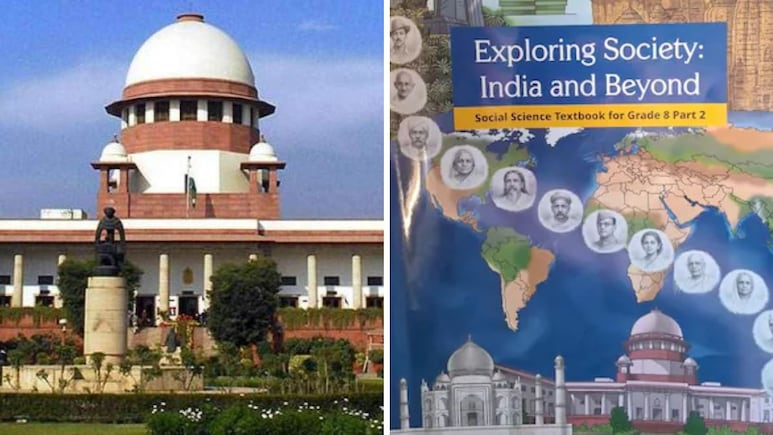
The NCERT's Class 8 Social Science textbook, which was withdrawn after a controversy over a reference to corruption in the judiciary, was prepared by a panel of subject experts that included a lawyer, officials said. The officials, however, clarified that there is no mandatory rule that requires such chapters to be independently vetted by members of the legal fraternity.
The clarification comes after criticism that the chapter titled 'The Role of the Judiciary in Our Society', was not reviewed by legal professionals before publication. "There was a lawyer among the members who wrote that particular chapter. There was no one from the legal fraternity to review the book," an official said.
Responding to a question on whether a chapter related to the judiciary must be separately examined by legal experts, the official said, "That is not the process followed in preparing textbooks. There is no compulsory provision that mandates such independent vetting."
The book, 'Exploring Society: India and Beyond', was released on February 24. It was developed between 2023 and 2025 and introduced into the curriculum in 2026 as part of NCERT's phased rollout of revised textbooks for Classes 1 to 8 under the National Curriculum Framework for School Education 2023 and the National Education Policy (NEP) 2020.
Supreme Court Steps In
The Supreme Court has called for action against those responsible for drafting the controversial chapter, observing that there appeared to be a "well-orchestrated conspiracy" to defame the judiciary. The court imposed a blanket ban on the Class 8 textbook and ordered that all physical and digital copies be seized.
Union Education Minister Dharmendra Pradhan also expressed dismay over the content and assured that accountability would be fixed. The NCERT has issued a public apology and halted distribution of the book, with an official acknowledging that "inappropriate textual material crept into the textbook", and describing it as an "error of judgement".
What The Chapter Says
The controversy centres on the second part of the Class 8 textbook, which discusses challenges faced by the judiciary, including corruption and pendency of cases.
The chapter explains that the government performs three primary roles: protector (law and defence), provider (welfare and infrastructure), and regulator (economic activity and social justice), through mechanisms such as the Constitution, laws, elected representatives, the bureaucracy and the judiciary. It then poses a question to students: if these institutions are meant to serve citizens, "Why do we still hear of cases of bribery and corruption in public office?"
The book also outlines grievance redressal mechanisms, noting that government departments have dedicated grievance offices and vigilance commissions where complaints, including those related to corruption, can be lodged.
Officials said the previous Class 8 Social Science textbook, used until 2024, did not mention corruption.
However, corruption is discussed in both the new Class 7 and Class 8 textbooks, which are divided into two parts each. The Class 7 book refers to corruption in the legislature and during elections, but does not mention the judiciary.
"The government also has vigilance commissions to investigate matters of corruption. You can approach them if you find cases of corruption," the Class 7 textbook states.
In its section on elections, the textbook says: "We learn about the election process, including sealed ballot boxes, qualifications of members, their duties, and also the conditions that could lead to their dismissal. For instance, members would be immediately removed if found to have indulged in any corruption."
It also addresses broader democratic concerns, stating: "Issues such as corruption, wealth disparity, excessive control by a few over democratic institutions, erosion of the judiciary's independence, manipulation of information channels, and several more, can cause hurdles in achieving the ideals of democracy. What can we do as individuals, and as a society, to remain vigilant and minimise these issues and hurdles?"
The first part of the Class 8 book also discusses political corruption. One cartoon shows bundles of Rs 500 notes discovered in a candidate's car during election inspections.
"India's electoral system is celebrated as the world's largest democratic exercise. However, like all systems, it faces its share of challenges. Issues such as the growing influence of money in elections, a significant proportion of candidates with criminal records, and voter apathy, (particularly in urban areas), raise important questions about the health and future of our democracy," the book states.
How NCERT Develops Textbooks
People familiar with the process said NCERT follows a multi-layered system of drafting and review, with no single author responsible for individual chapters.
For each subject, a Curricular Area Group (CAG) is constituted, which sets up a textbook development team. Drafts may be prepared by academics or invited experts and are then reviewed at multiple levels, by the development team, external experts, teachers, the full CAG, NCERT faculty and finally the National Syllabus and Teaching-Learning Material Committee (NSTC).
"There is a certain process for writing textbooks. The books are written by subject experts, reviewed extensively, and eventually vetted by the National Syllabus Learning Teaching Mate Committee before publication. The book is read by many people within NCERT. There is usually a lot of debate and changes before it is finalised," the official said.
Officials added that the content was aligned with NEP 2020, which encourages students to "investigate, explore, and respond to complex questions, real-world challenges, and problems."
Corrective Steps Underway
Sources said NCERT Director Dinesh Prasad Saklani is examining how the content was included and will identify the individuals or procedures responsible.
The Education Ministry has written to the Ministries of Information and Broadcasting and Electronics and Information Technology, seeking immediate action to prevent further dissemination of the withdrawn textbook through digital and electronic platforms.
Meanwhile, NCERT and the Education Ministry have initiated steps to rectify the issue, officials added.
Track Latest News Live on NDTV.com and get news updates from India and around the world

