





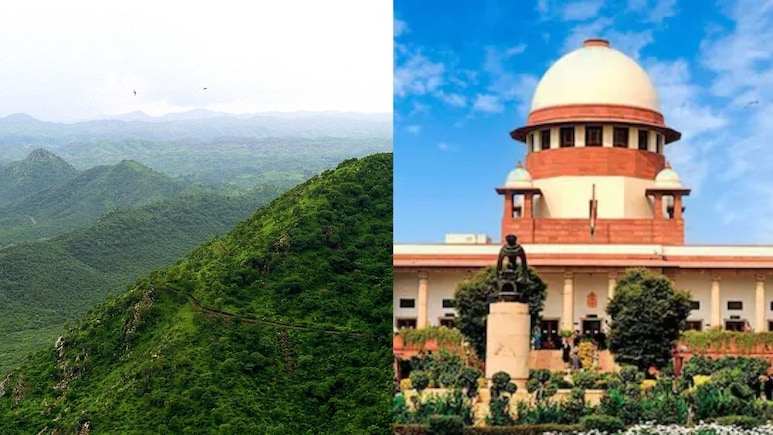
The Supreme Court has been informed that the panel led by the Environment Secretary "completely suppressed" the opinion of the Forest Survey of India (FSI) while recommending the controversial 100-metre height definition for the Aravalli hills.
Senior Advocate K Parmeshwar, who was appointed as Amicus Curiae by the Supreme Court in the Aravalli definition case, recently informed the top court that the report by the earlier Supreme Court panel on the Aravalli hills (which gave the 100-metre definition) defined the hills solely on the basis of height, ignoring the FSI's opinion regarding the importance of lower-lying hills.
The court has also been informed that the DG, FSI's email dated October 7, 2025, disagreed with the 100-metre definition and provided an alternative definition.
"Importantly, the FSI also issued a Report dated 22.09.2025 to the Secretary, MoEFCC, highlighting the importance of hills of varied heights. This FSI Report dated 22.09.2025 on the definition has been completely suppressed by the MoEFCC in the present proceedings. No mention has been made of it in the extensive affidavit filed by the MoEFCC dated 13.10.2025," the report stated.
"The Committee, too, did not deal with the contents of the Report. This is important to note, as the Committee defines the 'Aravalli Hills' solely on the basis of height, disregarding the FSI's opinion as to the importance of lower-lying hills," it added.
The Amicus has now recommended that the Indian Council of Forestry Research and Education (ICFRE) and the FSI may be directed to conduct surveys of the entire Aravalli geomorphological region to identify and map key ecological corridors and aquifers.
The Amicus report further adds that he received a letter dated October 14, 2025, from the Supreme Court's Central Empowered Committee (CEC) stating that the Aravalli committee report was never placed before it and was never approved.
The report added that the 100-metre definition did not sufficiently include the landforms that constitute the Aravalli hills in order to protect and conserve them. The Amicus report stressed that isolating only certain individual hills would result in fragmentation of the range, which in turn could adversely open up more areas for mining.
This would especially risk the lower hills, which play a vital role in combating desertification, hills that are more than 500 metres apart, and valleys and flat areas that also form part of the Aravalli range.
To recall, on November 20, 2025, the top court accepted the recommendations of the Aravalli panel that any landform at an elevation of 100 metres or more above the local relief would be considered part of the Aravalli hills, along with its slopes and adjacent land.
In December 2025, after huge public outcry, the Supreme Court bench led by CJI Surya Kant took suo motu cognisance of the matter and stayed the previous order that had upheld the 100-metre definition. The top court not only stayed the recommendations of the earlier committee but also stated that there was a need for a fresh committee with domain experts to revisit the issue.
The court also appointed Senior Advocate K. Parameshwar as Amicus Curiae to assist in the matter. In the last hearing, the Supreme Court directed that the Amicus report be circulated among the parties and sought recommendations on names for setting up a fresh committee with domain experts.
In his written submission dated February 24, Amicus Curiae K. Parameshwar highlighted that the hydrological features of the Aravalli region were not considered while recommending the 100-metre definition.
According to the CEC, there is "an immense potential of about 2 million litres of groundwater recharge per hectare of the landscape."The Amicus adds that the 100-metre height definition suffered from an inherent defect because the committee repeatedly recorded that "it is for the purpose of operationalising mining alone," which goes against the Supreme Court's intentions to protect and conserve the Aravalli hills."
"Having a definition tailored only to mining purposes ignores that the Aravalli range, although spanning across four different states, constitutes one contiguous ecosystem and ought to be treated as such. Any plan to conserve and protect the Aravalli range must comprehensively address the needs of the entire geographical feature as a whole," the Amicus stated.
Track Latest News Live on NDTV.com and get news updates from India and around the world

