





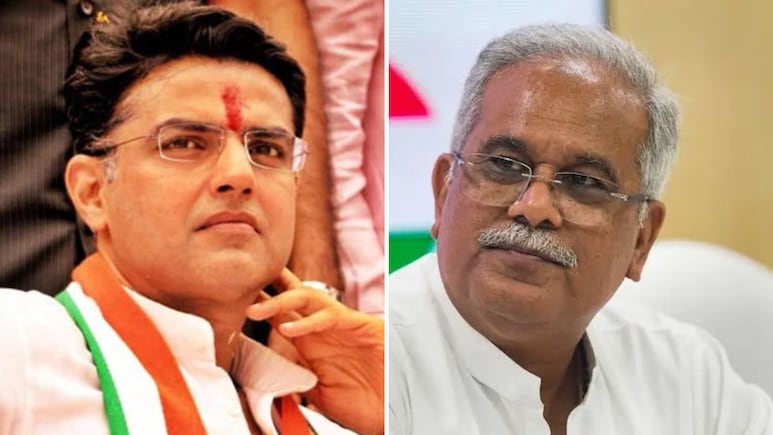
The Congress will enter the 2027 race with a troubled past - a history of internal rifts and public feuds that ensured it an exit from power and placed Arvind Kejriwal's Aam Aadmi Party firmly in the driving seat. Now, with Sachin Pilot now sent to manage another round of differences ahead of 2027, the party is trying to ensure history does not repeat itself.
The change in leadership comes months before the election, Pilot replaces Bhupesh Baghel as the All India Congress Committee (AICC) General Secretary in-charge of Punjab.
-

-
 Best Of NDTV World Summit 2026 | Defining Conversations, Big Ideas
 -
 PM Modi Says 'Parasite' Congress Hurts 'Honest' Dissent Movements
 -
 "Some Dreaming Of Disorder": PM Modi's Dig At Rahul Gandhi
 -
 PM Modi Highlights India's Firsts: Fast Breeder Reactor, Hydrogen Train, Asian Games Medals
 -
 "UN's Limits Clearly Visible": PM Modi Presses For 'New Solutions' At NDTV Summit
 -
 "World That Relied On India's Brainpower Now Trusts Its Mindpower": PM Modi
 -
 Non-Oil Trade With India Went Up 50% In 3 Years: UAE Minister At NDTV Summit
 -
 "Some Dreaming Of Disorder": PM's "Failed Product Of Congress" Jibe At Rahul Gandhi
 -
 'Viksit Bharat Not Just For Us': PM Modi's Top Quotes At NDTV World Summit
 -
 Has Indian Cuisine Arrived At The Global Stage? What Vir Sanghvi Believes
On paper, it is an organisational reshuffle. Politically, the timing makes it considerably more important.
Pilot arrives as differences within Punjab Congress again became visible and a talking point in the state. Punjab Congress has been in this situation before.
In September 2021, with barely five months left before the assembly election, an internal revolt led to Captain Amarinder Singh resigning as Chief Minister. Charanjit Singh Channi replaced him. Navjot Singh Sidhu, who had been central to the challenge against Singh, found himself disagreeing with the new government as well and the change at the top ultimately failed to produce stability. Sidhu resigned as the Punjab Congress president within days of Channi forming his government.
For voters, the larger message was difficult to miss: A government seeking another mandate appeared preoccupied with its own internal arrangements. The Congress went from 77 seats in 2017 to 18 in 2022, its vote share fell from around 38.5 per cent to 22.98 per cent.
It will be unfair to attribute that defeat entirely to factionalism. Aam Adami Party's extraordinary rise, anti-incumbency and dissatisfaction with governance were major factors.
But the Congress's internal conflict unquestionably contributed to the perception that the party was unable to keep its own house together. That history is what gives Pilot's appointment its real political significance.
Why Pilot, And Why Now?
Political pundits say Bhupesh Baghel's departure from Punjab need not automatically be described as punishment. He has been reassigned to Assam and remains an important Congress leader. The more relevant question is why the Congress felt Punjab required a change at this stage.
The state unit has been witnessing differences involving Punjab Congress chief Amarinder Singh Raja Warring and leaders associated with former Chief Minister Charanjit Singh Channi. Senior figures have voiced dissatisfaction, and the high command has had to engage directly with the situation.
In that backdrop, Pilot brings one immediate advantage: he enters without being identified with any established faction. That may also have been precisely what the party's central leadership was looking for - a leader with enough political weight to command attention, but without deep pre-existing alignments within Punjab's competing factions.His first job will therefore not be writing a manifesto or calculating constituency arithmetic.
It will be creating enough political trust within Congress for competing leaders to believe that they can coexist until the election. Only after that can the party seriously turn its attention towards AAP, the Akalis, BJP and other emerging political formations.
Rajasthan Is Pilot's Experience - And His Warning
There is an irony in the Congress's choice. It has sent to Punjab a politician who spent years at the centre of one of the party's most visible internal power struggles. After the Congress won Rajasthan in 2018, Ashok Gehlot became Chief Minister and Pilot Deputy Chief Minister. Pilot also held important portfolios, including Public Works, Rural Development and Panchayati Raj. But the arrangement gradually led to two political centres in Rajasthan.
Pilot later complained that he was being denied sufficient authority and alleged that bureaucrats were not responding adequately to him. In 2020, the confrontation finally burst into the open. Pilot lost both the Deputy Chief Minister's position and the Rajasthan Congress presidency.
The Gehlot-Pilot tension continued to shadow the party for years. The Congress eventually lost Rajasthan in 2023.
Again, it would be simplistic to argue that the leadership dispute alone defeated the Congress. But Pilot does not need anyone to explain how damaging it can be when an internal contest becomes more visible than the party's campaign against its opponents.
That experience may actually be his strongest qualification for Punjab. The test is whether experience as a participant in such a conflict can now make him an effective mediator of one.
The Randhawa-Pilot Equation
Sukhjinder Singh Randhawa adds an especially interesting dimension to Pilot's Punjab assignment.
Randhawa became the Congress in-charge of Rajasthan in late 2022, when the Gehlot-Pilot relationship remained one of the party's biggest organisational problems.
Their relationship during that period was not without friction.
In April 2023, when Pilot announced a fast over what he argued was the Gehlot government's failure to act on corruption allegations against the previous BJP regime, Randhawa publicly described the proposed protest as contrary to party interests and an "anti-party activity".
Yet the same Congress statement also described Pilot as an "indisputable asset" and called for dialogue. Now the roles have switched.
Randhawa is one of Punjab Congress's senior leaders, while Pilot is the AICC figure expected to manage Punjab's political equations. The leader who once had to deal with Pilot's rebellion in Rajasthan will now be part of an organisation Pilot has been asked to stabilise.
That history could create awkwardness. It could equally produce understanding. Both men know how quickly differences within Congress can become larger than the original issue.
Can Old Political Networks Help?
Pilot also arrives carrying a surname that has long been recognised inside the Congress organisation.
His father, Rajesh Pilot, was a Union minister, six-time Member of Parliament and an important figure in the national Congress. He operated in a generation that included major Punjab leaders such as Balram Jakhar and Buta Singh.
That legacy may offer Sachin Pilot familiarity and goodwill within older Congress networks. Pilot also has his own history of interaction with Punjab leaders. He was present when Amarinder took oath as Chief Minister in 2017. During Pilot's Rajasthan rebellion in 2020, then Punjab Congress president Sunil Jakhar publicly advised younger politicians that politics was "not fast food" and that leaders sometimes had to wait for their turn.
Amarinder and Jakhar have since moved out of Congress, but Punjab politics rarely operates through party labels alone. Personal equations, family familiarity and old political associations often survive changes in affiliation.
Pilot's Gujjar background may similarly provide some social connections in pockets of Punjab, including parts of the Kandi-Shivalik belt. But Punjab is not Rajasthan, and caste arithmetic that may matter in one state cannot simply be transplanted to another.
His real resource will have to be political management.
Punjab Is Also A Test For Pilot
There is another reason this assignment matters. Punjab votes in 2027. Rajasthan follows in 2028.
For Pilot, Punjab therefore becomes a major organisational test before politics in his home state again enters election mode.
If the Congress returns to power in Punjab under his charge, Pilot's standing within the national party would inevitably rise and he would have a powerful argument in his favour.
Also, forming the government is not the only possible measure of success. The Congress won only 18 seats in Punjab with 22.98 per cent of the vote in 2022. If Pilot helps the party substantially improve that position, prevents another organisational breakdown and establishes Congress firmly as the principal alternative, he could still emerge politically stronger from the assignment.
In that sense, Punjab offers him opportunity with relatively limited downside. Success can elevate him. A substantial Congress recovery can strengthen his credentials even without victory.
For Sachin Pilot, Punjab may ultimately contribute to his own political trajectory. But his more immediate task is considerably simpler to describe and far harder to accomplish:
The Congress has already seen how this movie ends. Pilot's challenge is to make sure Punjab gets a different ending in 2027.
Track Latest News Live on NDTV.com and get news updates from India and around the world

