





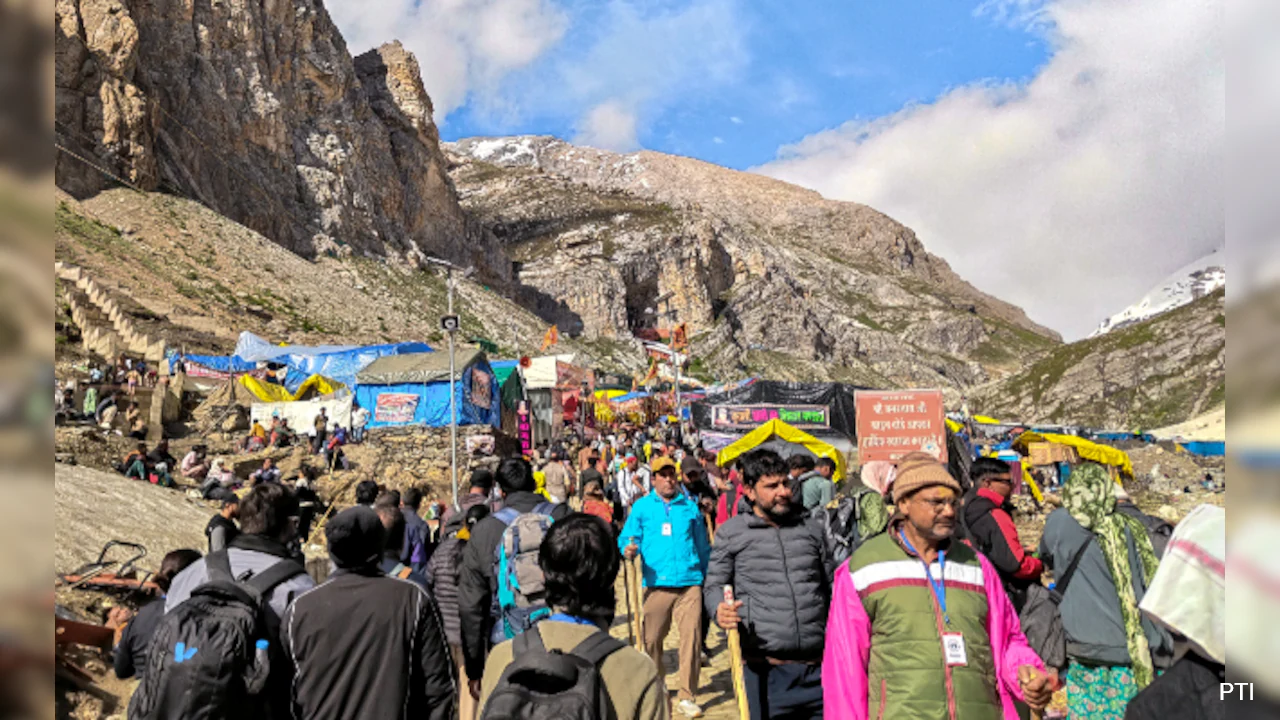
The Amarnath Yatra is witnessing an influx of devotees. More than a year after the deadly Pahalgam terror attack that claimed 26 lives in the Valley, devotees have begun trekking toward the shrine once again.
As a record number of devotees return to the Amarnath cave shrine to seek the blessings of the naturally formed ice lingam, also called Baba Barfani, concerning details have emerged. According to several reports, the ice lingam has melted by over 90% and has almost disappeared just days into the 57-day yatra.
While the melting of the lingam itself isn't the only story, deep concerns loom over the unprecedented speed at which it has vanished.
#Watch | Amarnath ice Shiva lingam melts 6 days into Yatra, leaves devotees disappointed
— NDTV (@ndtv) July 10, 2026
NDTV's @deepduttajourno brings this ground report pic.twitter.com/nbnaCy7mag
Experts point out that this phenomenon is the result of various intersecting factors. The melting of the ice lingam raises alarms that point straight toward the Himalayas and their complex equation with climate change.
The Himalayas And Climate Change
As details of the ice lingam melting emerge, scientists and glaciologists are pointing toward repeated studies analysing the heating of the Himalayas. Experts have frequently warned and documented that the Himalayan mountain system is warming at a faster rate than the global average.
The Amarnath cave sits at an altitude of 3,888 meters (12,756 feet). Unusually warm summer conditions around the cave and nearby glaciers have raised local temperatures past the threshold needed to maintain ice. Beyond rising temperatures, shifting rainfall patterns also contribute to how large the stalagmite can grow before the summer season starts and exposes it to premature heatwaves.
Dr Eklabya Sharma, Strategic Advisor & Director of The Himalaya Initiative at ATREE, who was awarded the Padma Shri in 2024 for his work on environmental science, notes that the "unusually rapid melting" of the Amarnath ice lingam this year has once again drawn attention to the vulnerability of the Himalayan cryosphere.
He states, "While no single event should be attributed to climate change alone, it is entirely consistent with the long-term warming trends that scientists have been documenting across the Himalaya for decades. The Himalaya is warming faster than the global average because temperatures increase more rapidly at higher elevations, a phenomenon known as elevation-dependent warming."
Warning against the compounding risks, Dr Sharma cautioned that in some high-altitude parts of the region, temperatures could rise by as much as 5 degrees Celsius by the end of this century if greenhouse gas emissions remain high. He further explained that this accelerated warming is already driving widespread glacier retreat, declining snow cover, earlier snowmelt, and more frequent extreme warm events.
Citing his work on the Himalayas, Dr Sharma adds, "Our recent study found that Himalayan snow and glacier cover declined by over 23% between 2000 and 2022, with the rate of loss accelerating markedly after 2010. The western Himalaya, where the Amarnath cave is located at nearly 3,900 meters, is among the regions experiencing particularly rapid warming. Whether viewed through the retreat of glaciers, shrinking seasonal snow, or changes in iconic natural ice formations, the message is the same: the Himalayan climate is changing at an unprecedented pace."
Expanding on how these shifts translate on the ground, professor BW Pandey, director of the Centre for Himalayan Studies at the University of Delhi, notes, "Earlier, the melting of the shrine occurred over a month. But this time, it has almost vanished in less than half that time, within even 15 days. This is all because of global warming and the climate change that is impacting the Himalayas. This is a phase of climate change in which the entire Himalayas, from east to west, are being affected. There is a direct impact on both the snow line and the tree line, as temperature alters the snow and the overall hydrological cycle in the region."
Expressing deep distress, professor Pandey warns, "The altitude of Amarnath is no longer a permanent base for the snow line. Already, the snow line has receded beyond 500 meters, and the flora and fauna that were previously restricted to a height of 3,888 meters are now moving beyond 4,500 meters."
Global Weather Links
While studying climate, one must also note that the localised distress in the Himalayas is not a phenomenon that occurs in a vacuum. Rather, it is deeply tied to macro-scale atmospheric shifts.
Explaining these links, professor BW Pandey says, "In the summer, the heatwave from the Atlantic affects the Mediterranean and Europe and travels all the way to the north-western Himalayas. The Atlantic heatwave, along with global warming-induced climate change, has resulted in the early melting of the lingam at the Amarnath shrine. The temperatures in the Himalayas are directly impacted by both the temperature of the Atlantic and the overarching force of global warming."
Micro-Climate Drivers And Social-Ecological Approach
The cave itself has a delicate micro-climate that must stay at or below freezing to keep the ice from melting. The introduction of external heat sources severely disrupts this balance.
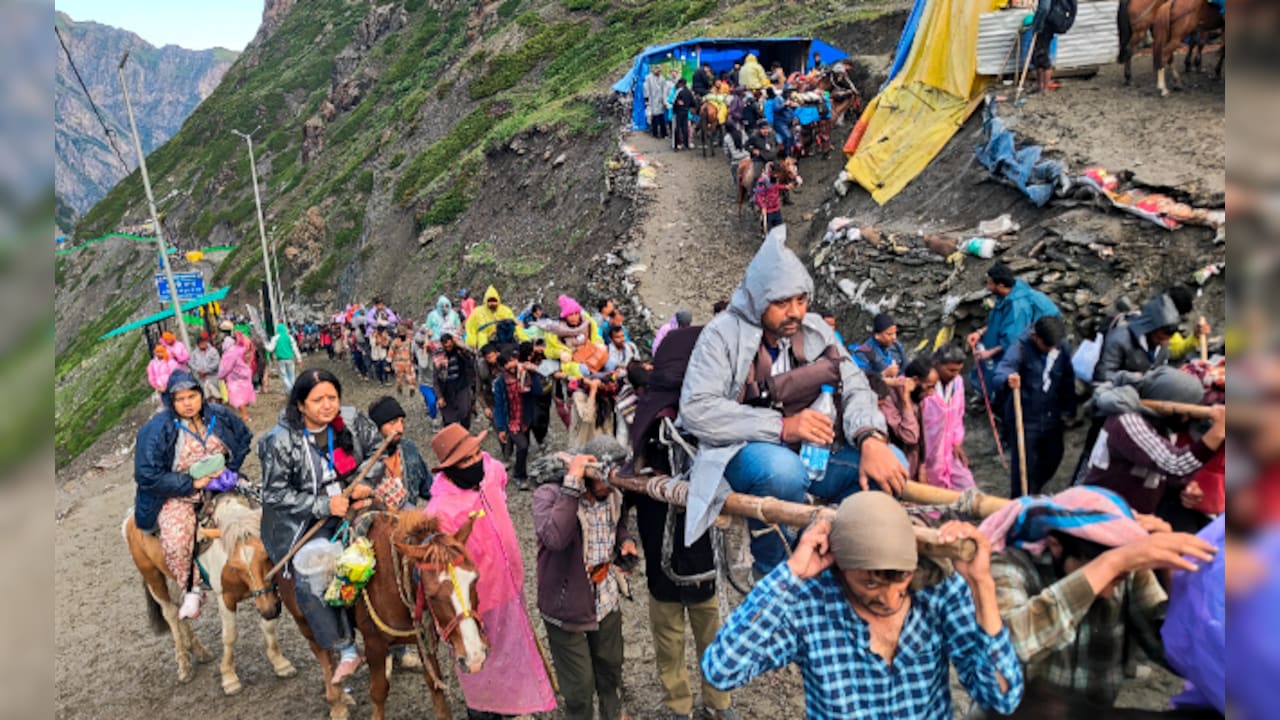
A year after the Pahalgam terror attack, the yatra is seeing a massive surge in the number of devotees, with over 93,000 pilgrims visiting in the first four days alone. Every individual releases body heat, raises humidity levels inside the enclosed cave, and alters the air temperature, thereby causing the ice to melt. This surge in pilgrims has strained the cave's infrastructure and led to the neglect of the daily caps recommended to protect the site.
Professor Sarmistha Pattanaik, who teaches at IIT Bombay, argues that one must look beyond just meteorological data to understand the problem fully. She states, "While scientists frequently frame the melting of the lingam purely around climate change and environmental impact, I view this crisis through other dimensions as well, from rising temperatures and reduced snowfall to diminishing winter days. This is not just a case of isolated environmental factors. Ecological processes and human activities are the deeply intertwined causes of the problem."
Flagging the tremendous growth in pilgrim numbers, professor Pattanaik argues that the influx of thousands of pilgrims, coupled with heavy infrastructure induces immense pressure on fragile mountain ecosystems, leading to habitat disturbance, ecological degradation, in addition to this, the contributing factors of degradation in the area could be the deforestation of the fragile Himalayan ecosystem which has further caused for global warming and the melting of ice Shivling.
When a massive influx of visitors crowds the cave, it creates severe resource strain. Furthermore, the cave's immediate micro-climate is severely impacted when large numbers of visitors enter, their body heat and the introduction of artificial lighting inside the cave can further degrade the cave ecosystem."
She adds, "India is a deeply religious country; completely controlling or restricting pilgrims is incredibly difficult. The true answer lies in governance: how effectively can we manage and regulate such tourism?"
Structural And Infrastructure Changes
Over the past few decades, major infrastructure changes have been introduced to make the high-altitude trek safer and more accessible. However, these changes inevitably trap or generate heat close to the cave.
From installation of heavy machinery to expanded temporary accommodations, electricity, solar lighting, and community kitchens moving closer to the shrine all contribute to localised ambient warming. While the solutions may fix the problem of mobility, they add another one to the list.
Professor Sarmistha Pattanaik explains how infrastructural development often overlooks the delicate internal workings of the shrine itself. "Altering the mountains to carve out roads does not just leave an ecological footprint; it directly impacts the cave's micro-climate. The heat generated by heavy machinery, generators, and support equipment close to the shrine disrupts the native thermal insulation of the cave and disturbs the local topography. accelerating the melting from within."
Moving Forward
Environmental experts stress that protecting the shrine means striking a fine balance between faith and ecology. Restoring the micro-climate and protecting the local environment may come at the cost of stricter policing, controlling entry and exit points, and regulating the activities of the pilgrims within and around the cave.
From enforcing daily pilgrim caps to limiting permanent structures near the cave mouth and regulating the proximity of high-emission infrastructure, the big test remains balancing the spiritual and scientific worlds.
As professor Sarmistha Pattanaik points out, a successful approach requires collaborating with local institutions and recognizing socio-economic realities. "We must remember that local communities depend entirely on this pilgrimage for their livelihoods, such as providing pony services. Restricting activities arbitrarily harms their survival. Therefore, we need strong environmental regulations paired with robust local institutions to effectively govern the resource system."
Ultimately, the survival of the Amarnath cryosphere relies on successfully balancing mass tourism with mitigation of the global climate threat. Dr Eklabya Sharma concludes, "Protecting this fragile mountain system is not only essential for preserving its ecological and cultural heritage, but also for safeguarding the biodiversity, water security, and livelihoods of millions of people who depend on its rivers downstream."
Track Latest News Live on NDTV.com and get news updates from India and around the world

