





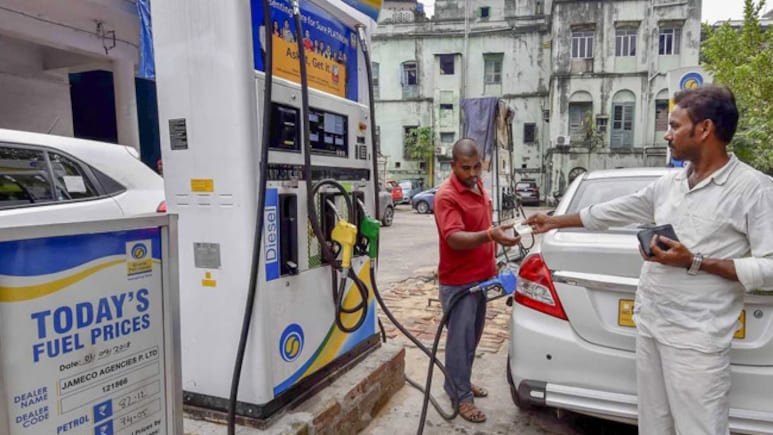
Delhi's 'No PUC, No Fuel' directive came into force across the national capital on Thursday amid claims of strict enforcement. Thousands of challans were issued, border checks intensified, and surprise inspections were carried out by the Environment Minister. But on the ground, enforcement appeared uneven, and the city's air quality only deteriorated through the day.
The overall AQI stood at 356 around 7 am and worsened to 397 by 9 pm, inching closer to the 'severe' category despite a full day of restrictions and checks.
Certificates Issued, But Pollution Persists
Official data shows over 61,000 Pollution Under Control Certificates (PUCCs) were issued between December 17 and 18 - 29,938 on Wednesday and another 31,974 by Thursday evening. During the same 24-hour window, 3,746 vehicles were challaned for not carrying a valid PUCC.
At Delhi's entry points, joint teams of the Traffic Police and Transport Department checked around 5,000 vehicles, turning back 568 non-compliant vehicles and diverting 217 non-destined trucks via the Eastern and Western Peripheral Expressways.
Despite these measures, there was no corresponding improvement in air quality through the day.
No Enforcement At Several Petrol Pumps
An NDTV ground reality check found that enforcement of the 'No PUC, No Fuel' rule was missing at several petrol pumps on day one.
At the Delhi Gate petrol pump, NDTV found the government notification prominently displayed across fuel dispensing aisles, clearly informing motorists that a valid Pollution Under Control certificate was mandatory for refuelling. However, no transport or enforcement officials were present at the pump at the time of NDTV's visit.
Petrol pump staff said officials had made only a brief appearance earlier in the day.
"Two DTC officials came in the morning, clicked some photos, and left. After that, we don't know where they are," a pump employee told NDTV.
The staff was also clear that they are not responsible for enforcing the rule.
"We are just informing customers about the rule. We are not the enforcing authority. These are our customers. If we try to enforce it, there will be arguments or fights, and we don't want that," the employee said.
'Even 80% Implementation Is Success'
Environment Minister Manjinder Singh Sirsa, who conducted surprise inspections at select petrol pumps, acknowledged that the rule may not be implemented uniformly everywhere on day one.
Speaking to NDTV, Sirsa said, "Even if 80% is implemented, it will be successful."
He also said he was receiving regular, real-time updates from the Transport Department on the status of enforcement at petrol pumps across the capital, indicating that the government was closely tracking compliance as the rule rolled out.
'This Is Not About Challans'
Sirsa urged petrol pump staff to remain calm while informing commuters about the requirement.
"You are the first interface of this campaign on the ground... politely explain that this rule is for their own health and for the health of our children," he told them.
Addressing commuters, the minister added, "This is not about challans; this is about clean air. Every valid PUCC issued today is a small victory in our war against pollution."
Impact Of Dust, Waste Action Unclear
Civic agencies also reported action on other pollution fronts over the past 24 hours, including mechanised sweeping of 2,300 km of roads, deployment of mobile anti-smog guns across 5,524 km, closure of 132 illegal dumping points, and processing of over 38,000 metric tonnes of legacy waste.
Even so, Delhi's AQI climbed steadily through the day, raising questions about how quickly such measures can translate into relief during peak winter pollution.
Sirsa said the steps were unavoidable, adding, "The Delhi Government has had to adopt tough but necessary steps so that pollution levels can be visibly reduced." He also flagged that several private offices are yet to comply with the 50% work-from-home advisory under GRAP-IV, warning that non-compliance could invite action.
As Delhi heads into another polluted night, the first full day of the 'No PUC, No Fuel' rule once again underlined a familiar gap—strong enforcement claims, partial implementation on the ground, and air quality that continues to worsen.
Track Latest News Live on NDTV.com and get news updates from India and around the world

