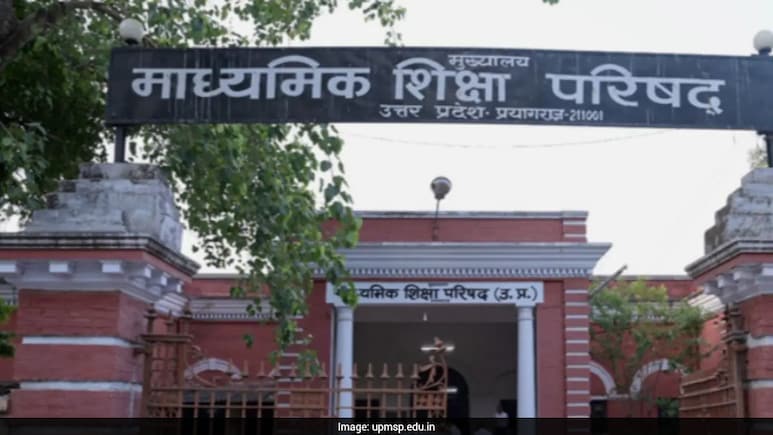

Oldest Education Board In India: India's school education system did not emerge overnight. It grew gradually, shaped by institutions that laid the foundation for how students are examined even today. At the centre of this history is the Uttar Pradesh Madhyamik Shiksha Parishad (UPMSP), widely recognised as India's oldest education board.
How the UP Board Began
The UP Board was established in 1921 in Prayagraj through an Act of the United Provinces Legislative Council. Just two years later, in 1923, it conducted its first examinations. What made it truly path-breaking was that it adopted the 10+2 system right from the beginning, long before it became the national standard. Students appeared for the High School examination after 10 years of schooling, followed by the Intermediate examination after completing 10+2. Before this system was introduced, these examinations were handled by the University of Prayagraj.
Over the decades, the Board grew rapidly. Today, it is known as the largest examining body in the world, managing examinations and results for nearly 64 lakh students each year. As this number increased, running everything from Prayagraj alone became difficult. To manage the workload better, the Board opened regional offices in Meerut, Varanasi, Bareilly and Prayagraj between 1973 and 1987. Later, after the creation of Uttarakhand in 2000, the Ramnagar (Nainital) office was separated from the UP Board.
Interestingly, the UP Board once served students beyond the boundaries of the United Provinces. It looked after examinations for regions like Rajputana, Central India and Gwalior. However, by the late 1920s, this responsibility became too vast to manage efficiently. The government eventually decided that students from outside the United Provinces would no longer be allowed to appear for UP Board exams after 1927-28. This decision played a key role in the birth of new education boards in India.
The Early Roots of CBSE
The idea of creating separate boards gained momentum after the recommendations of the Sadler Commission (1917-19), which encouraged the establishment of Boards of Secondary Education across the country. When the UP Board raised concerns about its expanding jurisdiction, the Government of India proposed two options for the affected princely states - either form individual boards or create a joint board.
The joint-board model was eventually chosen, mainly because it reduced administrative costs and allowed broader representation from all regions involved. As a result, in 1929, the Board of High School and Intermediate Education for Rajputana, Ajmer-Merwara, Central India and Gwalior was established, with its headquarters in Ajmer. This board later evolved into what is known today as the Central Board of Secondary Education (CBSE), which now functions as a national-level board for schools across India.
Understanding the ICSE System
Unlike government-established boards, the ICSE system operates through a self-autonomous body. It was created with the aim of supporting education for disadvantaged and marginalised groups, including street children, women, minorities and economically weaker sections. Its functioning is aligned with the Constitution of India, particularly Articles 19(1)(g), 29 and 30.
The legal right to establish and manage such institutions was also reinforced by the Supreme Court's judgment in the T.M.A. Pai Foundation vs State of Karnataka case (2003). The ICSE framework began in 1990, initially managed by The Educational Welfare Society. In 2009, its administration was transferred to the Council of Basic and Technical Education, giving it a more defined organisational structure.
A Shared Educational Legacy
While CBSE and ICSE are household names today, it was the UP Board that first introduced structured school-level examinations in India. Its early adoption of the 10+2 system and its ability to handle millions of students year after year highlight its lasting influence on the country's education system.
Together, these boards represent different phases of India's educational journey - from the early regional efforts of the UP Board to the nationally coordinated CBSE and the autonomous ICSE framework - each playing a vital role in shaping school education in India.
