






Southwest monsoon has become more desirable this year amid El Nino warnings and low reservoir levels in the country. India Meteorological Department (IMD) has predicted that monsoon rainfall will be 10 per cent below normal, which is worrying for areas that are already low on water.
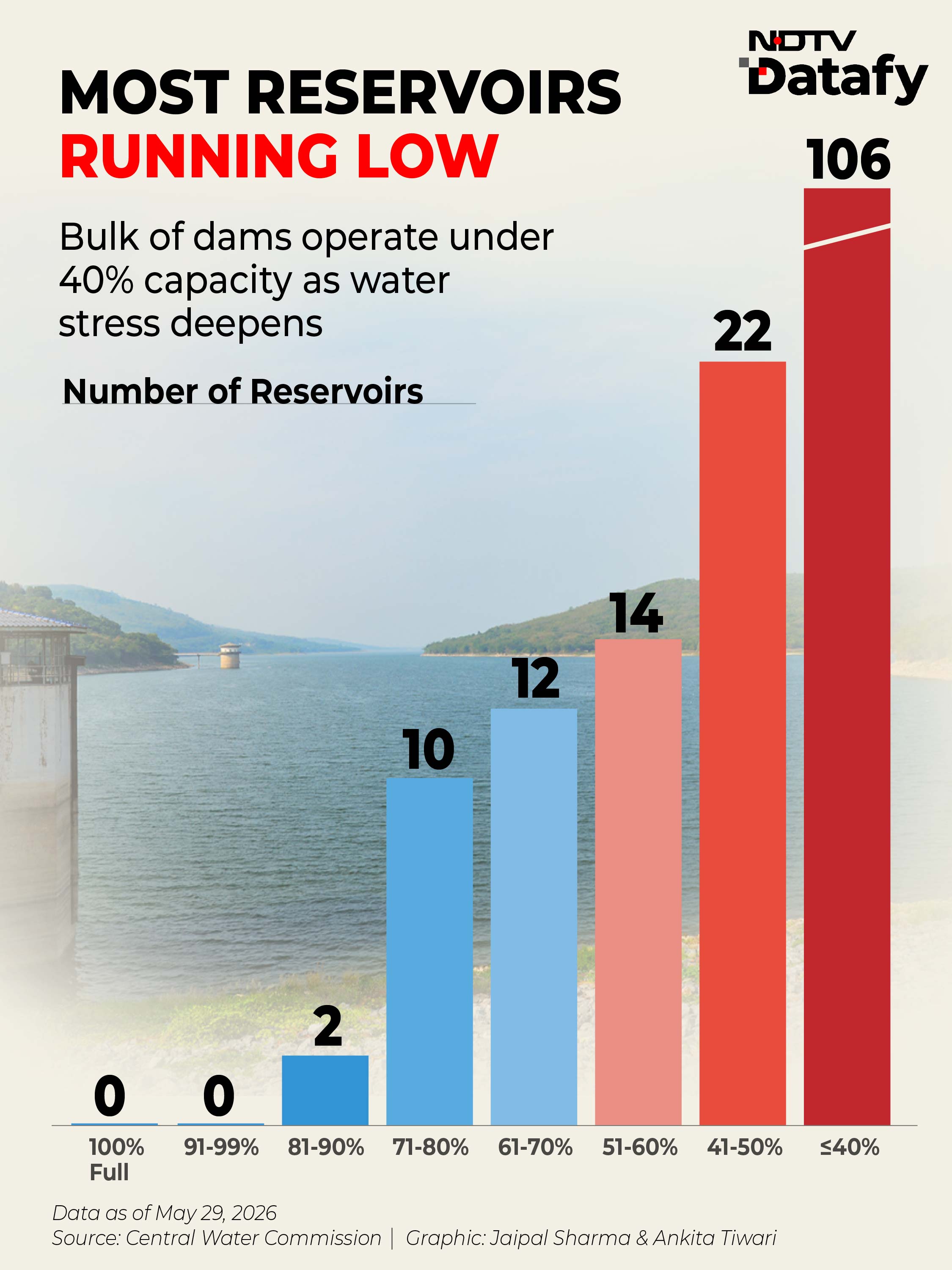
Of the 166 total reservoirs, two have storage levels between 81 and 90 per cent of capacity, while 106 reservoirs are filled 40 per cent or less. Another 22 reservoirs have storage levels between 41 and 50 per cent.
-

-
 The Mystery Of A Bare Nail In Ashwini Vaishnaw's Office
-
 Paris Setback, Asian Games Glory: Lovlina Borgohain's New Perspective
-
 To PM Modi's "Failed Product" Jab At Rahul Gandhi, A Shashi Tharoor Counter
-
 NDTV World Summit 2026: AI, Chips, Warfare And The Future Of The World | Key Conversations
-
 Kriti Sanon On Situationships, Open Relationships And Being Old-School
-
 'AI Scares Me': Kriti Sanon On Personality Rights And Need For Laws
-
 'AI Scares Me': Kriti Sanon On Personality Rights And Need For Laws
-
 'This Time I Wanted Gold': Savita Punia Reflects On Historic Asiad Success
-
 Favourite Bollywood Actor To 5-Year Plan, Kriti Sanon Interviews AI Actor Tilly Norwood
-
 Inside The Mind Of Archer Kumkum Mohod, Who Dared To Challenge South Korea
How is the country placed?
At the national level, reservoir storage stood at 56.3 billion cubic metres (BCM), which was slightly higher than last year and above the ten-year average for the same period. However, the situation varies significantly across regions.
Northern India reported the highest storage level at 38.79 per cent of total capacity, followed by the Western region (35.77 per cent) and Central region (35.40 per cent). Storage levels were lower in the Eastern region (24.46 per cent) and Southern region (22.53 per cent).
What is the condition compared to normal?
Compared with the average storage recorded on the same date over the previous ten years, the Western region reported the highest surplus at 43.86 per cent above normal, followed by the Northern region (33.69 per cent) and Central region (20.10 per cent). The Southern region was 5.88 per cent above normal, while the Eastern region remained 10.61 per cent below its long-term average.
At the state level, Gujarat reported the highest surplus, with reservoir storage 67.17 per cent above the ten-year average. Uttar Pradesh (65.35 per cent), Andhra Pradesh (58.86 per cent) and Himachal Pradesh (42.80 per cent) also recorded substantially higher-than-normal storage.
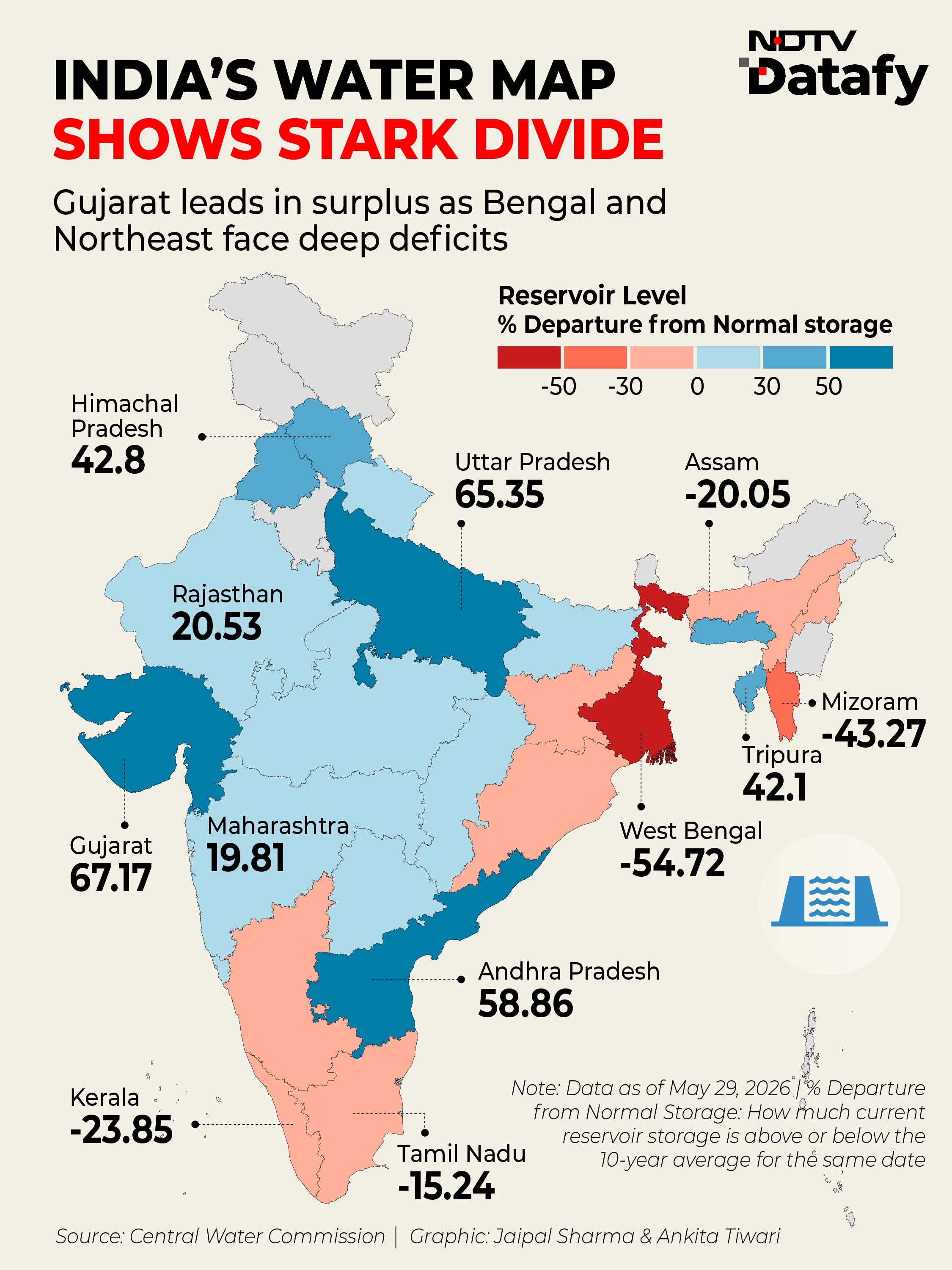
On the other hand, West Bengal reported the largest deficit, with storage levels 54.72 per cent below normal. Mizoram (-43.27 per cent), Kerala (-23.85 per cent), Assam (-20.05 per cent) and Tamil Nadu (-15.24 per cent) also reported below-normal storage.
Which reservoirs are under stress?
Despite overall storage being above the historical average, several individual reservoirs continue to face low water levels. Fifteen reservoirs across nine states have storage levels below 50 per cent of their normal storage for this time of year.
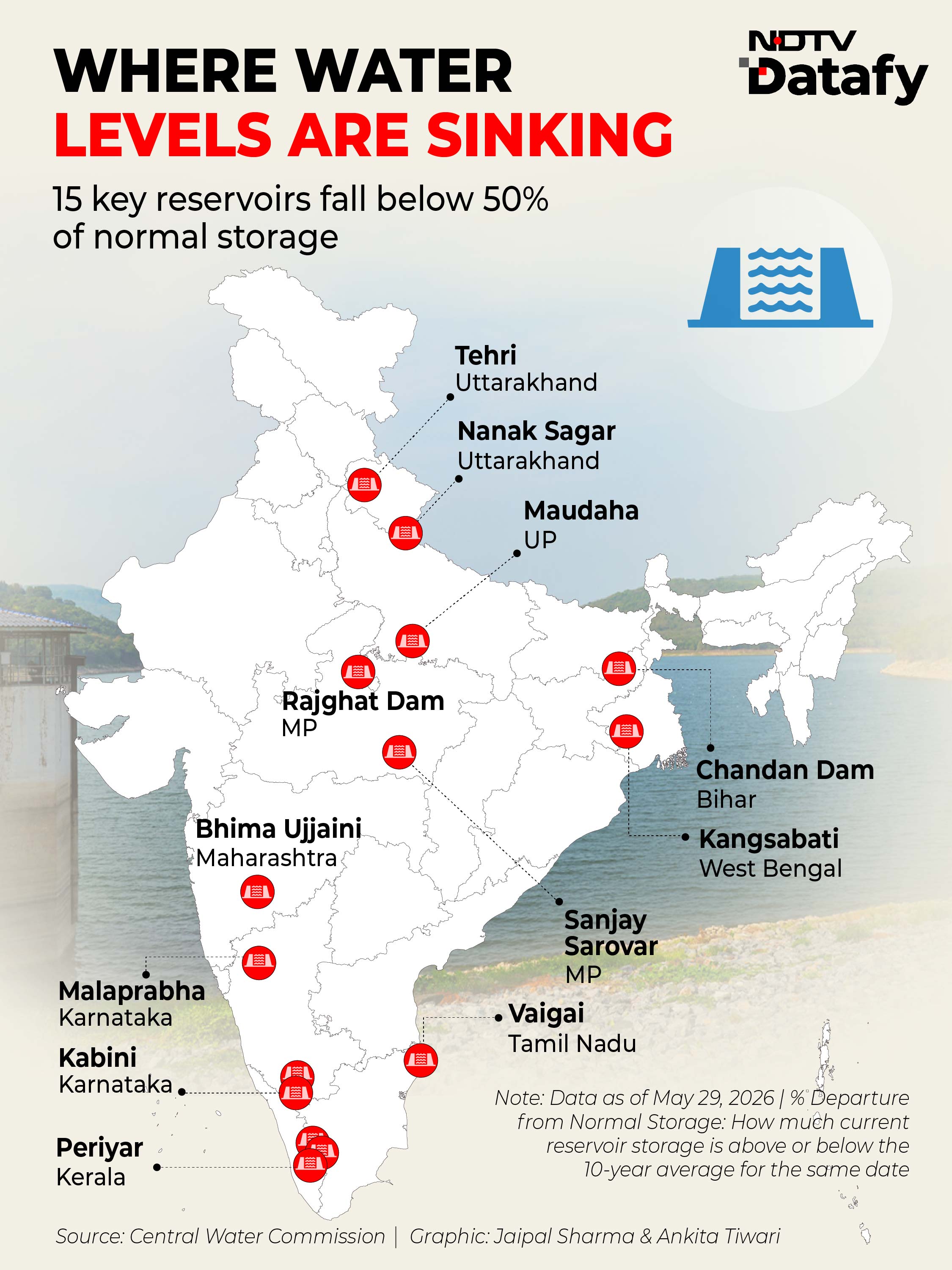
These include Chandan Dam in Bihar; Kabini, Krishnaraja Sagara and Malaprabha in Karnataka; Periyar in Kerala; Rajghat and Sanjay Sarovar in Madhya Pradesh; Bhima Ujjaini in Maharashtra; Aliyar, Karayar and Vaigai in Tamil Nadu; Maudaha in Uttar Pradesh; Tehri and Nanak Sagar in Uttarakhand; and Kangsabati in West Bengal.
Track Latest News Live on NDTV.com and get news updates from India and around the world

