

)
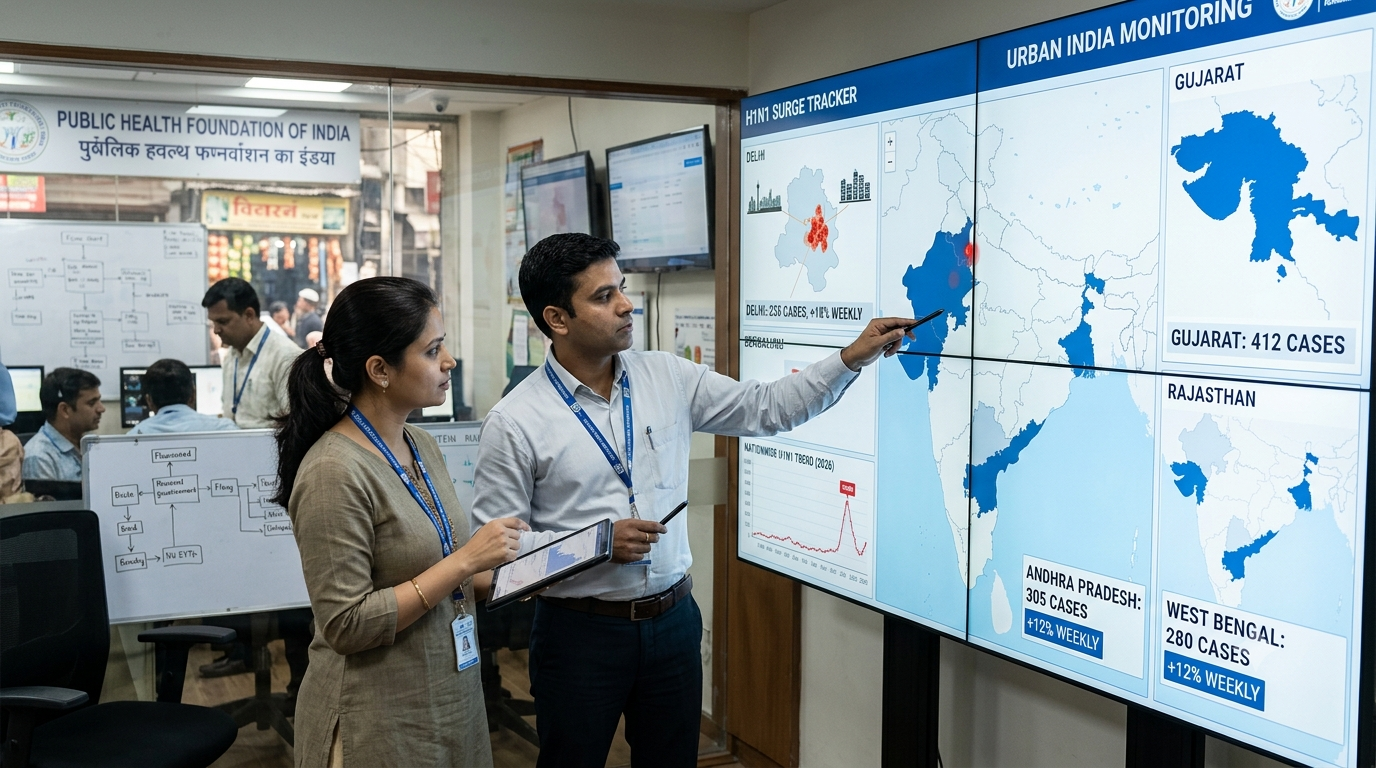
Why does H1N1 appear to hit some Indian cities harder than others? The question has become particularly relevant amid the current rise in H1N1 cases in Delhi and parts of North India. Delhi had reported 1,777 H1N1 cases by August 20, compared with 229 during the corresponding period last year, with H1N1 accounting for the largest share of influenza A infections this year. Meanwhile, a city like Bengaluru has seen a surge, but there aren't more than 300-400 active cases there. Many other states have seen minor surges.
However, the rise does not by itself mean that a new or more virulent strain is circulating. The Indian Council of Medical Research (ICMR) has said there is no evidence of a new H1N1 strain, while experts have described the current increase as consistent with seasonal influenza activity.
So why can one city see a much sharper rise than another?
Influenza transmission is shaped by a combination of climate, rainfall, humidity, population density, human movement, indoor crowding and the susceptibility of the population. India's enormous geographic and climatic diversity makes the answer particularly complicated.
"H1N1 does not behave homogeneously across India," says Dr Aishwarya R, Consultant - Infectious Diseases, Aster Whitefield, Bengaluru. "Transmission of the influenza virus is highly dependent upon a number of environmental, demographic and behavioural factors."
Why H1N1 Cases Vary From City To City
1. India's influenza seasons are not the same everywhere
Unlike countries where influenza predominantly peaks during winter, India has several distinct influenza patterns. A large multicity Indian surveillance study found influenza peaks during July-September in Delhi, Lucknow, Pune, Kolkata, Dibrugarh and Alappuzha, while Chennai and Vellore experienced peaks later, around October-November. Srinagar, meanwhile, showed a winter peak between January and March.
This means there is no single "Indian flu season" that applies identically to every city. Earlier surveillance has also found that influenza activity can occur throughout the year, with rainy-season peaks in several locations. In Delhi, influenza activity showed peaks during the monsoon as well as winter.
"The role of differing climatic conditions for influenza epidemiology has already been shown, with different hospitals in India experiencing peaks during monsoons, winter and year-round circulation," says Dr Aishwarya.
2. Rainfall, temperature and humidity may influence transmission
Weather does not cause H1N1, but it can influence the conditions in which respiratory viruses circulate and how people interact. Research from Indian surveillance networks has found associations between influenza activity and rainfall and other meteorological variables. A study from Delhi found influenza positivity during 2007-2010 coincided with peak monsoon rainfall, with a statistically significant correlation between influenza positivity and rainfall.
Research from Lucknow similarly found influenza activity was associated with rainfall, humidity and dew point, while a Pune study found relationships between influenza-like illness and relative humidity and temperature differences. But these relationships are complex and cannot be reduced to "cold weather causes H1N1". Climate interacts with human behaviour, immunity and viral characteristics.
3. Crowded cities give the virus more opportunities to spread
Population density is another important piece of the puzzle. In densely populated urban areas, people may have frequent contact with others at home, offices, schools, markets and public transport. During periods of increased respiratory illness, these repeated interactions can create more opportunities for influenza transmission.
"Crowded cities and the density of population give ample scope to the virus to spread because of constant movement of people and easy interaction," says Dr Niraj Kumar, Senior Consultant, Internal Medicine, ShardaCare-HealthCity.
Dr Aishwarya adds that a larger urban population means "a higher likelihood of the virus travelling freely and quickly from households into workplaces, school settings and general community interactions." This does not mean every crowded city will automatically have more H1N1. Rather, high population density can amplify transmission when other conditions are favourable.
4. Travel can connect outbreaks across cities
People do not remain within one neighbourhood, or even one city. Daily commuting, business travel, tourism, school and family visits can move influenza infections between communities. A person infected in one location may develop symptoms only after travelling elsewhere, making it difficult to identify where transmission actually occurred. This is one reason city-level case counts should not be interpreted as isolated events.
5. More reported cases do not always mean more infections
This is an important distinction. The number of reported H1N1 cases is not the same as the true prevalence of infection in a city. Testing availability, healthcare access, surveillance systems, referral patterns and who gets tested can differ considerably between locations.
Dr Kumar points out that "number of reported cases cannot be the same as prevalence." If one city tests substantially more people with influenza-like symptoms, it may identify more infections than another city where fewer patients are tested, even if the underlying level of transmission is similar.
Indian influenza research has also highlighted limitations in interpreting reported case counts because surveillance data depend on the populations being tested and the structure of local surveillance systems.
6. Air pollution may worsen respiratory vulnerability, but does not cause H1N1
Air pollution is another factor worth separating carefully from transmission. Polluted air can aggravate existing respiratory and cardiovascular conditions and increase vulnerability to respiratory illness. But this does not mean pollution directly causes H1N1 infection.
As Dr Aishwarya explains, the respiratory disease burden in highly polluted cities "could be compounded by the effects of air pollution on exacerbating pre-existing airway and lung disease," but pollution should not be regarded as a direct cause of H1N1 transmission.
This distinction matters because a city may see more severe respiratory illness during a flu surge without the pollution itself being responsible for spreading the virus.
Does A Higher H1N1 Count Mean A More Dangerous Virus?
Not necessarily. The current increase in Delhi and parts of North India has raised concerns about whether the virus has changed. However, current evidence does not support the conclusion that H1N1 has suddenly become more virulent.
The NCDC's current seasonal influenza resources continue to provide surveillance, technical guidelines and vaccine recommendations for H1N1. Former WHO Chief Scientist and former ICMR Director General Dr Soumya Swaminathan has also said there is no evidence of a major antigenic shift or that the virus has become more dangerous.
Influenza viruses do undergo smaller genetic changes over time, which can affect population immunity and seasonal patterns. Therefore, surveillance remains important even when there is no evidence of a fundamentally new strain.
Who Needs To Be More Careful?
Although most influenza infections are uncomplicated, certain people have a higher risk of severe disease and complications. These include children under five, adults aged 65 and above, pregnant women, and people with chronic conditions such as diabetes, cardiovascular disease or chronic respiratory disease.
Dr Kumar advises people in these groups to seek medical advice early rather than waiting for symptoms to become severe. Warning signs include breathlessness or difficulty breathing, extreme weakness, persistent or worsening fever, chest symptoms, confusion or an illness that appears to improve before suddenly becoming worse.
What Can People Do To Reduce Transmission?
The basics remain important: stay home when sick where possible, cover coughs and sneezes, wash hands regularly, improve ventilation in indoor spaces and avoid close contact with others when experiencing respiratory symptoms.
The WHO's 2026 guidance on public-health measures for epidemic and pandemic influenza also emphasises context-specific personal protection, environmental interventions and measures to reduce transmission in communities. Vaccination is another tool, particularly for people at higher risk of complications. The NCDC maintains current information on seasonal influenza vaccine composition and national influenza surveillance.
The H1N1 map of India is unlikely to ever look uniform. Delhi, Bengaluru, Chennai, Pune, Kolkata or Srinagar can experience very different influenza patterns because India's climate, geography, population density and human movement vary dramatically.
A spike in one city therefore does not automatically mean that the virus has become more dangerous there. Climate, rainfall, crowding, travel, population susceptibility, healthcare access and testing can all influence the numbers that appear on the dashboard.
The message for the public is neither panic nor complacency: monitor symptoms, reduce transmission when sick and seek medical care promptly if symptoms are severe or if you belong to a high-risk group.
Disclaimer: This content including advice provides generic information only. It is in no way a substitute for a qualified medical opinion. Always consult a specialist or your own doctor for more information. NDTV does not claim responsibility for this information.