

)
A woman finds a painless lump in her breast. Because it does not hurt, she wishes it away. Months pass. The lump grows. By the time pain, ulceration or bleeding forces her into a hospital, the cancer has already spread to distant organs. Her window for curative treatment has narrowed dramatically. This is not a rare story. It is a pattern repeating itself across India every single day.
Recent study findings confirm the scale of this problem. Close to 13% of breast cancer patients in India with metastatic disease at the time of their very first diagnosis. In high-income countries, that figure is roughly 6%. The gap is not a matter of biology. It is a matter of systems, awareness and timing.
What Metastasis Means for the Patient
Once breast cancer spreads, the clinical objective shifts fundamentally. Treatment progresses from curative intent to disease control. A cancer caught as a small, localised tumour is a fundamentally different disease from one that has already metastasised. Thousands of women each year lose the advantage of early, potentially life-saving intervention before they even enter the healthcare system.
What Is Driving Late Presentation
The pattern seen in India mirrors other low and middle-income countries. The drivers are well known. Most breast lumps are painless early on, so there is a delay in seeking help until the disease is large, symptomatic or visibly advanced. Even when women are aware of a lump, many delay or hesitate to seek medical attention, often hoping it will resolve on its own and the stigma associated with talking about one's breast. By then, cancers that have already involved the lymph nodes in the armpit are far more likely to metastasise.
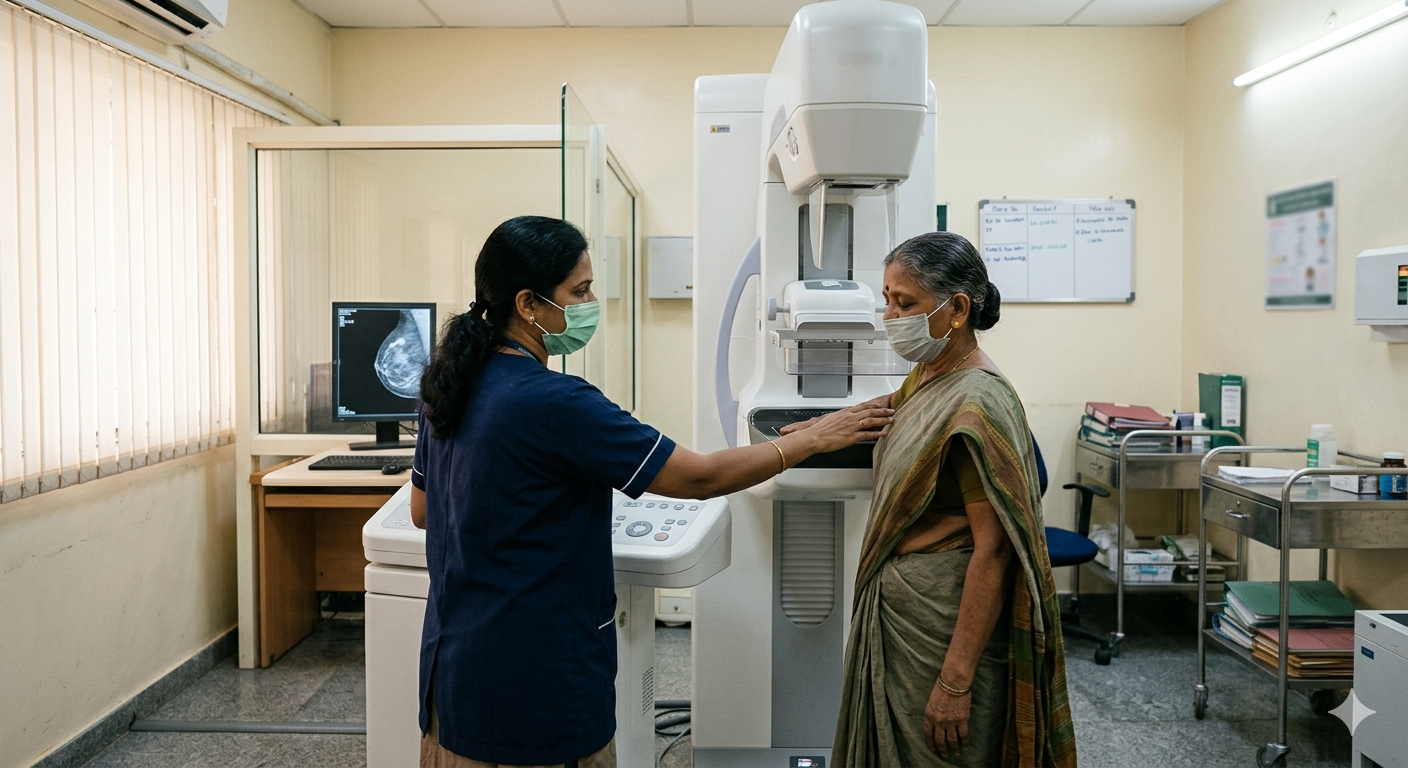
Compounding this is the absence of structured screening programmes. Widespread mammographic screening in India remains challenging due to current incidence levels, infrastructure limitations and access gaps, particularly in semi-urban and rural areas. High-income countries detect cancers early through robust mammographic screening and deep public awareness. India is yet to develop this infrastructure at scale. The facilities to deliver the same, particularly in semi-urban and rural areas, remain insufficient.
Healthcare Disparities Within India
Triple negative breast cancers, an aggressive subtype prone to early metastasis, have a significantly higher incidence in India compared to Western populations. This makes the urgency of early detection greater.
The stage at which cancer is diagnosed depends heavily on access to skilled oncology care, diagnostic services and functional referral pathways. Where these are fragmented, women present late. Specialised cancer centres may report higher metastatic rates not because of inferior care but because they serve as referral points for advanced disease from less equipped facilities.
A Practical Way Forward
Early detection remains within reach. Annual clinical breast examination by trained healthcare workers is practical, affordable and scalable. Another study from Mumbai showed that early diagnosis reduces breast cancer mortality risk by 30% in women over 50. Breast self-examination, promoted as an awareness tool, can help women notice changes early and report them on time. Equally important are referral pathways ensuring every suspicious finding reaches a well-equipped oncology centre without delay. Detection without a clear route to treatment remains the biggest roadblock. India has the talent to deliver world-class outcomes. It now needs the connective tissue to make that possible.
(Dr Geeta Kadayaprath, Principal Lead, Apollo Athenaa Women's Cancer Centres)
Disclaimer: The opinions expressed within this article are the personal opinions of the author. NDTV is not responsible for the accuracy, completeness, suitability, or validity of any information on this article. All information is provided on an as-is basis. The information, facts or opinions appearing in the article do not reflect the views of NDTV and NDTV does not assume any responsibility or liability for the same.
References
https://www.thelancet.com/journals/lansea/article/PIIS2772-3682(26)00051-X/fulltext
https://www.thelancet.com/journals/lansea/article/PIIS2772-3682(26)00051-X/fulltext
https://www.bmj.com/content/372/bmj.n256#:~:text=Statement%20of%20principal%20findings&text=We%20showed%20that%20biennial%20CBE,respectively;%20supplementary%20table%208).