

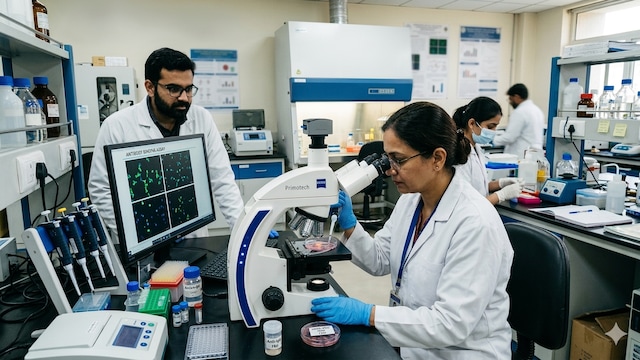
Cancer treatment is increasingly moving towards personalised approaches that take into account the genetic makeup of an individual's tumour. In one such development, Hyderabad-based biotechnology startup PopVax is working on personalised cancer vaccines that use artificial intelligence (AI), machine learning and messenger RNA (mRNA) technology to help the immune system identify and attack cancer cells. The company aims to design vaccines based on the unique mutations found in a patient's tumour, rather than using the same formulation for everyone. The approach involves analysing tumour genetic information, identifying abnormal proteins that could trigger an immune response and using mRNA technology to deliver instructions for producing these proteins inside the body. As part of its efforts to advance this research, PopVax has launched the RNA Foundry, an integrated research, development and manufacturing facility in Hyderabad, in collaboration with Stochastic Sciences. The facility is expected to support the development and production of personalised RNA medicines and contribute to India's growing capabilities in RNA-based therapeutics.
The development brings attention to an emerging area of cancer research in which scientists are exploring whether the body's own immune system can be trained to recognise tumour-specific markers. But how does this technology work, and can an mRNA-based personalised vaccine help fight cancer?
What Is A Personalised Cancer Vaccine?
Unlike conventional preventive vaccines, which prepare the immune system to fight infections before they occur, cancer vaccines are being developed to help the body recognise and target cancer cells. PopVax is exploring a personalised approach in which the vaccine is designed using the genetic information of an individual patient's tumour. This is important because cancer cells can develop mutations that distinguish them from healthy cells. Some of these mutations lead to the production of abnormal proteins that the immune system may be able to recognise.
These abnormal proteins or protein fragments are known as neoantigens. They can potentially act as markers that help the immune system distinguish cancer cells from normal cells. The objective of a personalised cancer vaccine is to use selected neoantigens to stimulate an immune response against the tumour. Since the genetic mutations can vary from one patient to another, the vaccine design may also differ between individuals.
According to PopVax founder Soham Sankaran, the company's approach combines AI, machine learning and molecular biology to identify potential targets and develop vaccines tailored to individual patients.
How Does PopVax Use AI To Identify Cancer Targets?
One of the biggest challenges in developing personalised cancer vaccines is identifying which mutations in a tumour are most likely to produce an effective immune response. A tumour can contain several genetic mutations, but not every mutation results in a protein that the immune system can recognise. Researchers therefore need to identify and prioritise the most promising targets.
The process begins with sequencing the genetic material of a patient's tumour. This allows researchers to examine the mutations present in cancer cells and identify differences between tumour tissue and normal tissue.
Machine-learning models can then analyse this information to predict potential neoantigens. These predictions help researchers shortlist abnormal proteins or protein fragments that may be recognised by the patient's immune system.
The selected targets are subsequently used to design the vaccine's mRNA sequence. The idea is to make the process of identifying suitable tumour-specific antigens more efficient and help develop a formulation based on the individual patient's cancer biology. However, AI-based predictions are only one part of the process. Laboratory studies and clinical trials are necessary to establish whether the selected targets can produce a meaningful immune response and whether that response can translate into better cancer outcomes.
How Does The mRNA Technology Work?
PopVax is using an mRNA-lipid nanoparticle (LNP) platform to develop its personalised cancer vaccines. Messenger RNA is a molecule that carries genetic instructions used by cells to produce proteins. In this approach, scientists design mRNA sequences that instruct the body's cells to produce selected tumour-associated antigens. The mRNA is packaged inside lipid nanoparticles, which help protect the genetic material and facilitate its delivery into cells. Once the mRNA enters the cells, it provides instructions for producing the selected proteins. These proteins can then be processed and presented to the immune system, allowing immune cells to recognise the tumour-related antigens.
The intended outcome is to activate immune responses, including those involving T cells, that can identify and attack cancer cells carrying the corresponding markers. An important feature of this approach is that the mRNA does not need to enter the cell nucleus or alter the person's DNA. Instead, it provides temporary instructions for making specific proteins, after which the mRNA is naturally broken down by the body. The technology is being investigated because it offers flexibility in designing vaccines against different tumour-specific targets.
What Is The RNA Foundry In Hyderabad?
PopVax has launched the RNA Foundry in Hyderabad in collaboration with Stochastic Sciences. The integrated facility is intended to bring research, development and manufacturing capabilities together to support the development of personalised RNA-based medicines. This is particularly relevant for personalised cancer vaccines because their development involves several stages, from analysing tumour genetics and designing mRNA sequences to producing the final formulation.
Having research and manufacturing capabilities within an integrated facility could help support the development process and strengthen the infrastructure required for RNA-based therapeutics. The initiative also reflects India's efforts to expand its domestic biotechnology capabilities beyond conventional pharmaceutical manufacturing. Although mRNA technology became widely recognised during the COVID-19 pandemic, researchers are now exploring its potential applications in cancer, infectious diseases and other areas of medicine.
For personalised treatments, manufacturing consistency and quality control are especially important because formulations may need to be designed around the genetic characteristics of individual patients.
Can Personalised Cancer Vaccines Become A New Cancer Treatment?
Personalised cancer vaccines are an active area of scientific research, with several approaches being investigated across different cancer types. The underlying idea is to use tumour-specific antigens to help the immune system recognise cancer cells more effectively. This is particularly relevant because cancer cells can sometimes evade immune detection by changing the proteins they express or by creating an environment that suppresses immune activity. However, developing a vaccine that triggers an immune response is not the same as proving that it can control or eliminate cancer. Researchers must establish whether the response is strong enough to affect tumour growth, how long it lasts and which patients are most likely to benefit.
Scientists are also investigating whether personalised cancer vaccines can work alongside existing treatments such as surgery, chemotherapy and immunotherapy. For PopVax, the next important milestones will involve demonstrating the safety and effectiveness of its platform through the necessary preclinical research and clinical trials. The technology should not yet be considered an established cancer treatment or a replacement for standard medical care.
PopVax's research brings together three important areas of biotechnology: artificial intelligence, tumour genetic sequencing and mRNA technology. By analysing the unique mutations in a patient's cancer, the company aims to identify potential neoantigens and design personalised vaccines that could help the immune system recognise and attack tumour cells. The launch of the RNA Foundry in Hyderabad adds a manufacturing and research dimension to these efforts, potentially strengthening India's developing RNA therapeutics ecosystem.
While personalised mRNA cancer vaccines offer an interesting direction for future cancer research, their clinical value will depend on evidence from rigorous testing. For now, the technology represents an experimental approach rather than an established cure for cancer.
Disclaimer: This content including advice provides generic information only. It is in no way a substitute for a qualified medical opinion. Always consult a specialist or your own doctor for more information. NDTV does not claim responsibility for this information.