

)
Squats are a staple exercise in most strength-training routines. They help strengthen the thighs, hips and gluteal muscles, improve lower-body strength and support everyday movements such as sitting, standing and climbing stairs. But if you experience knee pain while squatting, the exercise can quickly become uncomfortable. Many people assume that squats are bad for the knees or that knee pain automatically means they should stop doing them. However, the problem may sometimes be linked to poor technique, excessive weight, inadequate mobility or suddenly increasing workout intensity. From allowing the knees to collapse inward to forcing an uncomfortable squat depth, certain mistakes can affect how the load is distributed across the lower body. Understanding these errors and learning how to correct them can help you exercise more safely.
5 Common Squat Mistakes That Can Cause Knee Pain
1. Allowing Your Knees To Collapse Inward
One of the common mistakes during squats is allowing the knees to move inward while lowering the body or standing back up. This movement is often referred to as knee valgus. When the knees collapse inward, it can alter lower-limb movement and the way load is distributed across the knee joint. Repeatedly performing squats with poor control may contribute to discomfort in some people. "Squats are one of the most effective exercises for strengthening the thighs, hips and gluteal muscles, but poor technique can place unnecessary stress on the knees. Knee pain during squats is not always a sign that squats are harmful; more often, it indicates that the movement, load or volume needs to be corrected," says Dr. Dharam P. Pandey, Director, physiotherapy and rehabilitation sciences, ShardaCare - Healthcity. How to correct it: Keep your knees generally tracking in the same direction as your toes. Focus on controlled movement while lowering and standing up, rather than allowing the knees to buckle inward.
2. Believing Your Knees Should Never Cross Your Toes
A common gym myth is that the knees must never move beyond the toes during a squat. This can lead people to push their hips excessively backwards or adopt an unnatural movement pattern. In reality, the knees can naturally move beyond the toes during a squat. The amount of forward movement depends on factors such as body proportions, ankle mobility, squat style and the depth of the movement. Trying to prevent all forward knee movement may place additional demands on the hips and back. How to correct it: Allow your knees to move naturally in the direction of your toes. The movement should remain controlled and comfortable, without forcing an artificial restriction on how far the knees travel.
3. Squatting Too Deep Without Adequate Mobility Or Control
Deep squats can be part of a healthy strength-training routine, but depth should not be forced at the expense of control or comfort. Limited ankle or hip mobility, insufficient strength or poor movement control may make certain squat depths difficult for some people. Going deeper than you can comfortably manage may contribute to discomfort. However, deep squats are not automatically harmful. The appropriate depth depends on the individual and the exercise being performed.
How to correct it: Start with a squat depth that allows you to maintain control and a stable foot position. Gradually work on mobility and strength if you want to increase depth. A physiotherapist can help identify a suitable squat variation.
4. Increasing Weights, Repetitions Or Workout Frequency Too Quickly
Your muscles and joints need time to adapt to training. Increasing the weight on the bar, adding more repetitions or suddenly moving from a few weekly sessions to daily squats can increase the overall training load. This is particularly relevant for people who return to the gym after a break or begin a new lower-body workout programme.
How to correct it: Increase training intensity and volume gradually. Avoid pushing through persistent pain simply to complete a target number of repetitions. If discomfort develops after a change in training, consider reducing the load or modifying the exercise and seek professional guidance if symptoms continue.
5. Losing Control Of Your Foot And Body Position
Your feet provide the foundation for a squat. If the feet lift off the floor, the arches collapse excessively or the body loses stability, it can affect the movement of the knees and hips. A squat also requires coordination between the hips, knees, ankles and core. Poor control during the descent or while standing up can make the movement less efficient.
How to correct it: Keep your feet firmly planted, maintain control of your chest and spine, and brace your core. Focus on a smooth, controlled descent and return to standing without rushing.
What Is The Correct Way To Do A Squat?
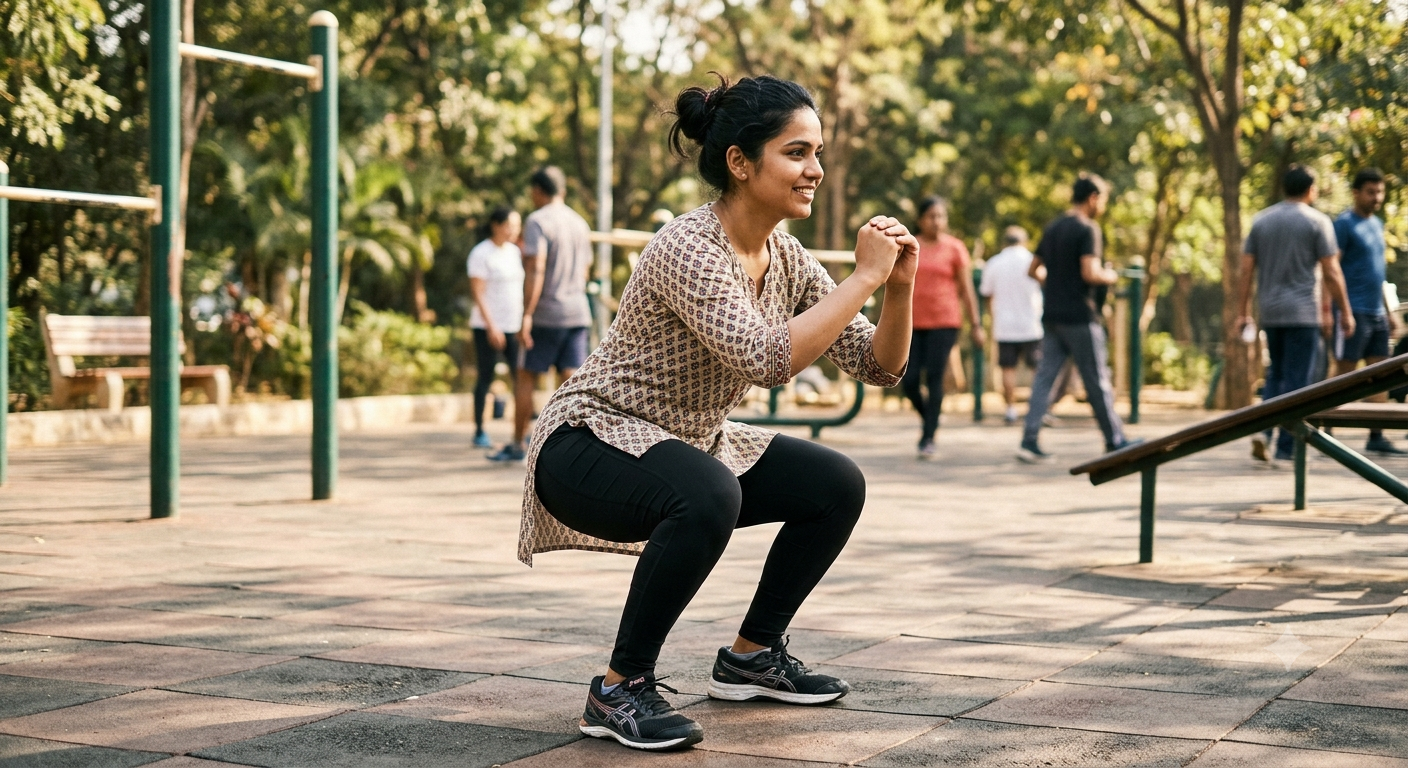
Correct squat form begins with a stable stance and controlled movement. However, there is no single stance that is perfect for every person. Foot position should be adjusted according to your anatomy, mobility and comfort. Here is a basic guide to performing a bodyweight squat:
- Step 1: Stand with your feet approximately hip- to shoulder-width apart. Adjust your stance according to what feels comfortable and allows good control.
- Step 2: Keep your feet firmly planted on the floor and brace your core.
- Step 3: Begin lowering your body by bending your hips and knees. Allow your hips to move back and your knees to move naturally in the direction of your toes.
- Step 4: Keep your chest and spine controlled. Avoid collapsing forward or losing balance.
- Step 5: Descend only as far as you can maintain good form and comfort.
- Step 6: Drive through your whole foot to return to a standing position, maintaining control of your knees.
Should You Stop Squatting If Your Knees Hurt?
Knee pain during squats should not automatically be interpreted as evidence that the exercise is damaging your knees. The cause may be related to movement mechanics, training load, mobility, muscle strength or an underlying condition. However, pain should not be ignored, particularly when it is sharp, persistent or associated with other symptoms.
"If pain is sharp, persistent, associated with swelling or continues after exercise, it should not be ignored. A physiotherapist can assess movement mechanics, muscle strength, joint mobility and the appropriate squat variation before progressing the load," says Dr Ravikant. If a particular squat variation causes discomfort, a physiotherapist may recommend modifying the depth, reducing the load, changing the stance or temporarily using a different exercise while the cause is assessed.
Squats can be an effective exercise for building lower-body strength, but technique and training progression matter. Avoid forcing a particular squat depth, do not restrict natural knee movement simply because of the toes myth, and focus on controlled movement with stable feet. For people experiencing knee pain, the goal should not be to push through discomfort. It should be to understand the cause, correct the movement where needed and choose an exercise variation that suits their current strength, mobility and symptoms.
Disclaimer: This content including advice provides generic information only. It is in no way a substitute for a qualified medical opinion. Always consult a specialist or your own doctor for more information. NDTV does not claim responsibility for this information.