

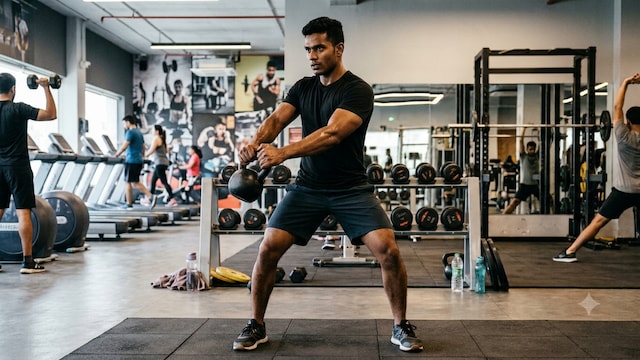
Your fitness routines may often focus on familiar movements such as regular squats, push-ups, lunges and planks. However, rotational exercises can add another important dimension to training by challenging the muscles responsible for turning, stabilising and controlling the torso. One such movement is the Spartan rotation, an exercise that can be incorporated into functional fitness and core-training routines. It involves controlled rotational movement and engages several muscle groups, particularly those around the abdomen, waist, hips and shoulders. But what exactly is the Spartan rotation exercise? Does it help strengthen your core, improve balance and build functional fitness? And how should beginners perform it safely?
What Is The Spartan Rotation Exercise?
Spartan rotations are a rotational training movement designed to challenge the core and improve control of the torso. Depending on the variation, the exercise may involve rotating the upper body while maintaining a stable lower body, often using body weight or an external resistance such as a dumbbell, resistance band or cable. The movement challenges the muscles that help rotate and stabilise the trunk. These include the obliques, which run along the sides of the abdomen, as well as the deeper core muscles and muscles around the hips and back. Unlike traditional crunches, which primarily involve bending the torso forwards, rotational exercises train the body to control movement in a different direction. The exact technique can vary depending on the programme or trainer using the term 'Spartan rotations'. Therefore, it is important to understand the specific variation being demonstrated before attempting it.
1. Helps Strengthen The Core Muscles
One of the primary benefits of rotational exercises is that they challenge the core muscles. The core is not limited to the visible abdominal muscles. It includes a group of muscles around the abdomen, back and pelvis that help stabilise the spine and transfer force between the upper and lower body. During controlled rotations, the obliques work to produce and control trunk movement. Other core muscles help maintain stability and prevent unwanted movement.
A stronger core can support everyday activities such as bending, turning, lifting and carrying objects. It can also help improve control during strength-training exercises. However, no single rotational exercise can independently develop the entire core. A balanced routine should also include exercises that challenge the body to resist extension, rotation and sideways bending.
2. Can Improve Rotational Control And Coordination
Many everyday activities involve turning the torso. Whether you are reaching for something behind you, changing direction while walking or playing a sport, your body needs to coordinate movement across multiple joints and muscle groups. Rotational exercises can help train this coordination. By practising controlled turns, you learn to move through the torso while maintaining balance and stability. This can be useful for people involved in sports such as tennis, cricket, golf and football, where controlled rotational movement plays an important role.The objective should be to develop control rather than simply rotate as quickly or forcefully as possible.
3. Engages More Than Just The Abdominal Muscles
Depending on the variation, Spartan rotations can involve several muscle groups working together. The obliques play an important role in trunk rotation, while the deeper abdominal muscles help stabilise the torso. The hips and glutes may also contribute to maintaining a stable base. If the movement involves a resistance band, cable or weight, the shoulders and arms may also work to control the resistance. This makes rotational movements useful additions to functional fitness programmes, where the focus is on developing strength and coordination that can transfer to everyday activities. However, the muscles involved and the intensity of the exercise depend on how it is performed.
4. May Support Athletic Performance
Rotational strength and control are relevant to several sporting movements. For example, a cricketer uses trunk rotation while batting, a tennis player rotates the torso during a forehand, and a golfer generates rotational force during a swing. Training the muscles responsible for producing and controlling rotation may help athletes develop better movement coordination. However, it would be inaccurate to suggest that Spartan rotations alone improve sporting performance. Athletic ability depends on several factors, including overall strength, speed, mobility, technique, endurance and sport-specific practice. Rotational exercises are best viewed as one component of a broader training programme.
5. Can Add Variety To Your Core Workout
Repeating the same abdominal exercises every week may make a workout monotonous. Adding rotational movements can introduce a different challenge to your routine. You can combine them with exercises such as planks, side planks, dead bugs, bird dogs and controlled cable rotations. This helps train the core through different movement patterns rather than focusing exclusively on crunches and sit-ups. For beginners, start with body-weight movements and a small range of motion. Once you are comfortable with the technique, you can consider adding light resistance under proper guidance.
How To Perform Rotational Exercises Safely
The technique depends on the specific Spartan rotation variation you are following. However, some general principles apply to rotational training:
- Begin with a comfortable stance and maintain balance.
- Keep your movements controlled rather than swinging your torso.
- Engage your core muscles throughout the movement.
- Avoid forcing your spine into an uncomfortable range of rotation.
- Start without weights before progressing to resistance.
- Stop if you experience pain, particularly in your lower back.
If you have a history of back pain, spinal problems or an existing injury, consult a qualified fitness professional or physiotherapist before adding loaded rotational exercises to your routine.
Spartan rotations can add a useful rotational challenge to a core and functional fitness routine. Depending on the variation, they can engage the obliques and other stabilising muscles, while helping develop trunk control and coordination. However, they should not be treated as a shortcut to visible abs or a smaller waist. A well-rounded fitness programme should combine rotational exercises with resistance training, aerobic activity, mobility work and adequate recovery. Start with controlled movements, prioritise technique and gradually increase the difficulty as your strength and coordination improve.