

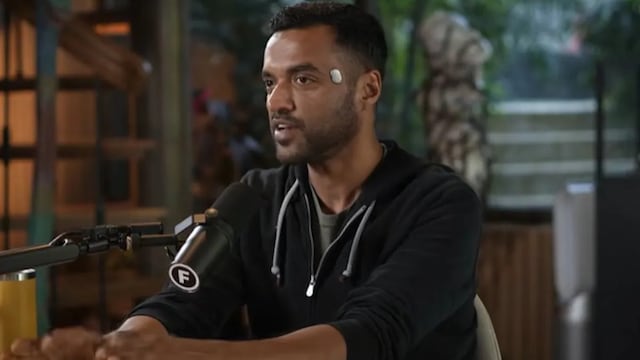
The Temple device is currently the talk of the town. The pre-orders officially started on November 1, and the Temple website states that the device will be delivered within three months. Deepinder Goyal, the founder of Zomato and Temple, has been actively sharing details about the wearable on X. While many people are excited about it, several health experts are expressing doubts and requesting "clinical evidence" to support its claims. However, Goyal has clarified that "Temple is a fitness tracker, and wellness device. We are not a medical device. If at some point, we clinically validate any of our metrics, we will let you know."
In a recent post on X, Goyal wrote an open letter to Indian doctors who are raising concerns about the accuracy, safety, and uses of the device.
"If Temple were a scam, and any of what we said weren't true, people would know it in just a few days of using Temple. We have 14-day, no-questions-asked returns (which even Apple doesn't offer in India). If the product doesn't work, it fails out of the gate and the company dies before recovering a tenth of its R&D," he wrote.
Regarding clinical evidence, Goyal stated, "Most wearable companies start with internal studies. Whoop shipped its band in 2015, and the first published validation followed a few years later. We hold ourselves to a higher standard; pre-prints are a step prior to peer-reviewed publications, and they are coming up."
Dear Concerned Indian Doctors, I see your rage against Temple on X. I have a few points to make: 1. First and foremost, a business lesson: if Temple were a scam, and any of what we said weren't true, people would know it in just a few days of using Temple. We have 14-day, no-questions-asked returns (which even Apple doesn't offer in India). If the product doesn't work, it fails out of the gate and the company dies before recovering a tenth of its R&D. 2. We have already spent $30m building Temple, $20m out of which is my own money. Selling a few thousand devices recovers a small fraction of this investment. A scam that pays nothing is not a scam anyone would run. 3. I left the Eternal CEO role to chase purpose with Temple. This is not about money. I have enough of it to last for generations. My incentives are fully aligned with getting the science right. I am not staking a reputation earned over 20 years on making a quick buck. 4. Our employees bought into our round a few months ago. The round we're raising now is mostly our customers. Scams don't build that cap table. 5. Most wearable companies start with internal studies. Whoop shipped its band in 2015, and the first published validation followed a few years later. We hold ourselves to a higher standard; pre-prints are a step prior to peer reviewed publications, and they are coming up. 6. At some point you have to stick your neck out and say: we believe in our science, and the product is now valuable enough for people to pay for and use. We believe we are there. More validation continues in public. 7. We are confident that we are building something that the world is going to be positively astonished with. We stand by our science and our methods. Each of our claims is easily verifiable by individuals and institutions alike, and you will see a lot of independent studies come up on their own when the device becomes available to use. Last but not the least, the most ground breaking features in Temple are not even public yet. And some of them, thankfully, have nothing to do with doctors 🤭 Hope this addresses some or all of your concerns. If not, keep raging 😘🤗
— Deepinder Goyal (@deepigoyal) November 5, 2026
In response, hepatologist Dr Cyriac Abby Philips, popularly known as The LiverDoc, remarked that "there is no science."
"His own Science Lead (Avi Roy) has accepted that the fact that their device is not yet proven to measure brain flow or "entropy" as they claim on their website and additionally, has directly addressed concerns of poor methodology as well as statistical misrepresentation, without responding to clear evidence of data falsification in their pre-print papers. Other wearables like Whoop (which he cited) measured and validated exactly what the wearable can measure within limits of human anatomy and physiology," the LiverDoc wrote.
The founder of the wearable device Temple, Mr. Deepinder Goyal (who has blocked me on Twitter) has now put out an official statement regarding concerns raised by the medical community on the said device being a scam. As expected, he has written a word salad. This man has provided no real evidence or proof that his device, which he is selling for INR 85,000/- can measure and interpret brain flow from a superficial artery (superficial temporal artery - which is an extracranial artery - meaning a blood vessel placed entirely outside the skull, supplying blood to the side of the face, temple, and scalp regions). His own Science Lead (Avi Roy) has accepted that the fact that their device is not yet proven to measure brain flow or "entropy" as they claim on their website and additionally, has directly addressed concerns of poor methodology as well as statisitical misrepresentation, without respond to clear evidence of data falsification in their pre-print papers. Other wearables like Whoop (which he cited) measured and validated exactly what the wearable can measure within limits of human anatomy and physiology. Temple is overdoing it and defrauding its potential customers. The device can only measure blood flow and flushing to the face in humans and has ansolutely NOTHING to do with the brain as they claim. This is the issue, not what can happen in the future. The device itself fails its primary objective. There is no our science and your science. But there is bad science, fringe science and science fraud and Team Temple, embraced all of these. Temple device is a scam. There is no doubt about it. The question is however, how long can this man and his team keep defrauding people under the garb of "we are spending millions for you" or "we are trying our best" or "we are taking the risk" kind of responses? These farts in the windtunnel responses are not what is expected from a company who's website claims "solid science". There is solid fraud though - pathetic little businessmen.
— TheLiverDoc™ (@theliverdoc) November 5, 2026
Another Indian doctor, Dr Zubin Sharma, a gastroenterologist, wrote: "Thank you @deepigoyal for saying Temple is shipping with no research at clinical outcomes/ peer reviewed level."
Thank you @deepigoyal for saying Temple is shipping with no research at clinical outcomes/ peer reviewed level And coming to all the money you have talked about - Could have easily been spent on healthcare problems that India is actually having...
— Zubin Sharma MD (@doc_zubin) November 5, 2026
Exactly the problem- People THINK it is measuring brain flow....an excellent hardware but not even Eternal knows what is the device measuring or can be used for ( not my words)- it's in their own papers
— Zubin Sharma MD (@doc_zubin) November 5, 2026
Amid all the discussions about this latest wearable, let's take a closer look at what Deepinder Goyal's Temple claims to do:
The Temple device is a pill-shaped wearable developed by Zomato founder Deepinder Goyal. Worn on the side of the head using a disposable medical-grade adhesive grip, the gadget claims to continuously monitor cerebral blood flow (blood flow inside the brain) and evaluate biological strain. Priced at Rs 85,000, the device uses light-based optical sensors to track metrics rather than relying on standard wrist-based tracking.
The device is available in six colours: True Gold, Rose Gold, Black Mirror, Real Jade, Deep Blue and Purple Funk.
READ | Temple Is The Most Accurate Heart Rate Detector, Claims Deepinder Goyal; Here's How It Works
Temple employs light-based sensing technology to track cerebral blood flow and oxygenation in real time, marketed as BrainFlow. In one of the posts on X, Goyal claimed that "Temple is the most accurate HR (heart rate) tracker compared to all flagship wearables, even in Zone 4 & 5."
The device calculates a biological entropy score ranging from 1 to 250. This metric claims to indicate the amount of physiological strain your body is under due to factors like stress, poor sleep, and caffeine intake.
The device has faced significant pushback from the medical community. Medical experts note that the superficial temporal artery where the device sits is entirely outside the skull. Readings taken from this area are heavily influenced by the scalp, skin, and muscle tissue, making it highly questionable whether it can accurately measure true blood flow inside the brain.
The Temple device is marketed strictly for general wellness and research. It is not approved by medical regulatory bodies.
Critics point out that the company's claims rely on internal studies with very small sample sizes rather than peer-reviewed, third-party independent trials. It cannot be used to diagnose, prevent, or evaluate any actual neurological or health conditions.
Disclaimer: This content including advice provides generic information only. It is in no way a substitute for a qualified medical opinion. Always consult a specialist or your own doctor for more information. NDTV does not claim responsibility for this information.