)
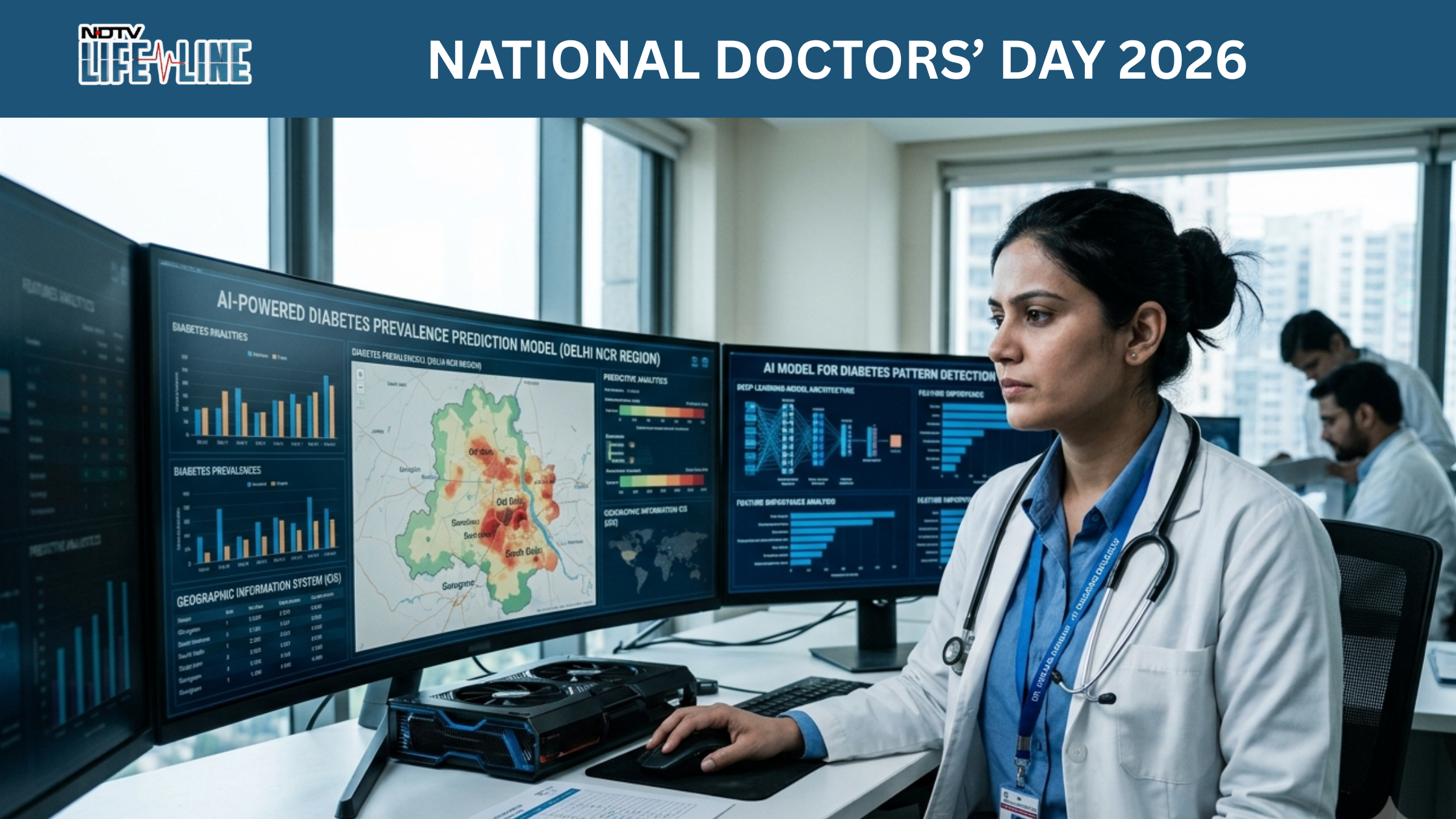
As artificial intelligence (AI) rapidly becomes part of everyday life, one question continues to dominate conversations across healthcare: Can AI replace doctors? From interpreting scans and identifying cancers earlier to predicting disease risk and summarising medical literature in seconds, AI is already changing the way medicine is practised. Around the world, and increasingly in India, hospitals are integrating AI into diagnostics, medical imaging, clinical decision support and hospital administration. Yet, despite its remarkable capabilities, India's leading doctors believe the future of medicine is not one where machines replace physicians, but one where technology enhances human expertise.
On National Doctors' Day, NDTV Lifeline spoke to leading clinicians across oncology, geriatrics, cardiology, psychiatry, pulmonology, ENT, internal medicine and diagnostics. Their message was remarkably consistent: AI is becoming an indispensable clinical partner, but compassion, judgement, ethics and trust remain uniquely human.
Medicine Is Entering The Age Of Prediction
Perhaps no specialty illustrates AI's promise better than geriatrics, where patients often live with multiple chronic illnesses requiring highly personalised care.
Prof. Nirmal Kumar Ganguly, former Director General of the Indian Council of Medical Research (ICMR), is currently working with Dr Prasun Chatterjee, Group Clinical Lead, Department of Geriatric Medicine and Longevity Sciences, Apollo Hospital Group, on a large-scale longitudinal study of healthy ageing in India.
Explaining why AI has become essential for modern research, Prof. Ganguly says, "We are looking at one group of aged people who are healthy... and another group with dementia, heart disease, hypertension, arthritis and sarcopenia. The data is massive. If you really want to create prediction and intervention, that data has to be analysed and an algorithm developed. That's where we need AI. Without AI, you can't do that."
Dr. Chatterjee believes medicine itself is undergoing a fundamental transformation. "Medicine is switching from preventive and reactive to predictive, and that's where AI will play a major role."
He goes further. "AI is a must for medicine. If we don't make AI our collaborators, it will surpass doctors in many aspects." Yet, he is equally clear that technology should remain under human supervision. "Medical science has to be AI-supported, but guided by doctors. The human element cannot and should not be removed."
Interestingly, Dr. Chatterjee says he already uses AI to review prescriptions for elderly patients with multiple diseases. "I honestly vet my prescriptions through AI. Five prescriptions with 20 drugs can often become one with five medicines that truly benefit that individual patient."
Also Read: Physician Heal Thyself? Indian Doctors Share Toll Of Hidden Health Burdens
AI Is Already Helping Doctors Work Smarter
Across specialties, clinicians describe AI not as a competitor, but as an intelligent assistant. Dr. Sumit Mrig, Director and Unit Head of ENT, Audiology and Cochlear Implant Programme at Max Smart Hospital, Saket, compares AI's arrival to robotic surgery. "AI can never replace the medical or surgical field, but it can be an assistive tool. It can help achieve earlier diagnosis, better outcomes and improved planning. Just as robotic surgery still depends on the surgeon sitting at the console, AI will still depend on the doctor."
He believes AI could become especially valuable for early cancer detection and patient triage. Similarly, Dr. Dilip Gude, Senior Consultant Physician at Yashoda Hospitals, Hyderabad, believes AI's greatest strength lies in processing enormous amounts of medical information rapidly. "AI does best what humans struggle with, speed. It can analyse huge volumes of data, interpret scans, detect disease patterns and reduce administrative work, allowing doctors to spend more time with patients." However, he adds, "Medicine is not just about data. Every patient is unique, and healing requires judgement, experience, ethics and compassion, qualities only humans bring."
Healthcare Is More Than Algorithms
Several experts emphasise that while AI excels at recognising patterns, it cannot understand the complexities of individual lives. Dr. Pallavi Sharma, Director, Kailash Healthcare, says, "Patients do not simply seek a diagnosis, they seek reassurance, trust and compassion. They want someone who listens, explains difficult choices and stands beside them through recovery. No algorithm can replicate that relationship." She believes AI should empower doctors by reducing administrative burden so they can spend more time where it matters most, with patients.
Likewise, Dr. Varun Bansal, Senior Consultant Cardiac Surgeon, Indraprastha Apollo Hospitals, reminds us that medicine is ultimately about treating people, not reports. "Treatment relies not only on the data fed into AI but also on the subtle information the human brain notices. We treat patients, not reports."
Clinical Judgement Cannot Be Automated
Pulmonologist Dr. Manan Bedi, Principal Consultant at Paras Health Panchkula, points out that every clinical decision depends on far more than laboratory values. "Doctors reassure anxious families, explain treatment options, make difficult decisions during emergencies and provide compassionate care. These qualities cannot truly be replicated by AI." Instead, he believes AI should reduce repetitive work while supporting earlier diagnosis of conditions such as cancer, stroke and diabetes.
Similarly, psychiatrist Dr. Pretty Duggar Gupta, Consultant Psychiatrist at Aster Whitefield Hospital, notes that psychiatry highlights AI's limitations more clearly than perhaps any other specialty. "Healthcare isn't only about diagnosing disease. Patients come with emotional concerns, multiple illnesses and situations where there is no single right answer."
She adds, "AI can analyse enormous amounts of data, but it cannot replace empathy, critical judgement or the therapeutic relationship."
Doctors Must Learn To Work With AI
Some experts argue that resisting AI would be a mistake. According to Dr. Deeksha Katiyar, Co-Founder of WeClinic Homeopathy, "Doctors should not fear AI. They should learn to work with it." She believes AI can identify patterns across years of patient records while helping doctors make more informed clinical decisions. "AI becomes dangerous only when it replaces medical judgement instead of supporting it."
AI Is Powerful, But It Isn't Perfect
Every expert also highlighted the challenges. AI systems depend heavily on the quality of the data they receive. Poor-quality or biased datasets can produce inaccurate recommendations. There are also growing concerns about privacy, cybersecurity, algorithmic bias and overdependence on automated systems.
The World Health Organization (WHO) has similarly cautioned that AI in healthcare must be developed and deployed responsibly, with strong safeguards for patient safety, transparency, ethics and data protection. As Dr. Bansal succinctly puts it, "AI will help those who learn to work with it, and become a problem for those who believe it is either the only tool they need or completely unnecessary."
Also Read: The Cost Of Being Available 24x7: A Doctor's Perspective On National Doctor's Day 2026
The Future Is Human Intelligence, Amplified By Artificial Intelligence
Across every conversation, one theme emerged. AI is changing medicine forever, but it is not replacing doctors. Instead, it is helping clinicians make faster diagnoses, analyse more information, personalise treatments and spend less time on repetitive tasks. Meanwhile, doctors continue to provide what no technology can fully replicate: empathy, ethical judgement, contextual decision-making and human connection.
As Dr. Chatterjee perhaps summarises it best, "AI-supported medicine, guided by doctors, is the future." This National Doctors' Day, the conversation should not be about AI versus doctors. It should be about AI for doctors, and ultimately, for patients.
India stands at an exciting crossroads where artificial intelligence has the potential to democratise expertise, improve early diagnosis, support overburdened healthcare systems and enable more personalised care. But technology must remain exactly what every expert interviewed for this story believes it should be: a powerful assistant, never a substitute.
Because while algorithms can process millions of data points in seconds, only a doctor can comfort a frightened family, balance uncertainty with experience, make ethically complex decisions and inspire the trust that lies at the heart of healing. The future of healthcare, therefore, belongs neither to humans nor machines alone, but to both, working together.
Disclaimer: This content including advice provides generic information only. It is in no way a substitute for a qualified medical opinion. Always consult a specialist or your own doctor for more information. NDTV does not claim responsibility for this information.