





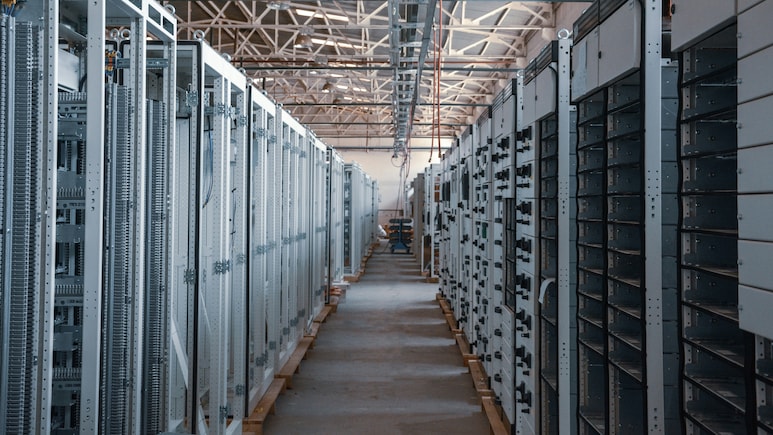
The rise of artificial intelligence (AI) tools in the last few years has led to companies setting up massive data centres around the world. Concerns over their massive water and electricity consumption have led to widespread protests, and now a new report by the United Nations University Institute for Water, Environment and Health (UNU-INWEH) has highlighted the severity of the issue, warning that AI-related water consumption may equal the needs of 1.3 billion people by 2030.
AI data centres rely on cooling systems that consume millions of litres of water, especially in warmer regions. This has raised questions about sustainability, particularly in areas already facing water stress.
"The associated water footprint of the projected 2030 electricity consumption of data centres is 9.3 trillion litres, or enough to meet the minimum annual domestic water needs of all 1.3 billion residents of Sub-Saharan Africa for a full year," the report highlighted.
The new findings suggest that global data centres powering AI are projected to consume 945 terawatt-hours (TWh) of electricity by 2030, which is nearly triple the combined annual electricity use of Pakistan, Bangladesh, and Nigeria, according to a report in Time.
The report highlighted that global data centres consumed approximately 448 TWh of electricity in 2025 alone. If data centres' electricity use were considered a country, it would have ranked 11th globally by electricity consumption.
"The energy consumed by data centres in 2025 was enough to supply the annual residential electricity needs of the entire population of Sub-Saharan Africa, 1.3 billion people, for 2.6 years," the report stated.
Nuclear Power Plants Preferrable
Last month, a US-based survey highlighted that the majority of civilians would rather have a nuclear power plant in their neighbourhood than an AI data centre. According to a Gallup survey, 71 per cent of Americans are somewhat or strongly opposed to the building of AI data centres in their area, primarily due to their environmental impact. Meanwhile, only 53 per cent of respondents opposed the construction of a nuclear power plant in their local area.
"Since Gallup first asked the nuclear power plant question in 2001, the high point in opposition has been 63 per cent." the survey highlighted, adding that 46 per cent of people were worried a great deal about the environmental impact of AI data centres.
A yet-to-be-peer-reviewed study highlighted that apart from consuming huge amounts of water and electricity, these data centres are also creating 'heat islands', warming the land around them by two degrees Celsius on average, making life hotter for more than 34 crore (340 million) people.
"We estimate that the land surface temperature increases by 2 degrees Celsius on average after the start of operations of an AI data centre, inducing local microclimate zones, which we call the data heat island effect," the study highlighted, adding that in extreme cases, the jump can be as high as 9 degrees Celsius.
The temperature increase by these AI data centres affected areas up to 9.9 km (6.2 miles) away, the research found, affecting more than 340 million people.
Track Latest News Live on NDTV.com and get news updates from India and around the world

