





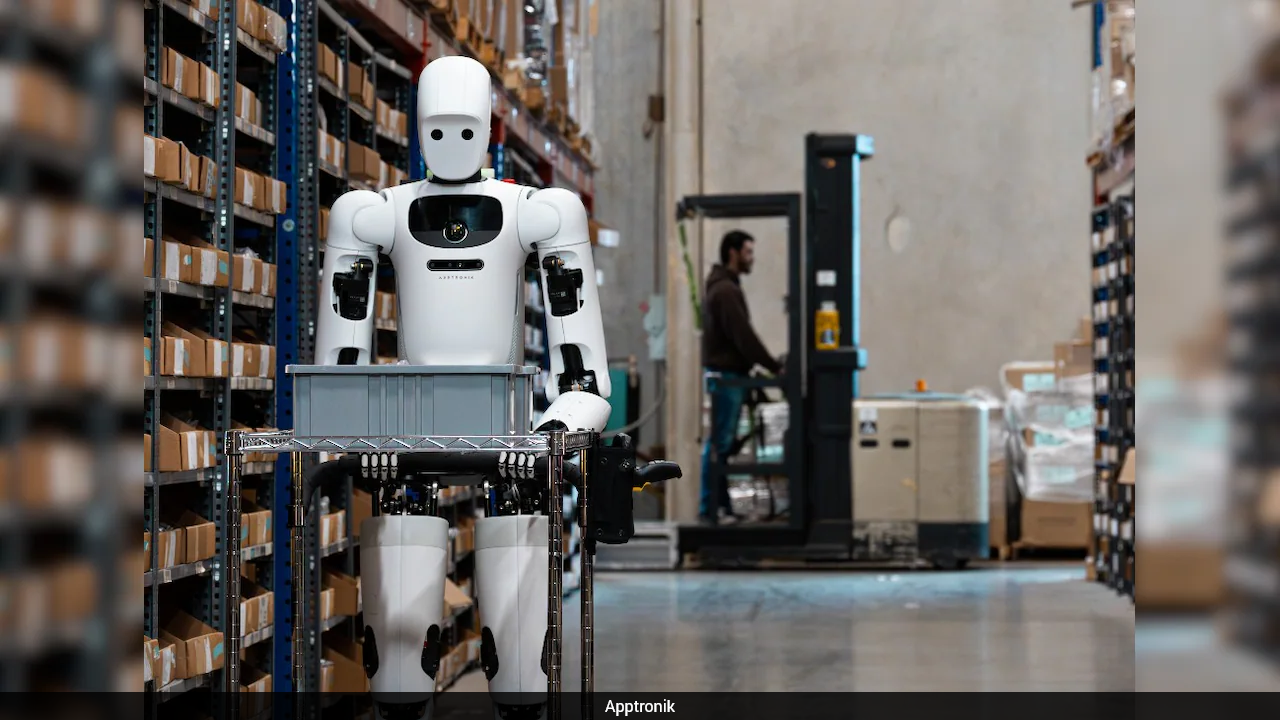
Apptronik, a Texas-based robotics firm backed by Google and Mercedes, has opened a "Robot Park" in Austin, a training ground where its humanoid robots learn to do everyday tasks before heading out to work, according to Business Insider.
The nearly 90,000-square-foot warehouse runs seven days a week. Inside, Apollo robots practise jobs such as stacking boxes onto conveyor belts and sorting toys into bins, mostly guided remotely by human operators standing close by. Every session generates data that feeds back into the AI systems controlling the robots, helping them get better over time.
Chief executive and co-founder Jeff Cardenas compared the facility to a factory, but one that produces learning rather than hardware. He said it works like a playground where robots build up real-world experience, something he calls a "data factory."
That approach mirrors a similar idea from Elon Musk, who has spoken about creating an "Optimus Academy" for Tesla's humanoid robots, aiming to build a steady loop of training data.
According to Business Insider report, founded in 2016 as a spin-out from the University of Texas's robotics lab, Apptronik grew out of research originally funded by a US military competition for disaster-response robots. It began by supplying robot components to other firms before shifting its focus to building a general-purpose humanoid.
The company has raised around $1 billion and is now valued above $5.5 billion. Mercedes already uses its Apollo robots on factory floors for simple assembly tasks, while Google's DeepMind unit uses them to help refine its own robotics AI models.
Apptronik launched the original Apollo in 2023 and has since moved on to Apollo 2, a stronger version with an improved battery, motors and sensors. It stands around six feet tall, can run for four hours, and can lift up to 55 pounds. A commercial version, Apollo 3, is currently in development, though Cardenas would not confirm a release date.
He described the humanoid robotics industry as moving through three stages: proving the technology works, proving that customers will pay for it, and finally scaling into a profitable business. In his view, the sector is now entering the second phase, comparing today's humanoids to personal computers in the early 1980s, on the verge of practical, everyday use.
Competition in the sector is heating up. Figure AI, valued at $39 billion, is starting to deploy robots in logistics centres, while 1X plans to send more than 10,000 humanoids into homes this year. Agility Robotics is further ahead still, with its Digit robot already working across nine sites for firms including Amazon, Toyota and GXO, and the company preparing for a stock market listing.
Apptronik stands apart from many rivals by developing both walking and wheeled versions of its robots. Cardenas believes legged robots hold the greatest long-term promise since they could eventually match human mobility, but expects wheeled versions to reach workplaces sooner because they are safer and use less power.
The company already runs additional Robot Parks at client sites worldwide and plans to open more. Cardenas said his ultimate ambition is to make these spaces public, so people everywhere can watch the technology develop firsthand.
Track Latest News Live on NDTV.com and get news updates from India and around the world

