





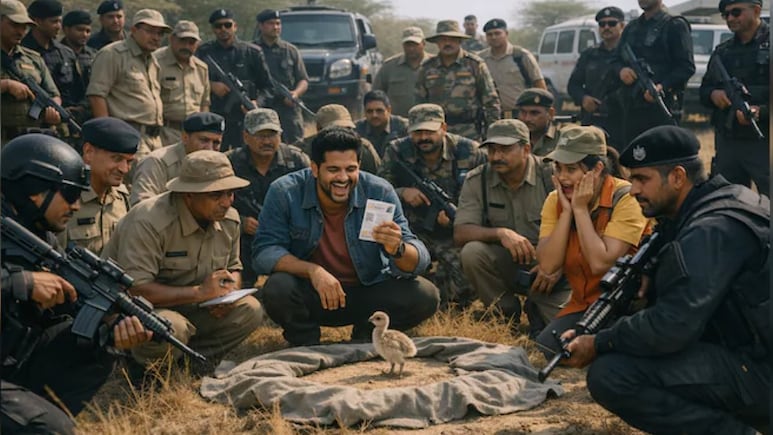
It arrived after an extraordinary 19-hour road journey, carried in a handheld incubator across nearly 800 kilometres of Indian highway. Now, this tiny great Indian bustard chick has something very few living creatures on earth can claim: a personal protection team of 50 wildlife officers watching over it every hour of the day.
The chick hatched recently in the desert grasslands of Kutch, in the western state of Gujarat, and was hailed immediately as a conservation milestone. It is the first great Indian bustard to hatch successfully in Gujarat in ten years.
Gujarat state conservation officer Dheeraj Mittal described the moment as "a rare and momentous occasion" for wildlife protection efforts in India. But he was quick to add that the hardest part was only just beginning. "The real challenge begins now," he said. Teams of around 50 people are now tracking the mother bird's every movement, around the clock, to keep both her and her chick safe.
The reason for such extraordinary care is simple: there are barely 150 great Indian bustards left anywhere in the wild. The metre-tall desert birds have been pushed to the very edge of extinction over the past 25 years. Feral dogs, shrinking habitat, and deadly collisions with power lines have all taken a heavy toll. The birds share their desert home with vast solar energy projects, and the power lines that come with them have proven fatal time and again.
The Supreme Court of India had ordered those power lines to be buried underground in key breeding areas. The government, however, successfully challenged that order, arguing it would hold back the country's renewable energy ambitions.
The situation in Kutch had grown particularly fragile. The last remaining local population consisted of just three birds, and all three were female. With no males present, natural breeding was impossible. Wildlife authorities stepped in with what Environment Minister Bhupender Yadav called a "jumpstart approach," transporting a fertilised egg from a separate breeding programme to give the Kutch population a new chance at survival.
That egg travelled nearly 800 kilometres by road, kept alive in a handheld incubator throughout the long journey. It hatched successfully, and the little chick that emerged is now at the centre of a carefully organised protection effort. Local villagers have been asked to keep their cattle away from the area, and officers say their top priority is shielding both the chick and its mother from predators.
The great Indian bustard is listed as critically endangered on the IUCN Red List of Threatened Species. For now, at least, this one small bird has the full weight of India's conservation machinery behind it.
(With inputs from AFP)
Track Latest News Live on NDTV.com and get news updates from India and around the world

