





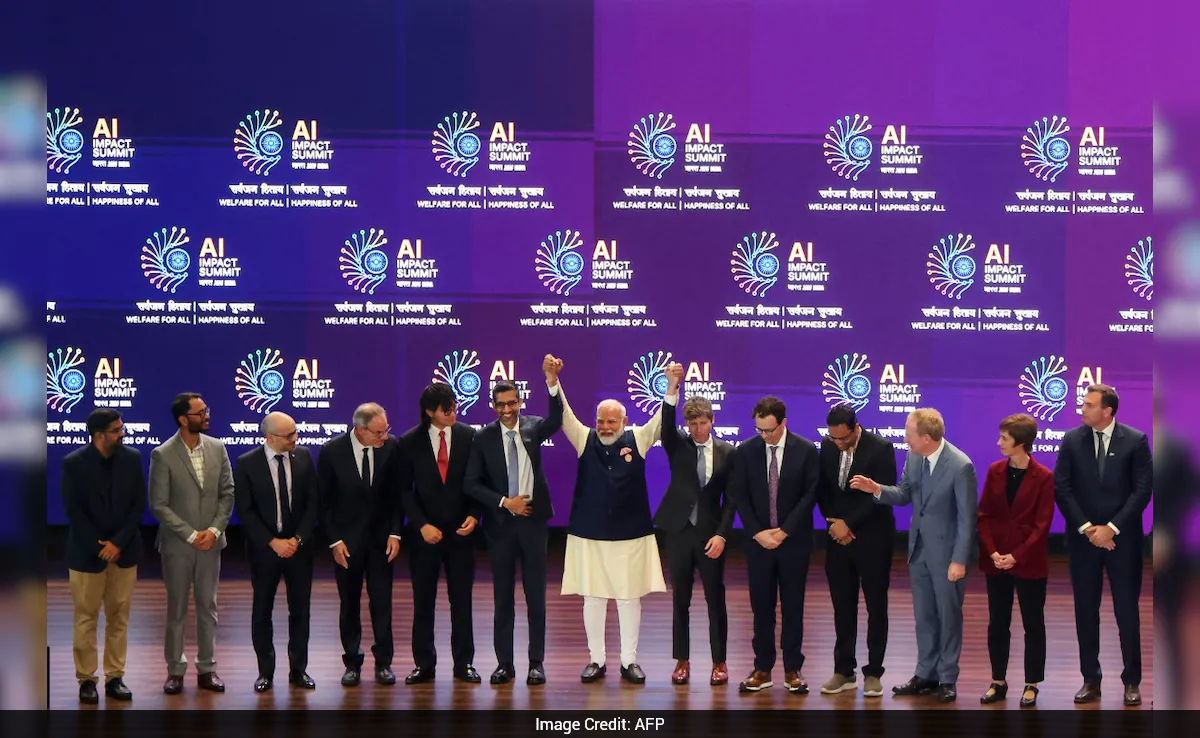
As New Delhi hosted global AI leaders for the India AI Impact Summit 2026, Prime Minister Narendra Modi emphasised a vision for a self-reliant India, centred on AI sovereignty, inclusivity, and innovation. While territorial sovereignty has long dominated the geopolitical discourse, the leader of 1.4 billion people made it clear that in the digital age, LLMs and algorithms are the new frontiers of national security and global influence.
The push from PM Modi comes in the backdrop of an intensifying 'AI Cold War' between the US and China. The extent of competition to one-up each other can be gauged by China's recent attempts to harvest massive swathes of data to train and upgrade its indigenous models.
Anthropic on Monday (Feb 23) accused DeepSeek, Moonshot and MiniMax of harvesting large amounts of data from its Claude models through 'distillation' campaigns. Using approximately 24,000 fraudulent accounts, the three Chinese companies generated over 16 million conversations with Anthropic's Claude chatbot that could be used to teach skills to their own chatbots.
Anthropic warned that such illicit campaigns were growing in "intensity and sophistication" and that the window to act was narrowing. "The window to act is narrow, and the threat extends beyond any single company or region. Addressing it will require rapid, coordinated action among industry players, policymakers, and the global AI community."
In a memo to the House Select Committee on China last week, OpenAI also alleged that Chinese firms had extracted extensive data from ChatGPT to bolster their own models, highlighting the extent of
Also Read | Meet Gaitana, Blue-Coloured AI Bot Running For A Seat In Colombian Parliament
AI Cold War And India
Just as the Cold War of the 20th century was defined by the space race and nuclear deterrence, the 21st century is being shaped by the "AI race". A cold war fought with algorithms means that whoever controls the most advanced model with a high level of reasoning controls the global narrative.
For a nation like India, relying entirely on foreign LLMs presents a cultural and political risk. Without indigenous models, India's unique values, histories, and local nuances risk being erased or filtered through a biased, algorithmic foreign lens.
India's response to this threat, however, is already taking shape. Last week, Bengaluru-based Sarvam AI unveiled a 105-billion-parameter model, developed entirely on Indian infrastructure. By optimising for low-resource languages and voice-first interfaces, Sarvam AI is targeting the next billion users who have been largely sidelined by English-centric models.
Sarvam's Vision model scored about 84.3 per cent accuracy, ahead of Gemini 3 Pro at roughly 80.2 per cent and a ChatGPT vision model at around 69 to 70 per cent on olmOCR Bench. The model also outperformed DeepSeek-R1, a 600B parameter model that was released a year ago, on the majority of benchmarks.
To achieve true self-reliance, India must build the AI models of the future, those that will drive healthcare, governance, and enterprise, on its own soil. While the ecosystem is still emerging, the nation is already prioritising AI sovereignty to ensure its digital backbone remains immune to foreign interference or geopolitical shifts.
In the global AI race, owning the code and infrastructure is no longer just a technical goal but the only way to guarantee a seat at the world's most influential tables.
Track Latest News Live on NDTV.com and get news updates from India and around the world

