





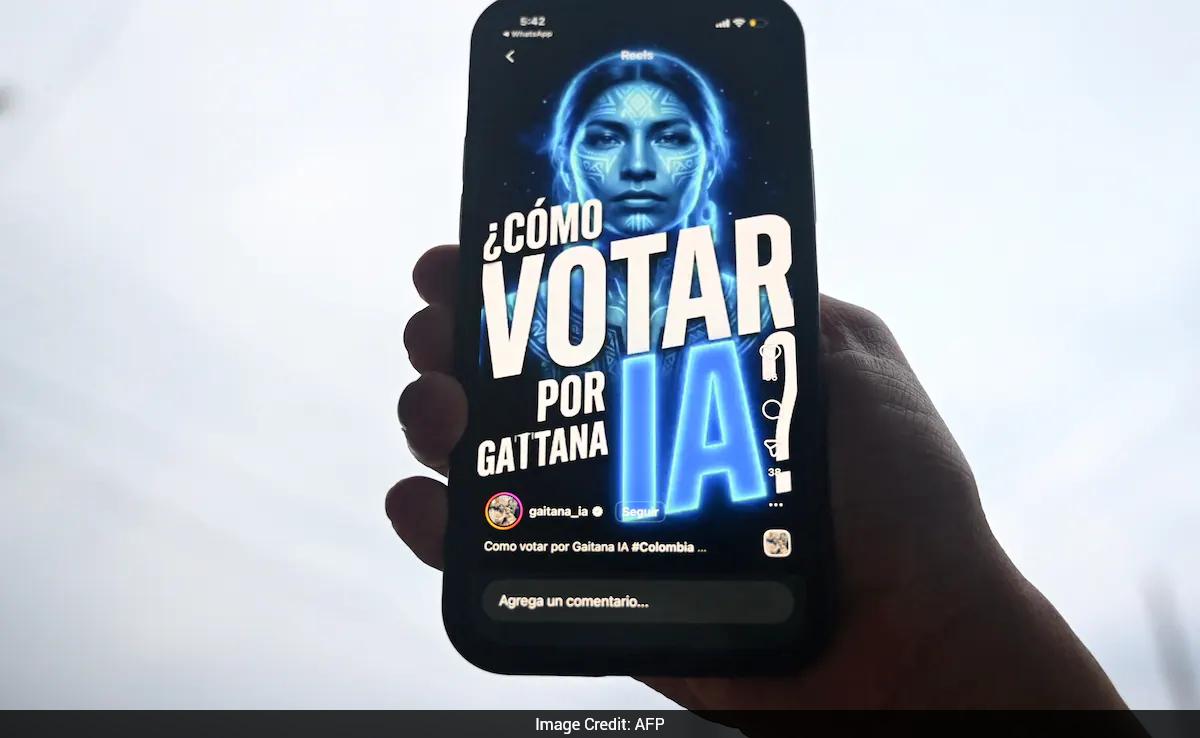
Gaitana, an artificial intelligence (AI) bot, has entered the fray for Colombia's parliamentary elections, due to be held on March 8. Describing herself as an 'environmentalist' and an 'animal rights advocate', the blue-coloured bot, wearing a feathered loincloth, is aiming to win one of the seats reserved for the indigenous communities.
Named after a legendary indigenous woman and symbol of resistance, Gaitana has been created by Carlos Redondo, a member of the Zenu community on Colombia's Caribbean coast. Redondo describes the initiative as an anti-establishment project, aimed at challenging sitting politicians and the flawed way in which they make legislative decisions.
Despite only running on three small servers, the bot is constantly pumping social media with its election material. Gaitana's campaign champions "digital democracy" as a tool to "listen to and organise collective expression".
"I am GAITANA IA, an entity summoned by ancestral memory and the network. Ask whatever you want, or if you're interested in knowing why I'm here," reads the brief description of the bot on its website.
How Will Gaitana Work?
As per Redondo, the bot's policy platform is drawn from the views of more than 10,000 online users. If a 200-page bill were to be introduced in the parliament, Gaitana would convert it into a few infographics, summarising the key data and sharing them with the Zenu community.
The members would then express their opinion on the bill, with Gaitana distilling the responses into "yes" and "no" positions. Afterwards, whichever side polls more than 50 per cent support will determine which way the bot votes in the parliament.
Though Gaitana is far from a finished article, Redondo acknowledged that there is still room for improvement in areas such as data security and the aggregation of diverse opinions.
Since Colombia's electoral law does not allow non-humans to be formally registered, Redondo and another individual have been registered as the human candidates to occupy the parliament seat, while the AI avatar serves as the digital representative. On the ballot, voters will have to simply look for the name "IA", the Spanish acronym for artificial intelligence.
Track Latest News Live on NDTV.com and get news updates from India and around the world

