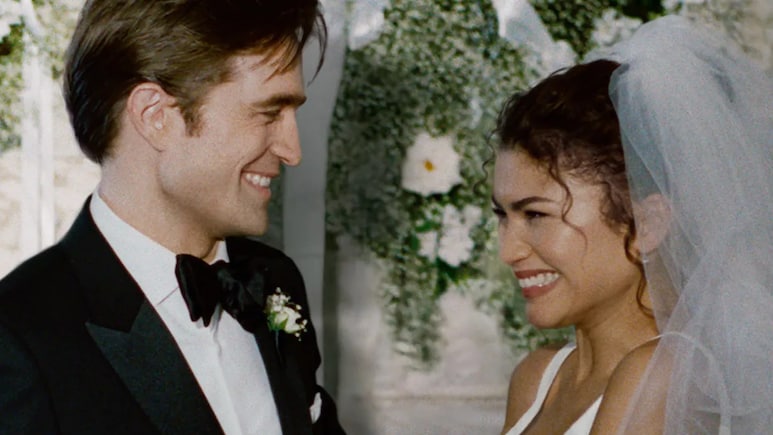
- The Drama is a darkly absurdist film by Norwegian director Kristoffer Borgli
- The story explores a conflicted couple navigating emotional turmoil before their wedding
- The film intertwines themes of love, violence, and social hypocrisy through contrasting character perspectives
Emotional and behavioural upheavals linked to acts contemplated, mishaps suffered, tragedies faced and choices made or evaded (most of them in the past) threaten to derail an impending wedding in The Drama, a darkly absurdist and discomfiting film written and directed by Norwegian filmmaker Kristoffer Borgli.
Starring Zendaya and Robert Pattinson as two deeply in love but massively conflicted individuals, The Drama is imbued with the Nordic spirit of moral inquiry of the kind that characterizes a Ruben Ostlund take on human foibles or a Thomas Vinterberg deep dive into ethical indiscretions that can send people and communities into a tailspin.
The Drama takes a genre that has seen varied and multifarious interpretations over the decades and imposes upon it a storytelling style that calls into question assumptions that movies make about love and marriage and the cock-ups that they often trigger for dramatic or comic effect.
Two recent films that come to mind as one The Drama unfolds are Ari Aster's Eddington (Aster is one of the producers of this film) and Halfdan Ullmann Tondel's Armand. But that is not to say that it is derivative in any way.
I have not seen Borgli's previous two narrative features (Sick of Myself and Dream Scenario, one premiered in Cannes, the other in Toronto) but having seen The Dream, I definitely will.
The Drama isn't just about a wedding. Nor is it only about America's rabid gun culture. The two unrelated themes are integral to the plot. They overlap with each other as Emma Hardwood (Zendaya), a bookstore clerk from Louisiana, and Charlie Thompson (Pattinson), a Londoner posted as the curatorial director of an American art museum, navigate the days leading up to their wedding.
The nitty-gritties of the preparations (complete with interjections by an unsmiling dance choreographer, a heroin-smoking DJ and an overly chirpy wedding photographer) generate an air of mild mirth as the ground is prepared for a serious turn at the point where the initial exposition of the principal characters (presented through two conflicting points of view) meets the business end of the film.
While Charlie shares his side of the story of the first awkward meeting and the blossoming of the romance with best friend Mike (Mamoudou Athie), Emma has a heart-to-heart with Mike's wife, Rachel (Alana Haim).
From a meet-cute at a coffee shop - the sequence begins with a close-up of a lady's ear that is going to return repeatedly to the conversations, reveals and confrontations that are to follow - to a bust-up at the wedding over a case of sexual harassment, The Drama lives up to the title without going overboard.
At a pre-wedding dinner with Rachel and Mike, Emma, a little drunk, is drawn into a seemingly harmless game that leads her to blurt out a secret that leaves her open to instant (and, as it turns out, constant) judgment not only by Rachel but also, more importantly, by the man she is about to marry.
Borgli's ambivalent approach to an act of violence that was contemplated but not eventually committed serves as a narrative tool to conduct an inquest into a desensitized culture that bears witness to alarmingly regular school shootings and then chooses to fixate on the individual perpetrators rather than examining and addressing the larger malaise.
Parts of The Drama may come across as a touch superficial because it is after all a film made by an outsider looking in on an unsettling phenomenon. The turmoil within and around Emma and Charlie - reflected as much in what the duo says to each other and to their friends and colleagues as in a couple of books that surface in the course of the film.
One is titled The Damage, a fictional tome that Charlie pretends to have read simply because he wants to talk to Emma, who is deaf in one ear and has an earphone in the other and is unable to hear what the man tries to say to her in order to draw her attention. The high-strung Charlie is left embarrassed and vulnerable and yet gets a chance to start over with the woman he wants to befriend.
The other book is aptly called Brainrot. It contains photographs of skimpily clad models posing with automatic weapons. It is left on Charlie's desk at the museum but neither he nor his secretary Misha (Hailey Benton Gates) knows by whom or why.
Unanswered questions and baffling conundrums are strewn across the film even as Emma and Charlie, after every dissonant moment, seek to make a fresh beginning and invariably come to the conclusion that it isn't working. But they are so much in love that Charlie never stops believing that he has a future with Emma even though he does not know her fully and perhaps never will.
A garrulous wedding photographer (Zoe Winters in a lively cameo) reminds the duo that they have to exude a sense of always being comfortable with each other. Remember, you know each other very well. That is where the irony lies - Charlie isn't sure he knows what Emma was, is and could be.
Love is a complicated thing, love is making sacrifices, Charlie says. He even cites Freud to the effect that feelings that we do not talk about get buried only to come out in uglier ways. Exactly how unsavoury matters can turn is what Borgli's screenplay explores, with the tone shifting all the time between very solemn and tangentially droll.
The Drama is somewhat reductionist in the manner it probes social hypocrisies and the vicissitudes of life buffeted by the incontrovertible truth that absolutely normal people are capable of straying into shockingly dark spaces of the mind, but with the two lead actors at their very best - this is Zendaya's career-best performance for sure - the film never ceases to be watchable.
It confronts what is uncomfortable and inescapable and grapples with it rather than seek to sugarcoat it.
-
Zendaya, Robert Pattinson, Alana Haim
