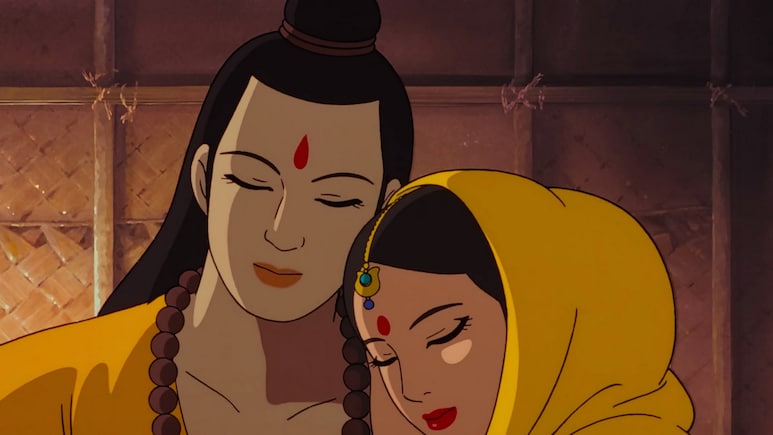
There was a time when watching the Ramayana did not require a Rs 4,000-crore cinematic universe, a sea of CGI or a teaser promising a visual spectacle unlike anything seen before. All it needed was a television screen, a familiar tune and a story that generations had grown up hearing.
And then, there was a Japanese-Indian animated film that decided to tell this very Indian story through the language of anime.
More than three decades later, Ramayana: The Legend of Prince Rama is an interesting watch, particularly for someone from Gen Z who has grown up in an era where mythology is increasingly being packaged as a grand cinematic event.
Having revisited the film, one thing becomes clear: while animation technology has come a long way, the emotional and artistic sincerity of this 1993 adaptation is not something that can simply be recreated with a bigger budget.
Originally completed in December 1992, Ramayana: The Legend Of Prince Rama was first screened at the International Film Festival of India (IFFI) in January 1993. However, it did not receive a proper theatrical release in India at the time.
After a limited theatrical outing in 1997 and finding a new generation of viewers through television broadcasts, particularly on Cartoon Network in the early 2000s, the film finally received a wide theatrical release in India on January 24, 2025, in a digitally remastered 4K version.
Directed by Yugo Sako, Ram Mohan and Koichi Sasaki, the film is an Indo-Japanese animated adaptation of the Ramayana. It features music by the celebrated Vanraj Bhatia and brings together the artistic sensibilities of two countries to interpret one of India's most enduring epics.
But does it still hold up? And does it offer anything beyond the nostalgia associated with watching it on television? Quite a bit, actually.
An Anime Adaptation That Understood The Assignment
The first thing that strikes you about Ramayana: The Legend Of Prince Rama is its visual language. Rather than attempting to recreate the epic through realistic-looking characters or excessive spectacle, the film embraces traditional hand-drawn animation and allows its illustrations to do much of the storytelling.
There is something genuinely beautiful about the way the filmmakers imagine Ayodhya, the forests, the palaces and Lanka.
The backgrounds are richly detailed, the landscapes have a distinct personality, and the use of colours lends the film an almost painterly quality. The transition between peaceful forest settings and the chaos of the battlefield is particularly effective.
What makes this even more impressive is the scale of the production. The film brought together approximately 450 Japanese and Indian artists and took years to complete. More than 100,000 hand-drawn animation cels went into its making.
At a time when international collaborations did not have the convenience of emails, video calls or digital file transfers, the teams worked across countries to bring the project together.
And you can see that labour on screen.
The animation is not necessarily flawless by contemporary standards. Certain character movements appear stiff, facial expressions can feel limited, and some action sequences lack the fluidity audiences are accustomed to today. However, the artwork has aged remarkably well. The hand-painted backgrounds, in particular, possess a warmth that makes the film visually distinctive even after all these years.
The 4K restoration certainly helps bring out the colours and finer details, but the underlying craftsmanship deserves the credit.
Ram, Sita And Ravana: Familiar Characters, Familiar Interpretations
The film follows the familiar journey of Prince Rama, who is exiled from Ayodhya for 14 years following palace intrigue involving Kaikeyi. Accompanied by Sita and Lakshman, he begins life in the forest, only for their peaceful existence to be disrupted when Ravana abducts Sita.
What follows is Rama's search for his wife, his alliance with Sugriva and the vanara sena, Hanuman's journey to Lanka, the construction of Ram Setu and the eventual battle against Ravana.
For anyone familiar with the epic, there are very few surprises here. However, the film's biggest achievement is how efficiently it translates an enormous story into an animated feature without making it feel like a collection of disconnected episodes.
Rama is presented as the ideal prince: composed, compassionate, courageous and unwavering in his sense of duty. There is very little attempt to explore his internal contradictions or the moral dilemmas that have made his character the subject of countless interpretations.
Sita, meanwhile, is portrayed with grace and dignity. Her devotion to Rama is central to the narrative, but her characterisation also reveals one of the film's limitations. Much of her journey revolves around being abducted, waiting for rescue and becoming the emotional motivation behind Rama's war.
Ravana, on the other hand, is an imposing antagonist. His ten-headed appearance, imposing palace and commanding presence make him an effective visual adversary. Yet, the film does not spend much time exploring the intellectual, scholarly or more complicated dimensions of his personality. He is largely positioned as the embodiment of arrogance and evil.
The characters are recognisable, and the film knows exactly how audiences are expected to perceive them. But that familiarity sometimes comes at the expense of complexity.
Hanuman Is An Absolute Scene-Stealer
If there is one character who consistently brings energy and personality to the film, it is Hanuman.
His introduction, his devotion to Rama, his journey to Lanka and his confrontation with Ravana's forces are among the most entertaining portions of the narrative. The film understands that Hanuman is not merely a supporting character but an integral part of the emotional and adventurous fabric of the Ramayana.
His leap across the ocean, his encounter with Sita and, especially, the sequence in which he carries the mountain of medicinal herbs to save Lakshman are beautifully imagined.
The latter remains one of the film's most memorable moments. It is an example of how animation can make extraordinary mythological imagery feel genuinely magical without relying on photorealistic effects.
There is also a certain lightness to Hanuman's character that provides relief amid the otherwise serious proceedings. His devotion never feels like an afterthought, and the film gives him enough room to leave a lasting impression.
The Music Deserves Its Own Appreciation
One cannot discuss this film without talking about Vanraj Bhatia's music.
The soundtrack adds considerable emotional weight to the narrative, particularly through its Sanskrit compositions. Rather than treating the music as background decoration, the film uses it to establish the spiritual and cultural atmosphere of the story.
The musical passages accompanying Rama's journey, the vanara sena and the eventual confrontation with Ravana lend the narrative a sense of grandeur without making everything sound unnecessarily bombastic.
The decision to retain the Sanskrit songs in the restored versions is particularly effective. They give the film a cultural specificity that might otherwise have been lost in translation.
For a generation accustomed to mythological films relying heavily on thunderous background scores and dramatic musical cues, there is something refreshing about the restraint here.
Has It Aged Well? More Than You Would Expect
This is perhaps the most interesting question about the film.
Animation has undergone a massive transformation since the early 1990s. Contemporary audiences are familiar with elaborate CGI, motion capture, sophisticated character design and enormous digital worlds. Against that backdrop, a traditionally animated film from 1993 could easily have felt dated.
Surprisingly, it doesn't.
The film's visual imagination remains its biggest asset. Its landscapes, architecture, character designs and use of colour have a distinct artistic identity. The 4K restoration makes these details easier to appreciate, but it is the original artwork that gives the film its enduring appeal.
More importantly, the film does not feel as though it is desperately trying to impress its audience. It is comfortable with its own storytelling style.
However, not everything has aged equally well. The pacing can feel uneven, particularly in the second half, where the narrative moves from one major event to another. Some emotional developments receive less attention than they deserve, while certain supporting characters are introduced without being given enough room to make an impression.
The dialogue and voice performances can also feel theatrical in places. That is not necessarily a deal-breaker, but viewers accustomed to more naturalistic performances might take some time to settle into the film.
Its storytelling is straightforward, sometimes to a fault. But the visual craftsmanship more than compensates for several of these shortcomings.
Where The Film Could Have Done Better
Admiring a film does not mean overlooking its limitations. And while Ramayana: The Legend Of Prince Rama is a sincere adaptation, there are aspects of its storytelling that deserve a closer look.
The most noticeable limitation is its treatment of Sita. Despite being one of the central figures of the epic, she is largely defined by her relationship with Rama and her position in the larger conflict. Her emotional experience is acknowledged, but her perspective rarely drives the narrative independently.
The film also depicts the humiliation of Surpanakha as an episode that moves the story towards the larger conflict, without spending much time examining the violence and gender dynamics involved. From a contemporary perspective, this sequence can feel uncomfortable, especially when the consequences of the incident become more important to the screenplay than the woman at its centre.
There is also the question of how the film presents morality. Rama is almost entirely idealised, while Ravana is largely reduced to the antagonist. The distinction between good and evil is deliberately clear-cut, leaving little room for the moral ambiguities that make the Ramayana such a fascinating text to revisit.
Interestingly, the film's version of the epic also leaves out several episodes associated with the later portions of the Ramayana, including Rama questioning Sita's fidelity, her subsequent exile and the story of Lava and Kusha.
This is a significant creative choice. It gives the film a more devotional and celebratory conclusion, but it also means that viewers looking for a more comprehensive exploration of the epic's difficult questions will not find it here.
The film is closer in spirit to the devotional tradition of Tulsidas' Ramcharitmanas than to a complete rendering of Valmiki's Ramayana. Its focus is on Rama's journey, the battle against Ravana and the triumphant return to Ayodhya.
These omissions do not necessarily make the film unsuccessful. An animated feature cannot accommodate every episode of an epic as vast as the Ramayana. However, it is worth recognising that the version presented here is a selective interpretation, not the entire story.
The Final Verdict
Ramayana: The Legend Of Prince Rama is not a flawless film, nor is it an adaptation that attempts to reinvent the epic for a contemporary audience. It is a largely traditional, devotional retelling that prioritises visual storytelling, cultural authenticity and the emotional familiarity of a story passed down through generations.
And perhaps that is precisely why it works.
For Gen Z viewers, the film offers an interesting alternative to the increasingly spectacle-driven approach to mythological cinema. It reminds us that scale is not always about the number of visual effects, the size of a production budget or how many screens a film opens on. Sometimes, it is about the thought that goes into creating a single frame.
There are storytelling choices one can question, characters one wishes had received more depth and moments where the pacing could have been tighter. But the film's artistic sincerity is difficult to dismiss.
More than 30 years after its completion, Ramayana: The Legend Of Prince Rama still has the ability to hold your attention. It may not have the technical polish of contemporary animation, but it possesses something that is considerably harder to manufacture: a distinctive visual identity and a genuine affection for the story it is telling.
