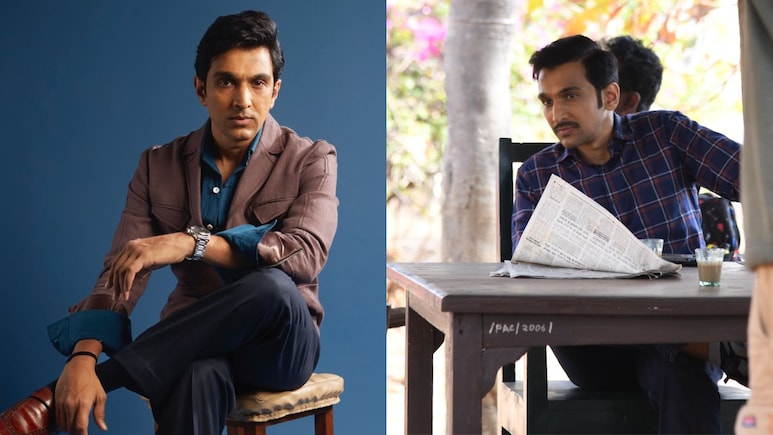
Pratik Gandhi is all set to enthral audiences with his upcoming film Ghamasaan, in which he plays the role of an IPS officer named Aditya. The film follows a cat-and-mouse chase between Aditya and a feared dacoit, Maharaj, played by Arshad Warsi.
In an interview with NDTV, Pratik spoke about what made him say yes to the film, the challenges of playing a police officer, his preparation process, and more.
Speaking about his decision to take on Ghamasaan, he told NDTV, "If Tigmanshu Dhulia offers you a heartland story, how do you say no to that? It was enough for me to get into it. Of course, the story is very well written. It's a page-turner when I read it. And I knew how Tigmanshu Sir looks at these kinds of worlds when it comes to dacoits, police, and all. So, it was more than enough for me to say yes to."
Pratik also shared his initial reaction to the role and the aspects he found most challenging. He revealed that Tigmanshu Dhulia had offered him the film while they were working together on The Great Indian Murder.
"So, I guess when he offered me this film, we were already shooting for The Great Indian Murder, the web series that we shot together, Tigmanshu Sir and I. During the last phase of the shoot, he offered this film and said, 'Let's shoot this film next.'"
"When I got to know the character, I learned that he was a police officer, the STF chief, who was sent on a mission to control dacoits during election time. So that's the brief. What excited me the most is that, though it is a police officer, which we have seen an ample number of times, right? But when it comes to Tigmanshu Dhulia's world of police officers, it is absolutely different. It is more real. The way he shapes courage, it is not in the muscles. It is not in the physical aspect of the character. It is more internal, and it is more in his thoughts and actions. So I guess that was the most challenging thing, to break that stereotype of how we see a certain type of police officer chasing dacoits."
Elaborating on how Aditya differs from the conventional on-screen cop, Pratik said the character is driven by internal conflicts rather than outward heroics.
"So I think I see a lot of human aspects in this character. There are a lot of conflicts he is dealing with, as well as internal dilemmas. He ends up fighting a dacoit who is against the system."
"But then, on his journey, he understands that he's fighting the same system that he's a part of. Because that system has created the dacoit. The system is using him. So, being in the system, how to fight and navigate his way out of it is something very interesting that has been written for this character."
"Apart from this, we've seen quintessential cops in most films. They get into any kind of action; they can chase anybody, and they can fight a bigger system without any fear. But here, his demeanour is different. He's fighting more of a mind game than a physical game. And then he gets into the action towards the end. So, in that way, it is very unique, especially for me, because I had never played a character like this before."
Speaking about his preparation for the role, Pratik said reading the script thoroughly was his biggest tool, particularly because the story draws inspiration from real incidents.
"So, for this particular role, my biggest preparation was reading the script because it is based on some real incidents. Though all the characters are not real-life characters as such, they are an amalgamation of a couple of people put together. The biggest preparation was reading."
"And when it comes to working with Tigmanshu Dhulia, who is an actor himself, there is a certain kind of preparation required to deliver the lines and dialogues because he wants you to prepare everything, and at the same time, he also wants you to add to it. He wants you to improvise without taking anything away from the script. So that's an interesting challenge for an actor. It's a very theatre-like process."
Asked about his favourite cop drama, Pratik recalled one film that left a lasting impression on him.
"I guess Gangaajal was something that I really enjoyed. It was very gritty, very fierce. That world, the conflict, and the way it was performed as well. So I guess Gangaajal is the first thing that comes to my mind."
Pratik also opened up about his experience of working with Arshad Warsi and revealed that, despite being the film's central adversaries, the two actors do not share a single scene in Ghamasaan.
"I guess we bonded only off-screen because on-screen we never worked together. In the whole film, we've never worked together."
Revealing why, he explained, "Because nobody has ever seen Maharaj, and that's the reason he's survived all these years."
Sharing more about their off-screen camaraderie, he added, "Oh, he is too funny; he is too witty. His sense of humour is always on point. He has some witty lines to deliver in any situation. A fun guy to be with."
Recalling one of the most emotionally challenging sequences in the film, Pratik spoke about a scene involving a young child in a village affected by the presence of dacoits.
"I think there is this one scene in the village with a small kid, where these dacoits used to come and stay for a few days randomly. The whole thing was that when the dacoits came to the village, all the men would leave. The dacoits would stay in those houses with their families and wives. Some of those women would have children fathered by the dacoits, and the village would never accept those children."
"When the men of the house would return after the dacoits had gone, those children were treated very badly. So I guess that entire sequence with that kid was heartwarming. In fact, I used that as a turning point for Aditya to take it personally. That now it is not just a mission. I will take it personally and see to it that Maharaj is finished forever."
Pratik concluded by revealing how his background in theatre helps him switch in and out of characters with ease once filming wraps.
"I guess I would give credit to my theatre days because switching on and switching off comes very naturally to theatre practitioners. Most of the time, it happens that we have multiple shows in the same day, sometimes of different plays as well."
"I have worked for the longest time while balancing a full-time job and theatre together. So after spending a full day at work, making presentations and presenting to top management, you would suddenly go and perform on stage in the evening."
"So that switch-on, switch-off process becomes your second nature. Without putting in extra effort, you start doing it naturally. The more you practise it, the easier it becomes."
Ghamasaan releases on ZEE5 tomorrow.
