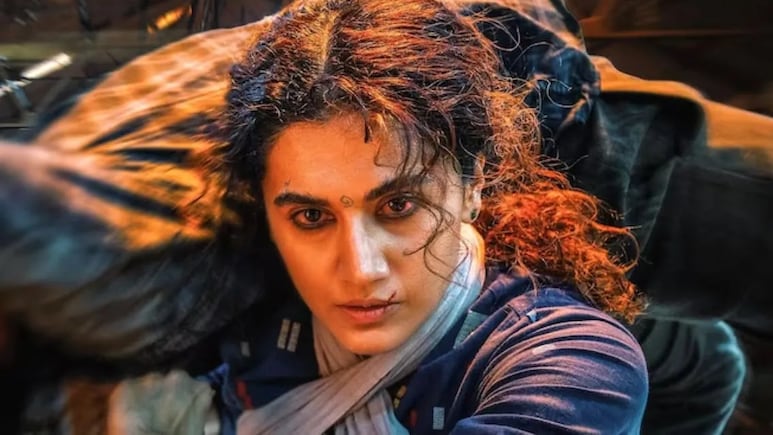
It's surprising how every time a story about child trafficking hits the screens, it instantly boils your blood to see the blatant atrocity that this illegal business entails. Netflix's newest action-thriller, Gandhari, led by Taapsee Pannu, with Ishwak Singh, Swastika Mukherjee, Chhaya Kadam, Mita Vashisht and Jatin Sarna in key roles, is one such blood-boiling watch.
But it blows hot and cold.
Directed by Devashish Makhija and written and produced by Kanika Dhillon, Gandhari tells the story of a mother in deep remorse after her daughter gets abducted during a train ride. Into the throes of the fictional and mysterious town of Joypurra, where everyone is incognito and masked, Bani (Taapsee Pannu) goes to extreme lengths with fearless fervour to rescue her child Mishty. What she combats along the way is a series of secrets, betrayals and violence.
The title Gandhari is a reference to one of the oldest mythological tales. Gandhari was a princess of Gandhara, the queen of Hastinapura and the mother of the one hundred Kauravas in the Mahabharata. As we turn back the pages of this epic, we learn how Gandhari chose a life of darkness by voluntarily blindfolding herself after she discovered that her betrothed, Dhritarashtra, was born blind.
However, in Taapsee Pannu's Gandhari, nothing is voluntary. When her child Mishty is kidnapped from the train, she runs after her, bashing into piles of sacks and hitting herself. But the final blow comes when an iron rod hits her eyes, leaving her temporarily blind in both eyes due to internal haemorrhaging. Yet her physical disability becomes her biggest strength in finding her daughter in the dangerous lanes of Joypurra.
Hence, Taapsee Pannu is the modern-day Gandhari, who trains her remaining senses, making them so strong that they become lethal weapons in her decision to hunt down the child-trafficking network rampant in Joypurra, a town culturally rooted in the presence of disguise artists-behrupias.
This is not the first time we see Taapsee Pannu spearheading a film on her own. Her combat skills seem to have improved further as she lands every punch in the high-stakes action sequences. A wronged woman mixed with a mother's fury, Taapsee Pannu is convincing as a mother who is bereaved after losing her child and never knowing when-or if-she will find her. But the search continues. In fact, the actor certainly has a penchant for action, and those are the sequences in the film that are the most delightful to watch, especially when compared with the more emotional arcs.
It is during this journey that her path crosses with those of several 'behrupias' residing in Joypurra, blessed by Maa Chaumukhi. At every step of the way, from her neighbour Uma Didi (Chhaya Kadam) to her motherly figure Jhunu Amba (Mita Vashisht), and the strange Churni Didi (Swastika Mukherjee), who runs a shelter of sorts where information about every 'runaway, missing and kidnapped' child reaches her, Bani encounters people who appear willing to help.
Everyone seems to be kind and helpful-until they are not, as the story progresses and each of them is unmasked.
The point to be noted is that one might come to Gandhari for Taapsee Pannu but stay for the stellar performances by Chhaya Kadam and Mita Vashisht. In their calm, composed and yet menacing roles, the supporting cast holds your attention.
Ishwak Singh plays the role of Gokul, Bani's grieving husband, who, in his own way, sets off on a journey to unearth the truth about their missing daughter. This leads to information about the 'Blackhole' gang, the forerunners of Joypurra's growing child-trafficking market.
There is a particular line in the film in which the heinous criminal says that the deal always states, "A girl for a girl."
This is also when Bani's past comes back to haunt her, bringing her connection to Jhunu Amba and Gokul full circle. Even more so when they turn out to be villains in certain respects. Bani is shattered, and that adds to the premise of Gandhari and the backdrop of Joypurra, where the story is set. Here, everyone is a behrupia.
The few truths in the plot, which unfold through Ishwak Singh's and Mita Vashisht's characters, indeed come as a hard-hitting betrayal. Credit goes to the actors for making it convincing.
Gandhari low-key gives off a very Mardaani vibe. Mardaani (2014) and Mardaani 3 (2026) both focus on child trafficking. The films tell the story of an unabashed female police officer-Senior Inspector Shivani Shivaji Roy (Rani Mukerji)-who goes against all odds and rules to do her duty as an officer.
In Gandhari, Taapsee Pannu fulfils her duty as a mother. The path to doing justice in both plots? The same. Fearless as a 'Mardaani'.
Taapsee Pannu and writer-producer Kanika Dhillon's association goes way back. The writer initially collaborated with Taapsee on films such as Manmarziyaan, Haseen Dillruba and Rashmi Rocket, before producing films through her production house, Kathha Pictures, such as Phir Aayi Hasseen Dillruba (2024). It goes without saying that these films have all been critically acclaimed, and hence it can be said that Taapsee Pannu is a lucky mascot of sorts for her.
With Gandhari, Taapsee Pannu strengthens her niche as a solo-lead star in content-heavy films. That she is strong competition when it comes to action is on full display in Gandhari. The only thing different this time is how the grief of a mother can elevate every act of betrayal, allowing her to ultimately rise from the ashes and conquer all the behrupias.
Gandhari makes for a decent one-time watch. At times, it seems convoluted, with sudden flashes of traditional impressionist behrupia performances, even as the director links them to the storytelling and the film's underlying message. At other points, it might feel like just another tragic tale of child trafficking, with the same premise-small-town, lower-middle-class families and their helpless cries. Needless to say, it reflects a truth about society that continues to prevail, and Gandhari makes for an arresting showcase for the most part of it.
-
Taapsee Pannu, Swastika Mukherjee, Ishwak Singh, Mita Vashisht, Chhaya Kadam, Jatin Sarna
