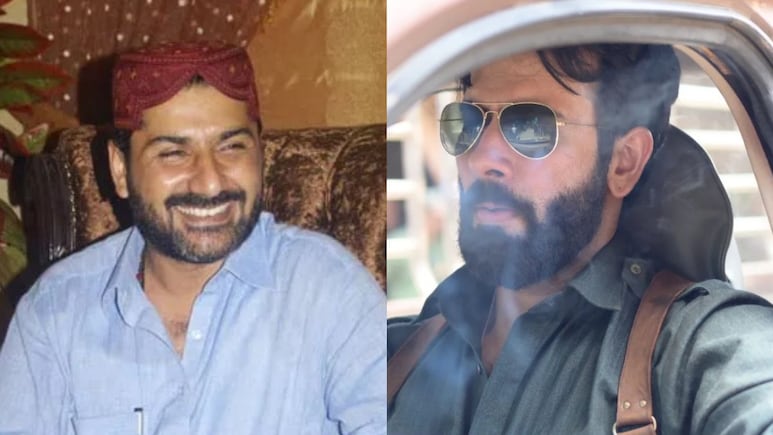
In Dhurandhar, death does not always mean closure. Just when the film seems to have wrapped up its blood-soaked power struggle, one grieving man arrives too late and unknowingly embraces the person responsible for his loss. That moment, quiet yet devastating, is also a narrative bridge between cinema and a far darker real-world story.
Ranveer Singh-starrer Dhurandhar closes on a decisive note with the killing of crime lord Rehman Dakait, played by Akshaye Khanna.
His end comes at the hands of Ranveer's undercover operative Hamza, who executes the final blow in collusion with Sanjay Dutt's formidable Chaudhry Aslam Khan. But while Rehman's chapter ends, another one is only just beginning.
The Brother Who Arrives Too Late
In the film's final moments, Rehman's younger brother Uzair, portrayed by Danish Pandor, rushes to the hospital. Overwhelmed and shattered, he breaks down in Hamza's arms, unaware that the man comforting him is also the one who killed his brother. The scene is deliberately restrained, but its implication is loud: Uzair's story is far from over.
That promise is not symbolic. Dhurandhar 2, slated for release in March, will bring Uzair back to the forefront, mirroring a real-life trajectory that was far more violent, complex and disturbing than what the first film could contain.
Uzair Baloch, The Man Behind The Character
In reality, Uzair Baloch was one of Karachi's most feared gangsters. Following Rehman Dakait's death, Uzair took control of his brother's criminal empire and rapidly consolidated power in Lyari.
His name would soon be associated with some of the most brutal episodes in the area's violent history.
Uzair is believed to have been responsible for the killing of gangster Arshad Pappu, whose mutilated body was later found in Lyari.
Local accounts claim that after the murder, Uzair and his associates openly displayed the body, tossing it around in the streets. Some eyewitnesses even alleged that his severed head was used as a football, an act that became symbolic of the unchecked brutality that ruled Lyari at the time.
A Kidnapping That Changed Everything
Uzair's descent into the criminal world was shaped by personal loss. In 2003, his father, Faiz Muhammad, was kidnapped for ransom by Arshad Pappu. The kidnapping ended in murder, leaving the family devastated.
After this incident, Uzair's cousin Rehman Dakait invited him to join his gang. At the time, Rehman had established dominance over Lyari's gang networks and was already in conflict with Arshad Pappu, who was attempting to assert his own control in the region.
Despite this shared enemy, reports suggest that Uzair was initially reluctant to enter organised crime.
According to a report by Dawn, Uzair was eventually persuaded to join the gang because of their common rivalry with Arshad. Revenge, rather than ambition, appears to have been the turning point.
Drawn Into A War He Didn't Choose
Around the same period, Uzair was arrested by Chaudhry Aslam Khan, a character portrayed by Sanjay Dutt in Dhurandhar. The arrest, however, did not mark the end of his criminal journey.
Owing to Rehman Dakait's political connections, Uzair was eventually released, though not before spending nearly two years in Karachi Central Prison.
The film mirrors this uneasy relationship between crime and power. Much like their cinematic counterparts, both Rehman and Uzair were known to have links with leaders from the Pakistan Peoples Party (PPP), connections that would prove crucial in the years to come.
The Political Arm Of The Underworld
Rehman Dakait was killed in a police encounter in 2009. While questions were raised about the circumstances of his death, one thing became clear almost immediately: Uzair Baloch was now in charge.
By this point, Uzair had already emerged as the de facto leader of the gang. He also took control of Rehman's political outfit, the People's Aman Committee (PAC), which wielded significant influence in Lyari's local elections.
Following Rehman's death, PPP leaders reportedly continued to shield Uzair until 2012, allowing him to operate with relative impunity.
In 2011, the Pakistani government dissolved the People's Aman Committee under the Anti-Terrorism Act. The move prevented Uzair from contesting elections under the party's banner, but it did little to weaken his hold over Lyari.
Despite the ban, Uzair's presence remained visible. Posters bearing his image continued to dot the area, reinforcing his dominance on the ground even as his political platform officially ceased to exist.
The Political Rivalry That Turned Lyari Into A Battlefield
The rivalry between Uzair Baloch and politician Nabil Gabol forms another crucial layer of both the real story and Dhurandhar. Rakesh Bedi's character Jameel Jamali is loosely based on Gabol.
A 2012 Vice News documentary, Guide to Karachi, suggests that Nabil Gabol and Chaudhry Aslam had aligned with the objective of eliminating Uzair. By this time, the PPP and PAC were openly at war, leading to the launch of the 'Lyari grand operation' in 2012, spearheaded by Chaudhry Aslam.
The 'Robin Hood' Image And The Reality
The documentary also highlights that Gabol had not visited Lyari for four years. Locals reportedly questioned his absence while describing Uzair as a "Robin Hood" figure who had provided local support in an area plagued by poor infrastructure and chronic shortages of basic amenities.
When Gabol finally returned to Lyari, he reportedly did so armed, describing the region as a "Chicago-like mafia". Uzair, in response, claimed he was being targeted because of the goodwill he had built among residents.
Wealth In A Neighbourhood Starved Of Basics
Lyari has long been associated with gang wars, poverty and neglect. Clean water and stable wages were persistent struggles for its residents. Against this backdrop, Uzair's wealth stood out starkly.
Funded by extortion rackets and drug operations, Uzair built himself a four-storey mansion in Lyari, complete with a swimming pool.
Revenge That Shook Lyari's Streets
Years after Rehman Dakait's death, Uzair finally exacted revenge. In 2013, Arshad Pappu was captured and killed. Reports suggest that parts of his body were mutilated and burned publicly on the streets of Lyari. Eyewitness accounts once again pointed to grotesque displays of violence meant to instil fear.
In Dhurandhar, Arshad Pappu appears briefly during a sequence where Jameel Jamali plots Rehman Dakait's death with Chaudhry Aslam. Shown as a co-conspirator, his presence hints at a larger role in the sequel, much like his real-life significance grew after Rehman's demise.
Arrest, Conviction And Prison
By 2014, Uzair Baloch was facing more than 50 cases of extortion and was linked to the killings of gang members and police officers. Warrants were issued against him, but he managed to flee Pakistan before he could be arrested.
In 2015, Uzair was apprehended by Interpol at Dubai International Airport and extradited to Pakistan. Five years later, in 2020, he was sentenced to 12 years in prison and sent to Karachi Central Jail.
Just days ago, Uzair was acquitted in a 2012 arms case due to a lack of evidence. Despite this, he remains behind bars.
But... Uzair Baloch's Story Isn't Over Yet
In Dhurandhar, Rehman Dakait's death is presented as the end of a reign. In reality, it was merely a transfer of power. With Dhurandhar 2 set for an Eid 2026 release, the film's narrative is poised to explore the rise of Uzair - a character shaped by loss, politics and extreme violence.
If the first film was about infiltration and sacrifice, the sequel promises to examine what happens when grief hardens into dominance, both on screen and in history.
Also Read: The Real Rehman Dakait, Akshaye Khanna's Dhurandhar Character, Killed His Mother At 15
