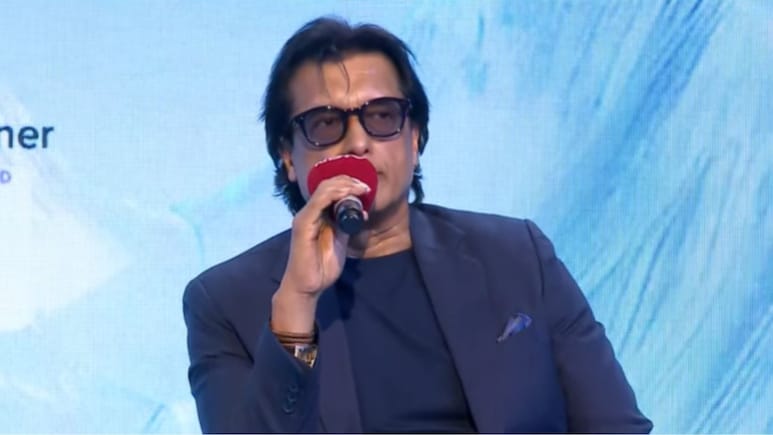
Nepal's iconic actor Rajesh Hamal, revered as the country's Mahanayak, spoke about his nearly four-decade journey in cinema, the cultural bonds between India and Nepal, the aspirations of Nepal's youth, and the role of films in shaping society during a conversation at the NDTV World Anviksha Summit in Kathmandu.
In a wide-ranging discussion moderated by NDTV's Aditya Raj Kaul and Meenakshi Kandwal, Hamal spoke about his rise in Nepali cinema, his enduring popularity, the influence of Indian films on Nepal's entertainment industry, and the country's changing political landscape driven by younger generations.
Opening the conversation, Aditya Raj Kaul remarked that while many people in Nepal regard Hamal as a Mahanayak, others have described him as the "Amitabh Bachchan of Nepal." Kaul added that Hamal's personality and appearance also reminded him of former cricketer Imran Khan, prompting a light-hearted response from the veteran actor.
"If you are confused by so many personalities while comparing me, I probably don't compare to anyone. But thank you so much. I hope you are all having a wonderful time here in Nepal."
Hamal also used the opportunity to acknowledge Nepal's challenges and express solidarity with those affected by the recent flash floods.
"We are meeting at a turbulent period in Nepal. Our thoughts are with all those who are suffering and have suffered. As a nation, we need to be united, build our resilience, and strengthen our endurance to recover. We also need the support of kind neighbours like India during times of despair."
Shedding light on his career, he recalled entering the film industry at a time when Nepali cinema barely existed as a structured industry. "I have been in Nepali cinema for almost 40 years now, but I am only 25 years old, so you do the maths."
Meenakshi Kandwal then took the audience back to the 1990s, recalling how young boys across Nepal aspired to imitate Hamal's hairstyle, sunglasses, and screen presence. She asked when he first realised that he had become a trendsetter. Hamal responded with humour, "It pays to be an actor."
Speaking about his famous long hair, he said, "My hair has been long for as long as I can remember, since I was three, four or five years old. It was always a bone of contention with my father."
The discussion then turned to the relationship between the Indian and Nepali film industries. Responding to a question about the possibilities for greater cinematic collaboration between the two countries, Hamal highlighted the deep cultural connections binding India and Nepal.
"The strongest link between India and Nepal is not politics. It is culture, language, religion, family ties and friendships on both sides of the border."
He described Indian cinema as a powerful cultural force and acknowledged its influence on Nepali filmmaking. "Our people were introduced to films through Hindi cinema. The culture of watching films and the early understanding of filmmaking came largely from Hindi movies. That is undeniable."
Can Cinema Narrate The Story Of Nepal's Gen Z?
Turning to Nepal's rapidly evolving political landscape, Aditya Raj Kaul referred to the emergence of independent political figures such as Kathmandu Mayor Balen Shah, the frustrations that fuelled youth-led protests, and growing public anger over corruption and governance. He asked whether cinema could do more than entertain and help tell the story of Nepal's younger generation and the aspirations driving societal change.
Hamal argued that cinema has always been a reflection of society.
"Cinema can deliver so many things. Cinema is like books. You can write on various subjects. You have books on history, books on politics, books that simply entertain you, novels and non-fiction. Cinema is like that in a way. We make films on various issues and various subjects."
He said films can both mirror and influence social change.
"Cinema, in many ways, can be a turning point in how society moves, how people think, and the direction in which their thoughts evolve. It is a give-and-take relationship between cinema and the public. We try to emulate or imitate what is happening in society, and society watches our films and takes certain nuances from them into real life. We have this continuous cycle between cinema and the cinema-going audience."
Speaking about Nepal's changing political mood, Hamal said he was not surprised by the youth-led push for change.
"I think we all agree that change was due."
He recalled warning a prominent political leader years earlier that a widening generational gap was emerging.
"I told him that while there has always been a generation gap, the gap between his generation and the generation coming up was enormous. If political leaders were not able to address the frustrations, concerns, and aspirations of young people, they would be off track."
Hamal said he had predicted that any future movement would not be driven by ideology or traditional political leadership.
"If there was going to be another revolt or uprising in this country, it would not happen under the banner of an ideology or behind prominent leaders. People would come out voluntarily because of frustration and demand for core issues such as an end to corruption, job opportunities, better education, and better healthcare. That is exactly what happened."
Later, Meenakshi Kandwal raised the issue of political expression among artists, noting that actors and musicians often face intense scrutiny and online trolling for expressing political views. She asked how easy it is for public figures in Nepal to speak openly about politics.
Hamal emphasised the importance of independent thought and self-expression. "I am a true believer in critical thinking. I can admire a person and still be critical of that person."
He continued, "Parents can be critical of their children and children can be critical of their parents, yet the bond and the love remain."
For Hamal, political allegiance should never come at the expense of intellectual honesty.
"Just because I support a political party does not mean I should only speak about its good side. If a party I disagree with does something good, I should praise it. Likewise, if the party I support loses its way, I will be vocal about it."
He added, "I do not invest my ego or emotions in any political party. Support whoever you want, but never stop your critical thinking."
Chandigarh, Delhi, And Memories Of India
Towards the end of the session, Hamal spoke about his personal connection with India, recalling his years as a student in Chandigarh and later his time in Delhi, where his father served as a diplomat.
"I went to Chandigarh in my late teens and spent seven to eight years there. Those years gave me many memorable experiences as a young person."
After completing his studies, he joined his family in Delhi. "My father was posted in Delhi, and that posting eventually stretched to seven or eight years. I have very fond memories of my time in India."
Speaking fondly of Indian cuisine, he added, "Rajma chawal, aloo paratha, lassi and chole bhature are among my favourites. I also love tandoori dishes."
"Rajma chawal was my favourite meal in Chandigarh," added Rajesh.
Also Read: 'Heartbreaking Situation': Manisha Koirala To NDTV On Nepal Flash Floods
