Blog | 'No Calls, People Scanning Banks For Bodies': Nepal Journalist Describes Flood Aftermath
As of Thursday evening, it was still impossible to get through to mobile phones in Dhunche, the district headquarters, or the flood-ravaged towns of Syabru Bensi or Timure.
Just four days back, on Saturday, I had returned to Kathmandu from a trekking pilgrimage to Lake Gosainkunda (4,400 m) located some 120 km north of Kathmandu (1,300 m). Crossing innumerable bends along the mountain highway, surrounded by lush green vegetation and sparkling white waterfalls, I had started my uphill trek from a hillside Tamang village of Thulo Syabru.
Just below Thulo Syabru (2,500 m) lay the bustling riverside town of Syabru Bensi, gateway to the Nepal-China border some 30 km away, and the site of the Langtang hydroelectric plant.
Four days later, I was shell-shocked. It was painful to see horrific images of the collateral damage in Syabru Bensi, Langtang, and scores of other human settlements, right from Gyirong dry port on the Tibet border to Syabru Bensi and Betrabati in Rasuwa - plus Nuwakot, Dhading, Gorkha, and Chitwan districts downstream.
Located just a couple of hours' drive away from Kathmandu or Chitwan, Rasuwa is famous for its scenic Himalayan peaks, such as Langtang Lirung, with Ganesh Himal piercing the sky right across the valley to the west. The ice and snow melting from these peaks trickle down into valleys below, forming serene snow-fed rivers that gradually swell and get bigger as they flow further downstream.
Among others, the area is inhabited by the indigenous Tamang, Ghale Sherpa people, who are famous for their hardy physical attributes and exceptional mountaineering skills. A key highway linking Kathmandu and several other towns of southern Nepal with Tibet passes through Syabru Bensi and reaches Rasuwagadi right across Gyirong county, in Tibet, China. Over the last few years, Rasuwagadi emerged as a popular route not just for Nepal-China cross-border trade and commerce but also for the Kailash Mansarovar pilgrimage. Most of the indigenous people in Rasuwa resemble Tibetan folks and follow Tibetan-Buddhism, taking pride in their rich culture and tradition.
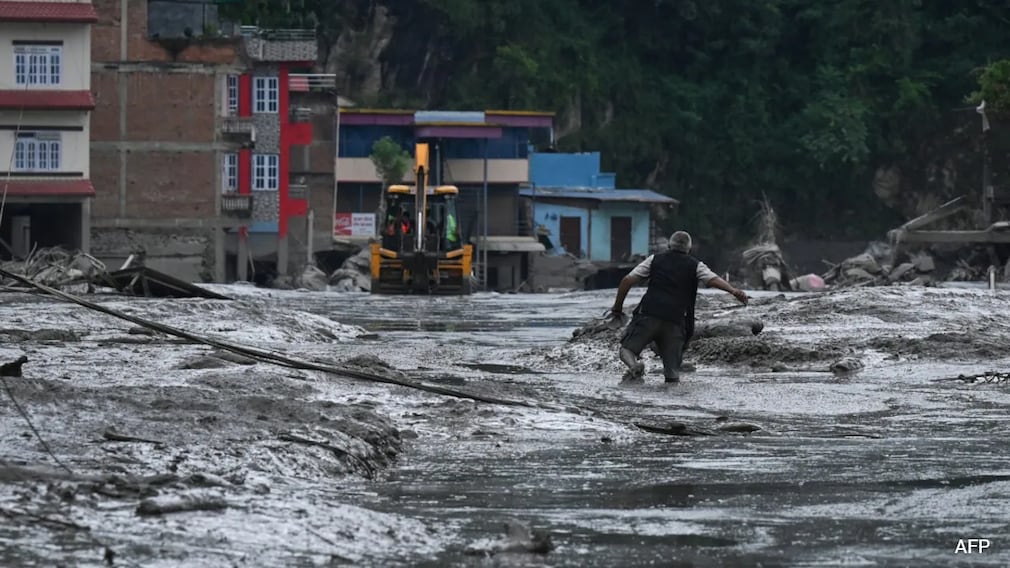
The disastrous flash flood that rapidly gushed down into the area, destroying everything in its wake, has left the banks of one of Nepal's biggest river systems, the Sapta Gandaki, flowing down the very heart of Nepal, in ruins.
Soon after Wednesday's catastrophic flash flood, and right up to this moment on Thursday evening, it has been impossible to get through to officials posted in Rasuwa, or hoteliers and locals elsewhere in Rasuwa. The mobile telecommunication networks haven't been restored as yet, let alone power supplies and highways that remain destroyed as a result of tsunami-like flash flooding. The death toll has climbed to 359 in Nepal itself - at the time of writing this - with nearly 1,300 still missing.
Shakti Maya Tamang, a journalist in Nuwakot, described the August 26 flooding as a "never-seen-before" disaster. Others call it the second-biggest natural disaster after the April-May 2015 earthquakes that claimed the lives of 9,000 people across central Nepal.
Initially, several Nepali experts guessed that a glacial lake outburst flood (GLOF) might have triggered the apocalyptic flash flood that has left a trail of destruction across central Nepal, right from the Himalayas to the river valley and plains. A similar flash flood had hit the border town a year ago, too. That claimed the lives of 18 people, besides causing other damage.
Although Chinese scientists haven't yet publicised their version of the trigger factor, Nepali experts are now almost certain that a glacial collapse on the western slope of Mount Langtang Lirung might have caused the flash flood and subsequent cascading hazards. The Nepali government on Thursday decided to expedite scientific studies of all glacial lakes at risk of flooding.
Arun Bhakta Shrestha is one such expert. In a LinkedIn post, the senior specialist on climate, cryosphere, and risk management at Kathmandu-based International Centre for Integrated Mountain Development (ICIMOD) asked if the two devastating floods in the same region in 14 months were a "coincidence or pattern". Initially, a small earthquake in the region was blamed for the disaster. Later, that was ruled out. But Shrestha concludes that the flash flood was triggered by a glacial collapse on the North Face of Mount Langtang Lirung. Experts recall a similar disaster, possibly a similar glacial collapse on the mountain's South Face, which obliterated an entire village in Langtang, Rasuwa, during the devastating earthquake on April 25, 2015.
This time around, Shrestha writes, "A rock and ice avalanche detached from a glacier north of Langtang Lirung and dammed the Lhende Khola, a tributary of the Bhote Koshi River on the Nepal-China border. The impounded water subsequently broke through, releasing a sudden, high-energy flood that has devastated Timure, Syabrubesi, and downstream settlements along the Trishuli, damaging homes, bridges, roads, and hydropower infrastructure."
As the area also saw a similar but slightly smaller disaster 14 months ago, he notes that "a second major event on the Lhende (basin) in 14 months is not a coincidental repeat, it points to an unstable catchment that needs sustained monitoring, not one-off assessment after each disaster".
Meanwhile, experts are concerned that since the debris dam has not emptied out completely, there could be more flash floods down the road. Shrestha says, "Efforts are underway to obtain satellite imagery to assess the remaining blockage. Until that is confirmed, downstream communities and infrastructure remain at risk."
Since glacial collapse-led floods have become a new normal across the Himalayas, experts are stressing the need to take better care of river banks, especially while planning towns and infrastructure. Shrestha writes: "Events like this are a stark illustration of why climate and glacial hazard risk needs to be built into infrastructure planning as a live, evolving variable rather than a historical baseline. Cascading hazards originating far upstream, often across an international border, can strike with very little lead time."
Meanwhile, my heart breaks to see the next of kin of people killed or missing in the catastrophic flood, walking downstream, closely scanning the Bhote Koshi (called Trishuli downstream) river banks looking for their loved ones - dead or alive.
As of Thursday evening, it was still impossible to get through to mobile phones in Dhunche, the district headquarters, or the flood-ravaged towns of Syabru Bensi or Timure, near the border, where over 400 international tourists are still unaccounted for.
(Surendra Phuyal is a multilingual independent journalist based in Kathmandu, Nepal. The former BBC journalist started his career at The Kathmandu Post in 1998.)
Disclaimer: These are the personal opinions of the author
-
Opinion | Great 'Exceptions': How The Oil India Was Attacked For Is The Oil Trump Now Seeks

A law written to punish the buyers of Russian oil was suspended by the US to protect a purchase of Russian oil. India spent fourteen months being lectured for less.
-
Opinion | Louis Vuitton Loot, Torched Cars: France Protests Have An Unlikely Beneficiary
It's an unbelievable moment. Crowds looting the most exclusive stores in Paris, including the famed Luis Vuitton. But what's behind this meltdown?
-
Blog: Kolkata Didn't Learn From 2015. Eleven Years Later, It Proved To Be Fatal
The City of Joy isn't a stranger to crowd control. Be it during Pujo or Christmas at Park Street, Eden Gardens cricket matches, or Derbies between Mohun Bagan and East Bengal. But during Pujo, the entire city is on alert.
-
Opinion | Slurs, Threats, Now A Temple Attack Plot: When Did America Become So Hostile To Indians?
The rising tide of anti-India, anti-Hindu, and racist attacks serves as a stark reminder that economic prosperity does not automatically guarantee social immunity from bigotry.
-
A Step Behind Neha Bora: What Rahul Gandhi's Gesture Says About Congress' Gen-Z Pitch
At INDIA bloc's march to Supreme Court, Rahul Gandhi placed himself a step behind two women, hands resting on their shoulders. One was his sister Priyanka. The one on his right was Neha Bora. Here's what the image means for the protest wave now, and for Rahul's politics in general.
-
Opinion | Imran Khan, And The Perils Of Having An 'Opinion' In Bollywood
The reality of the industry is quite grimy. More often than not, its inhabitants have been fairweather friends, happy to sing the praises of whoever is in a position of authority.
-
Exclusive: India's Food Safety Problem Goes Beyond Just Dirty Kitchens - By Tukaram Mundhe
On World Food Day, Maharashtra's Commissioner of Food Safety explains why instead of taking stopgap measures, the entire supply chain in India needs to be held accountable and made transparent.
-
Opinion | India Has Enough Coal. So Why Are Power Plants Running Short? A 76 Million 'Crunch'
As of October 5, as many as 82 of the 191 thermal plants monitored by the Central Electricity Authority were in the 'critical' category
-
Opinion | Starlink, India, And Why Elon Musk Must Know His Billionaire Tantrums Won't Work
India should neither be intimidated by Musk's global influence nor distracted by his theatrics.
-
Blog | 'Baap Da Brat': Kerala Mini Cooper Crash, And Why 'Daddy' Can't Keep Saving You
There are three things you should never underestimate in India: the power of 'jugaad', the elasticity of the law, and the confidence of a 'Baap da Brat' who believes his Papa Posh can fix absolutely anything.