- Rajkumar Santoshi adapts Asghar Wajahats 1989 play for film Batwara 1947 with major textual changes
- Sunny Deol stars as Sikander Mirza in a Partition-era drama produced by Aamir Khan Productions
- Shabana Azmi plays a Hindu widow uniting a divided community amid post-Partition refugee conflict
Rajkumar Santoshi, reuniting with Sunny Deol three decades after their hattrick of 1990s superhits (Ghayal, Damini, Ghatak), takes the core of Asghar Wajahat's celebrated 1989 play Jis Lahore Nai Vekhya O Jamyai Nai and effects sweeping textual changes to expand the dramatic scope of the screen adaptation, Batwara 1947.
Some of extensions hit home, a few don't. The tweaks in the period drama bankrolled by Aamir Khan Productions are dictated by the need to heighten emotional impact and give the lead actor a lion's share of the footage. On both counts, the writer-director gets it right. Well, almost.
Parts of Batwara 1947 are palpably weighed down by the male protagonist's dhai kilo ka haath approach to resolving conflict, but the narrative is never knocked out cold because it remains resolute in its pacifist worldview.
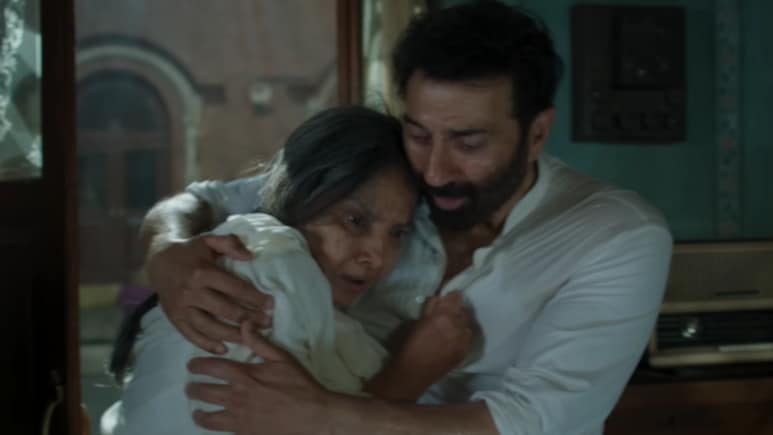
While the character portrayed by Deol - Meerut businessman Sikander Mirza - is the pivot around which the plot revolves, the mother figure, embodied by Shabana Azmi in the guise of a Hindu widow left behind in a Lahore haveli that is named after her, holds the balance between the hero's displaced family and the antagonistic elements that they are surrounded with.
Unsullied by the madness swirling around her, the old woman clings to her faith in mankind and the haveli that has always been her home. She pines for her missing son and vows not to leave the mansion until he returns.
Sikander - in the play, the city that his family flees is Lucknow, not Meerut - and his wife Hameeda (Preity Zinta), daughter Tanno (Khushi Hajare) and son Javed (Karan Deol), who is unable to board the train to Lahore and is separated from his parents for a while, are allotted a 22-room mansion that was once owned by a prosperous Hindu jauhari (jeweller).
The widow, who has no inkling of what is going on around her, is both a bone of contention between opposing forces in the immediate aftermath of the post-Partition refugee influx in a newly-created Pakistan and an unlikely unifier in a community torn apart by the fierce struggle between hate and sanity.
To begin with, Sikander and Hameeda have no love lost for the old, infirm Durgavati, who they address as Mai once suspicions and trepidations melt away. They begin to bond with her as her benign, matronly qualities come to the fore.
The development puts Sikander on a collision course with his own son Javed and a local thug with political ambitions, Yakub (Abhimanyu Singh), who wants to evict Mai and usurp part of the sprawling haveli from the Mirzas.
In one sequence, Sikander wards off an attack by three of Yakub's henchmen ordered to kill Mai. The unscathed old woman tries to light a lamp before a miniature idol of Lord Krishna. The match does not ignite. Sikander takes the matchbox from her lights the lamp. All differences between them vanish in a flash,
A ray of hope is also represented by two other male characters - a refugee poet, Habib Anwar (Ali Fazal), and a maulvi who spurns Yakub's call to action. The former conveys the anguish of losing his home and his beloved, Tabassum (Isha Sandhir); the latter stands firmly on the side of amity between communities. But the film ill-advisedly sidelines both in its larger scheme of things.
One cannot but feel a tad shortchanged by the treatment meted out to Habib Anwar, the poet from Firozpur (in the play he is from Ambala), who refuses to abandon his spirit of generosity in the face of the constant spewing of venom that he has to countenance. The character and the actor definitely deserved better from Santoshi's script.
Asghar Wajahat's play, written and staged in an era that was far less fractious than the times that we live in, found takers across the country and the world, including in the Pakistani cities of Karachi and Lahore. The film will certainly not travel across borders quite that easily.
The ideas that it gives voice to are, therefore, as urgent as they have ever been. Batwara 1947 is a welcome addition to a season of Bollywood films like Ikkis and Main Vaapas Aaunga that have highlighted the subcontinent's shared humanity in times of conflict.
When Batwara 1947 ends with the emphatic pronouncement that there is no religion greater than humanity, it does not catch us as much surprise as it might have only a few months ago, when all that Bollywood could churn out were bellicose movies that thrived on baying for blood and saw humanism and nationalistic fervour as antithetical notions.
The technical attributes are of the highest order. Santosh Sivan's cinematography more than just enhances the veneer of the big-budget production. It lends the film visual registers that differ in accordance with changing spaces and shifting moods.
Also noteworthy is the consistency of the production design by Subrata Chakraborty and Amit Ray, who pull off an impressive balancing act between opulence and period appropriateness.
Music may not be the film's strongest suit but A.R. Rahman and Javed Akhtar, as they always do, form a strong music director-lyricist team. Kahaan chale gaye ho Ram does not come anywhere near putting O Paalanhaare in the shade (can any song ever do that?) but its plaintive notes resonate beyond the screen and the film and assume the form of a lament for what we lose when we lose our humanity.
On the acting front, the man of action persona stalks Sunny Deol all through the film but to his credit the lead actor makes the most of the film's quieter moments and emotive scenes to add a kind of weight that is far more powerful than his fists of fury.
Preity Zinta, providing an ideal foil, also does her bit to enhance a few of the crucial turning points.
Shabana Azmi delivers an absolute tour de force. She does in Batwara 1947 what Naseeruddin Shah did in Main Vaapas Aaunga. She lends it the sort of depth and gravitas that instantly elevate the entire enterprise.
Batwara 1947 makes a plea that we would all do well to heed.
-
Sunny Deol, Shabana Azmi, Preity Zinta
