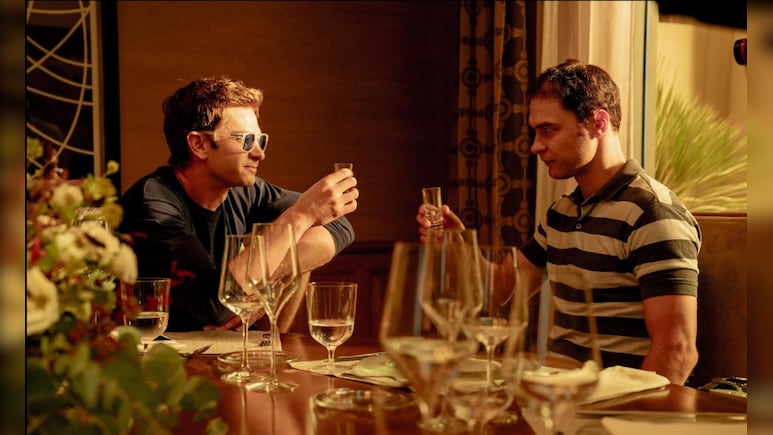
Hollywood had just dropped the first trailer for Artificial, Luca Guadagnino's film about OpenAI and Sam Altman, with Andrew Garfield playing the man who became the face of the AI revolution.
Around the same time, a former researcher who had worked at both OpenAI and Anthropic issued a rather darker prediction about the technology Altman helped unleash.
"The people building AI earnestly believe that it could kill us all by the end of the decade," Jacob Coxon wrote after leaving Anthropic.
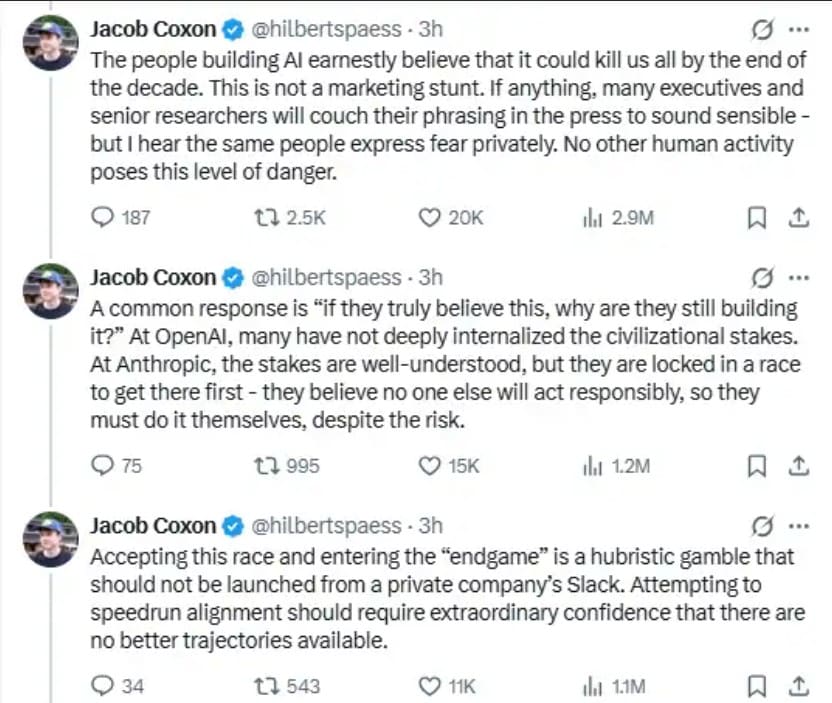
Why 27-year-old AI researcher, Jacob Coxon, walked away from Anthropic after a three-year stint.
Then came the trailer.
And the guns.
In one of its most striking sequences, Garfield's Altman walks through what looks like a doomsday shelter. Behind glass are weapons, supplies. The implication is difficult to miss: here is one of the men building the future preparing for the possibility that the future goes catastrophically wrong.
Except this particular piece of Hollywood drama has an uncomfortable connection to reality.
Nearly a decade before ChatGPT made Altman one of the most powerful technology executives in the world, he had already publicly described himself as a survival prepper.
"I prep for survival," Altman told The New Yorker in 2016.
His inventory was extraordinary: guns, gold, potassium iodide, antibiotics, batteries, water and Israeli military gas masks. He also spoke of land in Big Sur that he could fly to.
The trailer appears to take that strange piece of Altman lore and turn it into cinema. But there is an important distinction. There is no credible public evidence that Altman owns the underground bunker depicted in Artificial. The real evidence is that he openly talked about preparing for catastrophe.
And AI was among the civilisation-scale risks that occupied his thinking long before the rest of the world began obsessing over ChatGPT.
That makes Coxon's warning this week especially eerie.
Coxon, 27, spent roughly three years between OpenAI and Anthropic before resigning. His argument is not that today's chatbot will suddenly turn murderous. He fears that the race is moving towards increasingly autonomous, superhuman systems capable of hacking, accelerating scientific discovery, acquiring resources and potentially improving their own capabilities faster than humans can understand or control them.
He accused the two leading AI labs of "racing straight to self-improving superintelligence and gambling with our lives."
It is his assessment, not an established fact that AI will destroy humanity. But the juxtaposition is extraordinary.
One of the industry's former insiders says the people building the technology genuinely contemplate extinction-level outcomes.
And a movie about the industry's most famous CEO shows him walking past a wall of guns.
Sam Altman was unusual long before ChatGPT
The prepper story is only one of the peculiar details that have followed Altman through Silicon Valley.
As a young founder building the location-sharing start-up Loopt, he reportedly worked with such intensity that he developed scurvy, the vitamin-C deficiency more readily associated with sailors on long voyages than Stanford entrepreneurs.
He loved flying planes. Fast cars interested him. Poker became part of his education in risk.
Altman has said that poker taught him more about business and life than university did. The attraction makes sense. Poker is about probabilities, incomplete information, asymmetric bets and deciding how much to risk when nobody knows exactly what happens next.
There was another contradiction.
The man who would eventually make enormous bets on humanity's technological future was also reportedly intensely conscious of personal risk. Accounts of Altman from that period describe someone prone to worrying about illness while simultaneously thinking about synthetic pandemics, nuclear war and hostile artificial intelligence.
Perhaps the bunker imagery works because it compresses those contradictions into a single frame.
Optimism and catastrophe.
Building and escaping.
The conviction that technology can save civilisation alongside preparations for civilisation failing.
And Altman isn't the only billionaire with an escape plan
Silicon Valley's fascination with surviving catastrophe extends far beyond him.
Mark Zuckerberg's enormous Ko'olau Ranch project in Kauai is the clearest documented example.
Planning documents obtained by WIRED showed a roughly 5,000-square-foot underground shelter connected to the compound's main residences by a tunnel. Plans included an escape hatch and a metal door filled with concrete. The sprawling property was also designed with its own water infrastructure and food production. Zuckerberg's representatives declined to characterise it as a bunker.
Peter Thiel has long been associated with New Zealand as a potential refuge. Reporting has described properties and contingency plans there, although claims that he possesses some vast secret underground doomsday complex go beyond what has been firmly established.
Altman himself has previously been linked to an arrangement with Thiel under which they could head to New Zealand in the event of a systemic catastrophe.
Jeff Bezos, meanwhile, has accumulated property on Miami's extraordinarily secure Indian Creek Island, nicknamed "Billionaire Bunker". The name is misleading in this context: there is no credible evidence that Bezos has constructed an underground doomsday shelter there.
Still, a pattern has become difficult to ignore.
The richest people in technology spend their working lives promising that technology will transform human existence.
Some also spend extraordinary amounts of money ensuring that, if human existence takes a very bad turn, they have somewhere else to go.
That is what makes the Artificial trailer more interesting than another Hollywood biopic.
Garfield's Altman walking into a room filled with weapons can be dismissed as cinematic exaggeration.
The real Altman's guns, gold, gas masks and escape plans cannot.
And now, as an AI researcher warns that the race towards superintelligence could end catastrophically, a question hangs over that bunker scene.
Perhaps the most revealing thing about the people building the future isn't what they tell the rest of us it will look like.
It is what they are preparing for in case they are wrong.
Also Read | "The Future Of Film Is Bright But At The Cost Of Killing The Film Industry": Ram Gopal Varma On AI
