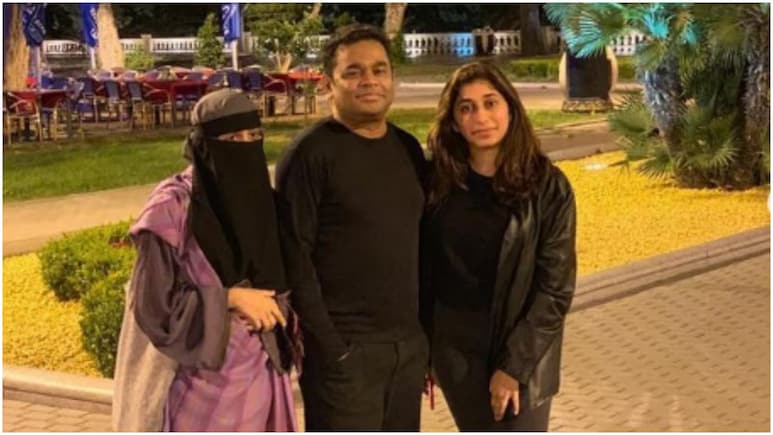
Hours after AR Rahman clarified his "communal" remark—which stirred a massive uproar on social media—with an Instagram video, his daughters Khatija and Raheema re-shared a post asserting their stance on the "communal" row.
Khatija and Raheema re-shared a note on their respective Instagram Stories. Originally written by Malayalam music composer Kailas Menon and titled "Disagree, Don't Disgrace," the note read: "People blaming A. R. Rahman for speaking his mind are missing a basic point. He spoke about how he felt. That is his right. You may disagree with him, but you cannot deny him the freedom to express his experience."
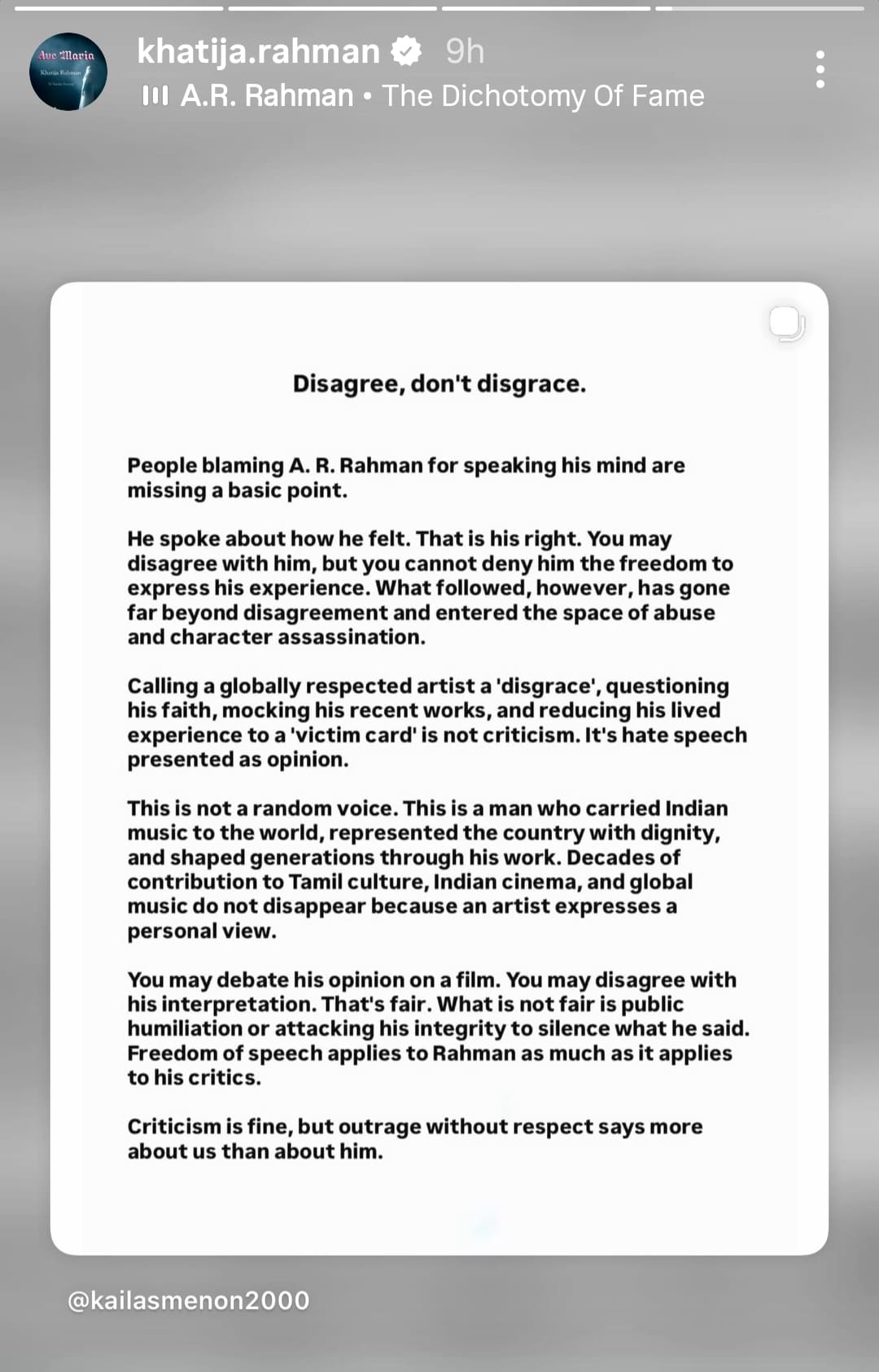
Menon mentioned that what followed Rahman's confession had gone far beyond disagreement and entered the territory of "abuse and character assassination".
"Calling a globally respected artist a 'disgrace', questioning his faith, mocking his recent works, and reducing his lived experience to a 'victim card' is not criticism. It's hate speech presented as opinion," Menon argued.
He added that Rahman is not a "random voice" but has given "decades of contribution to Tamil culture, Indian cinema, and global music".
"You may debate his opinion on a film. You may disagree with his interpretation. That's fair. What is not fair is public humiliation or attacking his integrity to silence what he said. Freedom of speech applies to Rahman as much as it applies to his critics. Criticism is fine, but outrage without respect says more about us than about him," wrote Menon.
Rahman's Clarification on Communal Remark
After incessant scrutiny over his remark, AR Rahman shared a video on Instagram on Sunday, clarifying that he never intended to hurt anyone's sentiments.
"Dear friends, music has always been my way of connecting, celebrating and honouring a culture. India is my inspiration, my teacher and my home. I understand that intentions can sometimes be misunderstood, but my purpose has always been to uplift, honour and serve through music. I have never wished to cause pain and I hope my sincerity is felt," Rahman said.
The clarification comes after Rahman said that work from the Hindi film industry had slowed for him in recent years, attributing this change to "shifting power dynamics" over the last eight years and possibly to what he described as "a communal thing" in a recent interview with the BBC Asian Network.
Elaborating on that shift, the composer added: "People who are not creative have the power now to decide things, and this might have been a communal thing also, but not in my face. It comes to me as Chinese whispers that they booked you, but the music company went ahead and hired their five composers. I said, 'Oh, that's great, rest for me, I can chill out with my family.'"
In recent times, Rahman has composed music for Ponniyin Selvan: I and II, Pathu Thala, Maamannan, Ayalaan, Lal Salaam, Raayan, Kadhalikka Neramillai, and Thug Life in Tamil; Shikara, 99 Songs, Dil Bechara, Mimi, Atrangi Re, Heropanti 2, and Tere Ishk Mein in Bollywood; and Malayankunju in Malayalam.
Also Read | AR Rahman Claims New Generation "Gaslit" Him Into Believing He Was Not Doing "Good Music"
