The Supreme Court today stayed the University Grants Commission's (UGC) new regulations aimed at promoting equity in higher education, which have triggered protests and criticism from several quarters, particularly among the general category. The top court directed all higher education institutions to continue following the UGC Regulations, 2012, until further orders.
A Bench issued notice to the Centre and the UGC and listed the matter for further hearing on March 19. The interim order has been passed by invoking the Supreme Court's powers under Article 142 of the Constitution.
In its observations, the court noted that the wording used in the new regulations raises concerns about potential misuse. "The language of the regulations suggests that they could be misused," the court remarked.
Justice Bagchi said the court was mindful of the need to create a fair and inclusive social environment. He also questioned the relevance of introducing new classifications, stating, "When the three Es already exist, how does the concept of 2Cs become relevant?"
The regulations in question were notified by the UGC on January 13, making it mandatory for all higher education institutions to constitute equity committees with members from OBC, Scheduled Caste and Scheduled Tribe communities. These committees were tasked with addressing complaints of discrimination and promoting inclusion on campuses.
Following the notification, protests intensified across the country, with critics allegeing that the UGC Regulations, 2026, could be misused, deepen caste-based divisions, and adversely affect the academic environment. The Supreme Court's stay will remain in force until the next hearing.
Track Here All The Latest Updates On UGC New Rule Row
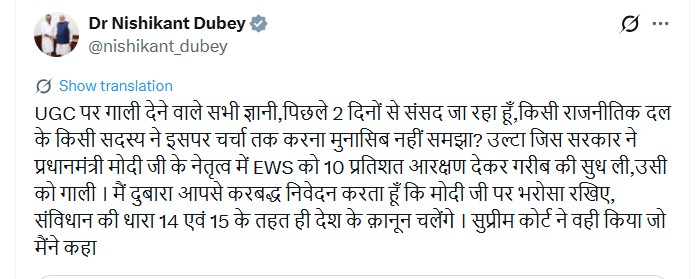
UGC New Rule Row Live: Nishikant Dubey Urges Trust In Constitution, Modi Government
BJP MP Nishikant Dubey defended the government, saying the controversy was being misdirected.
He said, "No political party seriously discussed the issue in Parliament. The Modi government introduced 10% EWS reservation to support the poor."
"The Supreme Court has done exactly what was expected," he said, urging people to trust Prime Minister Narendra Modi.

UGC New Rule Row Live: Digvijaya Singh Clears Parliamentary Committee's Stand
Amid growing political blame, Digvijaya Singh, Chairman of Parliament's Standing Committee on Education, clarified that the committee was not responsible for removing the punishment clause for false complaints.
"UGC Acted Unilaterally"
In a detailed social media post, Digvijaya Singh said:
The committee never recommended removing penalties for false cases
The decision was taken unilaterally by the UGC
The committee also did not suggest excluding general category students
"UGC Ignored Key Recommendations"
According to Digvijaya Singh, the UGC ignored two critical recommendations:
- Ensuring over 50% representation of SC, ST, and OBC members in Equity Committees
- Clearly defining what constitutes discriminatory behaviour
UGC New Rule Row Live: "2012 Rules Had Balance, New Ones Don't", Says BJP MLA Anil Singh
BJP MLA Anil Singh alleged that the rules create a narrative where the general category is presumed guilty, while safeguards against false complaints have been removed.
Addressing a public meeting in Hisua, Nawada, BJP MLA Anil Singh said that while the intent of the regulations may be positive, the execution was flawed.
He pointed out that:
- The 2012 regulations allowed complaints with safeguards
- The January 15 regulations lack checks and balances
- The exclusion of the general category is unjustified
Fear Of False Cases, Climate Of Anxiety
Anil Singh warned that the removal of punitive provisions for false complaints could create a climate of fear in campuses.
He said:
- The 2012 framework penalised false or malicious complaints
- Removing this provision could encourage misuse
- Students, teachers, and vice-chancellors are increasingly anxious
"Only genuine victims should approach grievance redressal mechanisms," he said.
Bihar Deputy CM Samrat Choudhary: Government Will Follow Court's Direction
Bihar Deputy Chief Minister Samrat Choudhary said the matter was sub judice and that the government would act strictly in line with judicial directions.
"The court will take its course. The government will act as per whatever the judiciary decides," he said.
UGC New Rule Row Live: Sanjay Nishad Welcomes Supreme Court Intervention
Reacting to the court's decision, Sanjay Nishad, National President of the Nishad Party and a Cabinet Minister in the Uttar Pradesh government, said the verdict was respectable and necessary.
He reiterated that: "No guilty person should escape, and no innocent should suffer."
UGC New Rule Row Live: Supreme Court Finds Regulations 'Vague', Calls For Expert Review
The Supreme Court expressed concern over the lack of clarity in the language of the regulations, noting that they appear vague at first glance.
Need To Prevent Misuse
The court held that:
- The rules require examination by a panel of subject experts
- The language must be revised to ensure clarity and safeguards against misuse
- Ambiguity in legal provisions could lead to arbitrary interpretation
Based on these concerns, the court directed higher education institutions to continue following the 2012 UGC Regulations until further orders.
UGC New Rule Row Live: Supreme Court Stays UGC Equity Regulations, Flags Risk of Social Division
The Supreme Court today stayed the University Grants Commission's (UGC) new Equity Regulations, warning that the rules, if allowed to operate, could have serious and dangerous consequences, including the risk of deepening social divisions.
A Bench comprising Chief Justice Surya Kant and Justice Joymalya Bagchi said judicial intervention was necessary at this stage to prevent wider societal impact.
UGC New Rule Row Live: Key features of the 2012 regulations
In 2012, the University Grants Commission (UGC) for the first time put in place a formal framework to prevent caste-based discrimination in higher educational institutions across the country. The objective was to curb injustice faced by individuals on the basis of caste (SC/ST), religion, gender, and language.
Key features of the 2012 regulations:
Appointment of an officer:
Institutions were required to appoint an Anti-Discrimination Officer.
Equal Opportunity Cell:
Colleges were mandated to establish an Equal Opportunity Cell to ensure equal access and opportunities for all students.
Time limit of 60 days:
A deadline of 60 days was prescribed for the disposal of any complaint.
Complaint mechanism:
If a student faced discrimination, they were required to submit a written complaint to the Anti-Discrimination Officer. The officer would then examine the matter and submit a report to the college administration. If any teacher, staff member, or student was found guilty, strict action was to be recommended in accordance with university rules.
Were there any shortcomings in these rules?
One of the major concerns with the 2012 regulations was the absence of stringent provisions to deal with false complaints. The rules did not clearly specify the action to be taken against those who deliberately made false allegations.
Additionally, the entire responsibility for inquiry rested with internal members of the institution, which often raised questions about the impartiality of the process.
"Are we moving backwards?" - CJI Suryakant
During the hearing, Justice Suryakant expressed concern over the growing social divisions and asked whether, even 75 years after Independence, the country was moving towards a society that is regressing. He said the goal was to build a society free from hierarchy and discrimination, but divisions based on identity and caste now appear to be increasing.
Addressing the issue of ragging, the court observed that students from southern India or the North East are often targeted. Justice Suryakant remarked, "For God's sake! Inter-caste marriages are taking place today. We too lived in hostels where everyone stayed together in harmony."
The court made it clear that if a student brings their own culture or food habits, any comments or attempts to demean them would not be tolerated.
Justice Joymalya Bagchi, who was part of the Bench, said it must be ensured that India does not resemble the United States of the past, where Black and White children were once educated in separate schools. The court warned that unless strict action is taken, mischievous elements could exploit the situation.
UGC 2012 Rules Explained: How Colleges Must Treat SC/ST Students Fairly
According to the University Grants Commission (Promotion of Equity in Higher Educational Institutions) Regulations, 2012, without prejudice to directives or instructions issued from time to time by the Central or State Governments regarding the treatment of students belonging to Scheduled Castes (SC) or Scheduled Tribes (ST), no higher educational institution shall discriminate against a student belonging to SC or ST categories, or allow or condone any member of the institution to discriminate against such a student or group of students. Institutions shall take the following measures:
(a) The higher educational institution, or any constituent of it, shall not discriminate against students belonging to SC or ST categories in admissions:
- By breaching the applicable policy of reservation in admissions.
- In accepting applications for admission from such students.
- In the manner in which an application is processed.
- In the arrangements made for, or the criteria used in, deciding who should be offered admission.
- By withholding or refusing to return any documents, such as certificates, degrees, or diplomas, deposited by such a student for admission purposes, with a view to inducing or compelling the student to pay any fee for a course or programme they do not intend to pursue.
- By demanding money in excess of the fees specified in the declared admission policy.
- By denying or limiting access to any benefits arising from such enrolment.
- By treating the student unfavorably in any way regarding their enrolment in a specific standard, class, area of study, training, or instruction.
UGC New Rule Row Live: Higher Educational Institutions were tasked to take measures against discrimination
Higher Educational Institutions were tasked to take measures against discrimination:
1) Every higher educational institution shall take appropriate measures to -
a) safeguard the interests of the students without any prejudice to their caste, creed,
religion, language, ethnicity, gender and disability.
b) eliminate discrimination against or harassment of any student in all forms in
higher educational institutions by prohibiting it and by providing for preventive
and protective measures to facilitate its eradication and punishments for those
who indulge in any form of discrimination or harassment;
c) promote equality among students of all sections of the society.
UGC New Rule Row Live: When Were The Regulations Notified
The regulations in question were notified by the UGC on January 13, making it mandatory for all higher education institutions to constitute equity committees with members from OBC, Scheduled Caste and Scheduled Tribe communities. These committees were tasked with addressing complaints of discrimination and promoting inclusion on campuses.
UGC New Rule Row Live: Supreme Court Flags Fairness Concerns
Justice Bagchi said the court was mindful of the need to create a fair and inclusive social environment. He also questioned the relevance of introducing new classifications, stating, "When the three Es already exist, how does the concept of 2Cs become relevant?"
UGC New Rule Row Live: What Court Noted In Its Observations
In its observations, the court noted that the wording used in the new regulations raises concerns about potential misuse. "The language of the regulations suggests that they could be misused," the court remarked.
UGC New Rule Row Live: Supreme Court Lists Matter For Further Hearing On March 19
A Bench issued notice to the Centre and the UGC and listed the matter for further hearing on March 19. The interim order has been passed by invoking the Supreme Court's powers under Article 142 of the Constitution.
UGC New Rule Row Live: Supreme Court Stays 2026 Regulations
The Supreme Court today stayed the University Grants Commission's (UGC) new regulations aimed at promoting equity in higher education, which have triggered protests and criticism from several quarters, particularly among the general category. The top court directed all higher education institutions to continue following the UGC Regulations, 2012, until further orders.
