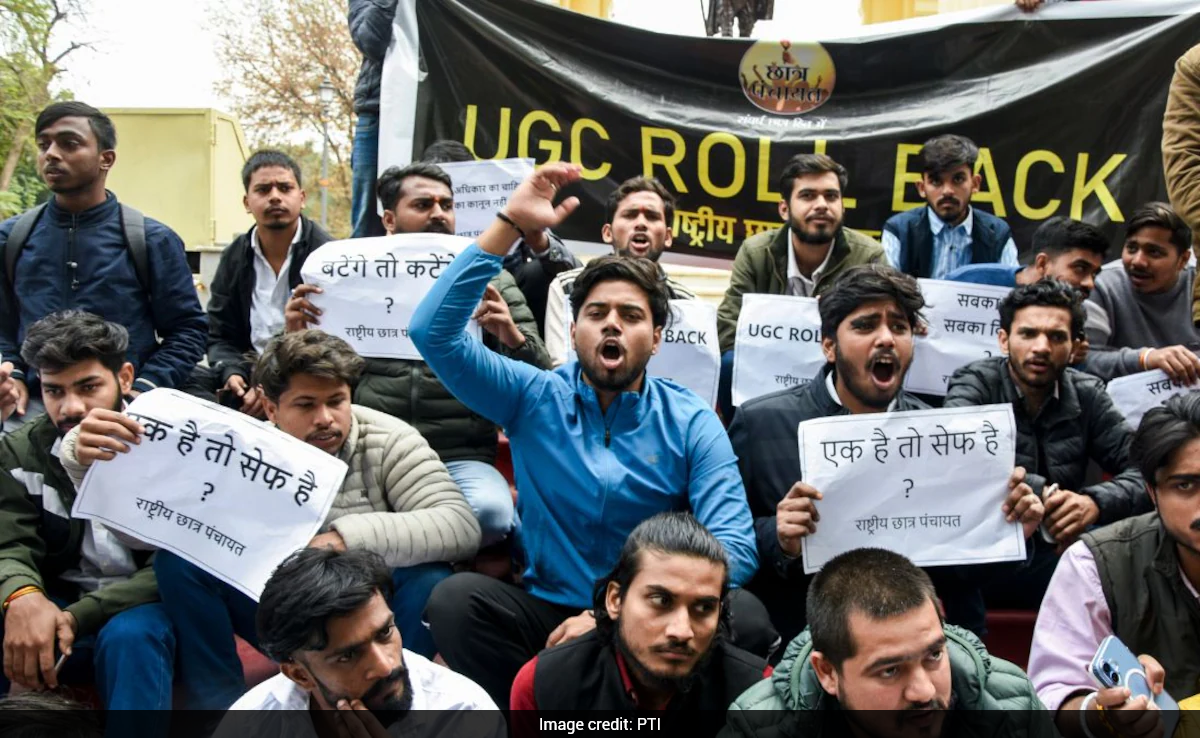
The Supreme Court has stayed the University Grants Commission's (UGC) new regulations for promoting equity in higher education, directing institutions to continue following the 2012 regulations until further orders. The court has issued notice to the Centre and the UGC, listing the matter for further hearing on March 19. The interim order was passed under Article 142 of the Constitution. The court observed that certain provisions in the 2026 regulations "could be misused" and questioned the relevance of new classifications introduced alongside the existing "three Es."
The UGC Regulations, 2026, notified on January 13, required all higher education institutions to set up Equity Committees representing OBC, SC, and ST communities. The regulations introduced Equal Opportunity Centres, Equity Helplines, Equity Ambassadors, and Equity Squads, with detailed procedures for reporting discrimination, grievance redressal, monitoring, and penalties for non-compliance, including debarment from UGC schemes or programmes.
In 2012, the University Grants Commission (UGC) for the first time put in place a formal framework to prevent caste-based discrimination in higher educational institutions across the country. The objective was to curb injustice faced by individuals on the basis of caste (SC/ST), religion, gender, and language.
Key features of the 2012 regulations:
Appointment Of An officer:
Institutions were required to appoint an Anti-Discrimination Officer.
Equal Opportunity Cell:
Colleges were mandated to establish an Equal Opportunity Cell to ensure equal access and opportunities for all students.
Time limit Of 60 days:
A deadline of 60 days was prescribed for the disposal of any complaint.
Complaint Mechanism:
If a student faced discrimination, they were required to submit a written complaint to the Anti-Discrimination Officer. The officer would then examine the matter and submit a report to the college administration. If any teacher, staff member, or student was found guilty, strict action was to be recommended in accordance with university rules.
Were there any shortcomings in these rules?
One of the major concerns with the 2012 regulations was the absence of stringent provisions to deal with false complaints. The rules did not clearly specify the action to be taken against those who deliberately made false allegations.
Additionally, the entire responsibility for inquiry rested with internal members of the institution, which often raised questions about the impartiality of the process.
UGC 2012 Rules: Key points to know
Higher Educational Institution to take measure against discrimination:-
1. Every higher educational institution shall take appropriate measures to -
a) safeguard the interests of the students without any prejudice to their caste, creed,
religion, language, ethnicity, gender and disability.
b) eliminate discrimination against or harassment of any student in all forms in
higher educational institutions by prohibiting it and by providing for preventive
and protective measures to facilitate its eradication and punishments for those
who indulge in any form of discrimination or harassment;
c) promote equality among students of all sections of the society
(2) Without prejudice to directives or instructions issued from time to time by the Central or State Governments regarding the treatment of students belonging to Scheduled Castes (SC) or Scheduled Tribes (ST), no higher educational institution shall discriminate against a student belonging to SC or ST categories, or allow or condone any member of the institution to discriminate against such a student or group of students. Institutions shall take the following measures:
- (a) The higher educational institution, or any constituent of it, shall not discriminate against students belonging to SC or ST categories in admissions:
- By breaching the applicable policy of reservation in admissions.
- In accepting applications for admission from such students.In the manner in which an application is processed.
- In the arrangements made for, or the criteria used in, deciding who should be offered admission.
- By withholding or refusing to return any documents, such as certificates, degrees, or diplomas, deposited by such a student for admission purposes, with a view to inducing or compelling the student to pay any fee for a course or programme they do not intend to pursue.
- By demanding money in excess of the fees specified in the declared admission policy.
- By denying or limiting access to any benefits arising from such enrolment.
- By treating the student unfavorably in any way regarding their enrolment in a specific standard, class, area of study, training, or instruction.
The new 2026 regulations sparked nationwide protests over concerns that they could deepen caste-based divisions and affect the academic environment. With the Supreme Court's stay, higher education institutions will continue operating under the 2012 framework while the legal review proceeds.
