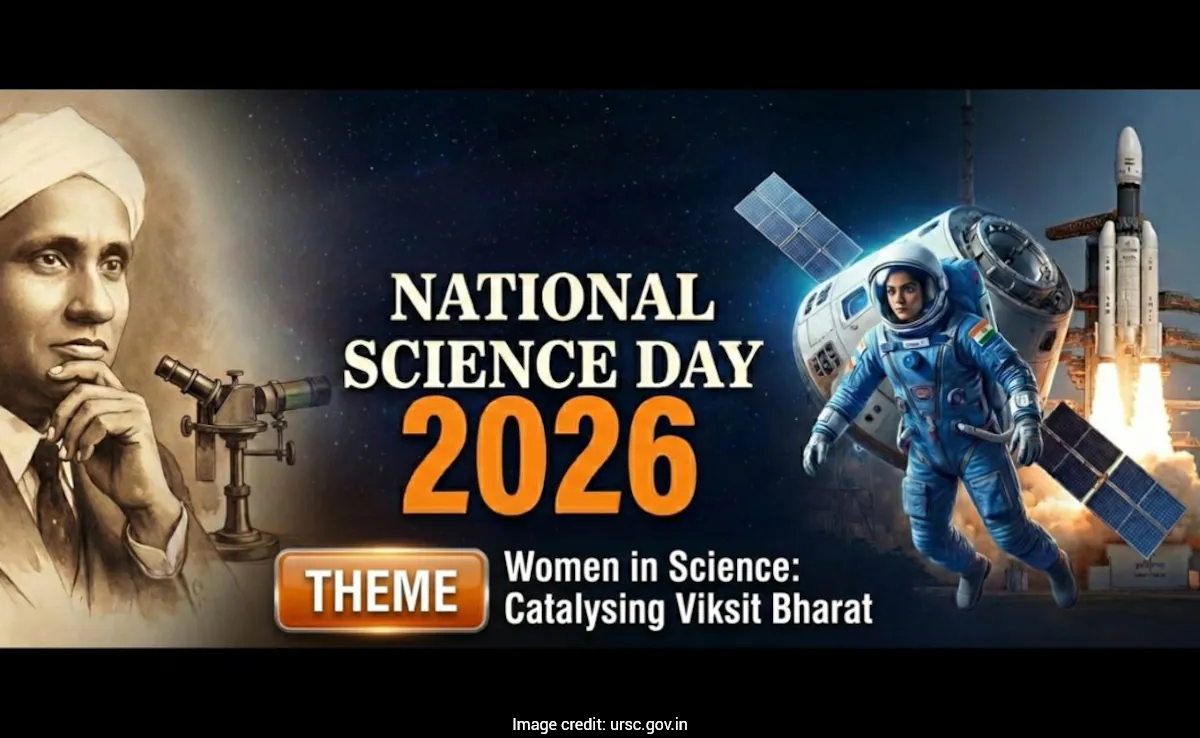

National Science Day 2026: India will mark National Science Day on February 28, 2026, celebrating the discovery of the Raman Effect by physicist CV Raman in 1928, a breakthrough that earned him the Nobel Prize and placed Indian science on the global map. Observed annually, the day is not merely a tribute to a historic scientific milestone but a nationwide push to promote scientific temper, research, and innovation.
The Origin: The Raman Effect
National Science Day is observed to honour Raman's discovery of the scattering of light, known as the Raman Effect, announced on February 28, 1928. The discovery later won him the Nobel Prize in Physics in 1930, making him the first Asian to receive the honour in the sciences. The day serves as a reminder of the transformative power of fundamental research and its long-term impact on technology and industry.
2026 Theme: Women In Science Catalysing Viksit Bharat
The Government of India, through the Ministry of Science and Technology's Department of Science and Technology (DST), will host the national-level celebration at Vigyan Bhawan in New Delhi under the theme: "Women in Science: Catalyzing Viksit Bharat." The theme aligns scientific advancement with India's vision of becoming a developed nation while recognising the role of women researchers and innovators.
The programme will open with National Science Day lectures chaired by Principal Scientific Adviser Professor Ajay K Sood. Speakers include Dr Shubha V Iyengar on indigenous aerospace and defence technologies, Dr K Balasubramanian on critical metals and materials, and Shri Shashi S. Vempati on direct-to-mobile broadcasting.
A panel discussion on the science-policy interface will follow, featuring experts from NITI Aayog, INSA, CSIR institutions, CSTEP and IGSTC, focusing on aligning research with national development priorities. Sessions on communicating science in Indian languages and interactive "Face to Face with Scientists" engagements are also scheduled.
Science Beyond Ceremonies: Institutes Open Doors To Public
Across the country, leading research institutions are organising outreach programmes to take science beyond laboratories.
In Bengaluru, the Raman Research Institute will host its annual Open Day to mark the 98th anniversary of Raman's discovery. The event will feature live demonstrations, research exhibitions, and hands-on experiments, with over 1,000 students from government and private schools expected to participate. Science quizzes, photography contests, and interactive sessions with scientists aim to encourage curiosity among young learners.
In Mumbai, the Homi Bhabha Centre for Science Education, a national centre of the Tata Institute of Fundamental Research, will organise interactive science activities on February 27. The programme includes experiments, puzzles, quizzes, sunspot observation, and rocket demonstrations designed for students from primary to higher secondary levels.
Why National Science Day Matters Today
National Science Day has evolved into more than a commemorative event. It acts as a platform to:
- Encourage scientific thinking and inquiry among students
- Bridge the gap between science and policy
- Highlight indigenous technological advancements
- Promote inclusive participation, especially of women in STEM
- Strengthen public engagement with research institutions
As India pushes towards technological self-reliance and global competitiveness, National Science Day reinforces the key role of science in economic growth, defence preparedness, digital communication, and sustainable development.
