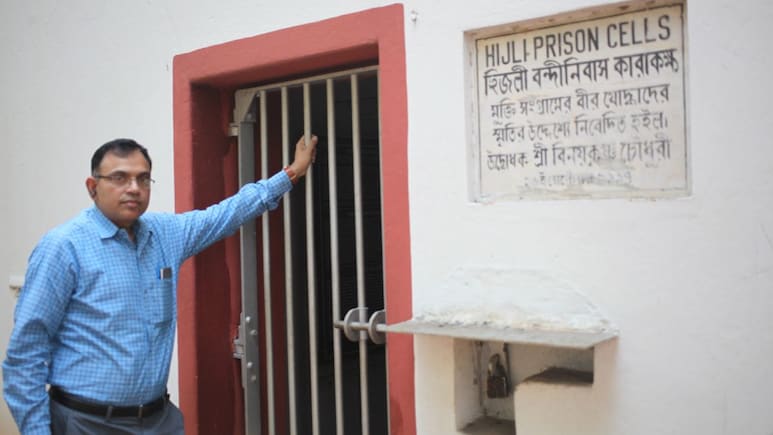

In the 75th year of India's adoption of the Constitution as a Republic, the campus of IIT Kharagpur celebrating its own Diamond Jubilee-stands as a powerful paradox. A place where minds were once shackled now nurtures some of the brightest intellects shaping a free and progressive India.
The Hijli Detention Camp, infamous during British rule for its brutal treatment of freedom fighters, today forms the historic heart of India's first Indian Institute of Technology.
Walking along the narrow, dimly lit cells of the Hijli prison, one cannot escape the chilling reminder of a time when the British sought to crush not just bodies but ideas.
"This was not just a jail; it was a symbol of mental imprisonment," says Professor Suman Chakraborty, Director of IIT Kharagpur, pointing to the cramped stone cells.
"The purpose was not to kill a person instantly but to kill the thought process-so that the entire nation would remain enslaved in mind."
The Hijli Detention Camp was second only to the Cellular Jail in Port Blair in its notoriety for torturing freedom fighters. Among those who suffered here were Shri Santosh Kumar Mitra and Shri Tarakeshwar Sengupta, who died due to the torturous conditions. Netaji Subhash Chandra Bose visited this very site, and Khudiram Bose-hanged at a tender age-hailed from the same Medinipur district.
"Imagine this place at night-dark, snake-infested, with barely any food. It was designed to break the spirit," Professor Chakraborty adds.
From Bondage To Freedom
When India gained independence in 1947, the symbolism of Hijli was profound. The government chose this very site to establish IIT Kharagpur in 1951, marking a transition from oppression to empowerment.
"From the life of the jail to the life of freedom-it was not just about physical liberation. It was about freeing the mind," says Professor Chakraborty.
Education became the cornerstone of that freedom. The vision was clear: to create a "temple of technology" that would lead India into a new era of scientific and industrial progress.
"The way one can combine human freedom with the freedom of knowledge, thought, and technology-that was the dream," he emphasises.
Today, IIT Kharagpur is not just an institution; it is a movement that began in the shadows of tyranny and now illuminates the path to Viksit Bharat.
Tagore's Dream Realised
Gurudev Rabindranath Tagore's immortal words echo through this transformation: "Where the mind is without fear and the head is held high..." In these very grounds, fear once reigned. Today, IIT Kharagpur embodies Tagore's vision-a place where minds are free to innovate, question, and lead.
Global Leaders From Historic Soil
Over the decades, IIT Kharagpur has produced alumni who have made India proud across the globe-Sundar Pichai, CEO of Google; Ajit Jain, Vice Chairman, Berkshire Hathaway; Dr V Narayanan, Chairman, ISRO.
The aspirations of a vibrant, developed India are echoed by the Indian National Young Academy of Science (INYAS), today led by Dr Nishant Chakravorty, a physician-turned-researcher and young faculty member at IIT Kharagpur. Incidentally, at 52, Professor Suman Chakraborty is among the youngest directors ever of an IIT.
From these cells of despair emerged a legacy of hope-over 70,000 graduates who have walked past these prison walls, reminded that freedom is not just a gift but a responsibility.
A Symbol For The 75th Year
As India celebrates 75 years of independence, IIT Kharagpur stands as a testament to resilience and vision.
"This place tells a story-from bondage to freedom, from darkness to enlightenment," Professor Chakraborty reflects. "Our role now is to ensure that fear never returns to the mind-whether in science, technology, or society."
The Hijli Detention Camp remains preserved within the campus, not as a relic of pain but as a beacon of purpose. It reminds every student that the freedom to think, create, and lead was hard-earned-and must never be compromised.
From the chains of Hijli to the corridors of IIT Kharagpur, India's journey is one of transformation-where the mind once imprisoned now soars without fear. In the words of Tagore, this is truly the land "where knowledge is free."
