





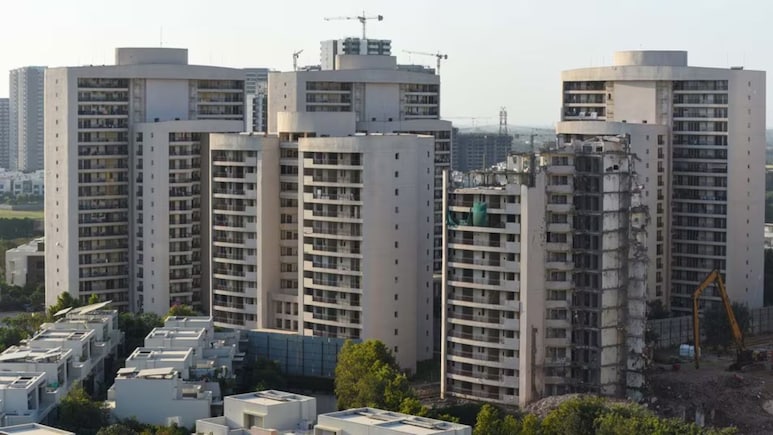
Noida's real estate market is heating up, but not with homebuyers. Property prices along the Noida Expressway have crossed Rs 25,000 per square foot, pushing the cost of a standard 1,000 sq ft flat to Rs 2.5 crore. But as Surbhi Gupta of 99acres points out, the real twist is that no one is building 1,000 sq ft homes anymore.
Gupta detailed how developers in Noida are focusing only on ultra-large formats. “Builders are launching only large formats: 3, 4, and even 5 BHKs, with carpet sizes starting at 2,000 sq ft,” she wrote in a LinkedIn post.
That means entry-level homes now cost upwards of Rs 5 crore, well beyond the reach of most genuine homebuyers.
Also Read | Layoffs Are Rising In Tech, But These Skills Are Helping People Unlock Better Pay
To afford a Rs 2.5 crore flat, a buyer would need roughly Rs 50 lakh in liquid capital and an annual income of around Rs 50 lakh to qualify for a corresponding loan. For a Rs 5 crore unit, the financial barrier is even higher.
Despite these steep costs, Gupta says end-users are largely absent from the market. “Very few real homebuyers are actually purchasing these,” she noted. “Most bookings are by investors who put in 20 percent upfront, wait for prices to rise, and exit when they find another buyer.”
This investor-driven cycle is inflating prices further, but not creating real housing occupancy. Units keep changing hands while remaining empty. According to Gupta, the situation often ends with two possible outcomes: either the builder buys the property back and holds it, or the investor is unable to pay the next tranche and is forced to sell at a loss.
In the worst cases, the project risks becoming a ghost town. “No real buyers exist for such inflated prices,” she explained. “Or worse, construction slows down or stops because the builder simply runs out of money.”
The pattern mirrors speculative real estate bubbles seen in other overheated markets, where asset flipping replaces genuine demand. As a result, projects get sold out on paper but stay unoccupied on the ground.
Gupta's observations raise critical questions for both buyers and policymakers. While investor interest fuels short-term growth and liquidity, the lack of end-user presence could weaken long-term project viability.
Without price correction or product diversification, Noida's high-end residential market may soon face a demand vacuum, one luxury flat at a time.
Track Latest News Live on NDTV.com and get news updates from India and around the world

