






US borrowing costs have hit levels not seen since 2001.
At a 30-year Treasury auction on Thursday, the US paid a yield as high as 5.22 per cent. That is the highest borrowing cost for a 30-year bond since August 2001, when the US paid 5.52 per cent. The same 30-year bond fetched 5.06 per cent at the previous auction in July. Before Donald Trump began his second term in January 2025, the yield was just 4.91 per cent.
Simply put, the world's biggest borrower, the United States, is now paying more interest to borrow. This puts fresh focus on America's ballooning debt, inflation and the risks for global markets, including India.
Also Read | Layoffs Are Rising In Tech, But These Skills Are Helping People Unlock Better Pay
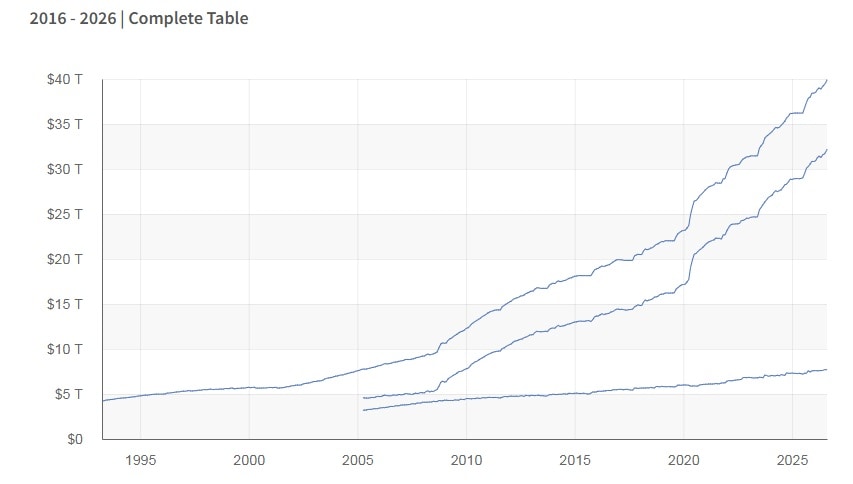
America's Debt Pile Nearing $40 Trillion
The US national debt has swollen to almost $40 trillion. Debt held by the public crossed the size of the US economy in the first quarter of 2026, according to government data analysed by the Committee for a Responsible Federal Budget.
The Congressional Budget Office expects the debt-to-GDP ratio to cross its post-World War II high of 106 per cent by the end of this decade. It could reach 120 per cent by 2036.
The problem is not simply the size of the debt. It is also becoming more expensive to service. The US government now spends more on interest payments than it does on national defence.
Why Are Investors Asking For More Money?
Investors buying a 30-year US Treasury bond are effectively locking their money into US government debt for three decades. They want to know that the interest they receive will adequately compensate them for inflation, interest-rate and fiscal risks.
Inflation remains a key worry. US inflation hit a three-year high of 4.2 per cent in May as energy prices surged. It cooled to 3.4 per cent in July, but that is still well above the Federal Reserve's target.
At the same time, Washington's borrowing needs remain enormous. Trump returned to the White House promising to get America's finances under control. But debt has continued to climb rapidly, with sweeping tax cuts adding to pressure on government finances.
The result is a difficult equation: higher debt, higher interest costs and investors demanding higher yields.
'Global Capital Could Become More Selective'
Chintan Hefa, Executive Director - IPO Advisory at Grant Thornton Bharat, said the development matters well beyond the US. "The move is significant because US Treasury yields act as a global reference point for the pricing of risk."
According to Hefa, investors demanding the highest long-term yields in more than two decades shows greater caution around America's long-term fiscal and economic outlook. He told NDTV that a prolonged period of high US yields could make global capital more selective, including in emerging markets such as India.
This matters because US Treasuries are considered a benchmark for borrowing costs across the world. When their yields rise sharply, investors can reassess whether taking additional risk in emerging markets is worth it.
AI Boom Adds Another Layer Of Pressure
There is another unusual factor in the current cycle: the massive spending on artificial intelligence infrastructure. Shashank Udupa, Founder of Vayu Capital and SEBI RA, said the rise in the real cost of capital is particularly concerning. "This is concerning, particularly because the real cost of capital has risen to levels that many investors in the current market cycle have never experienced," Udupa told NDTV.
He also pointed to America's huge spending on compute and AI infrastructure. If fiscal and financial pressures are not contained, Udupa warned that the consequences could extend beyond US markets. "We could see significant second-order effects," he said, with potential spillovers across markets and economies globally.
What Does This Mean For India?
India may not be responsible for America's debt problem. But it cannot completely escape the consequences. Higher US yields can make dollar assets more attractive. That could strengthen the US dollar and put pressure on the rupee.
It could also make Indian equities and other emerging-market assets relatively less attractive to foreign investors. Ashish Singhal, Co-founder of Lemonn, told NDTV that the record-high 30-year Treasury yield shows that markets are reassessing the long-term cost of inflation, government borrowing and interest rates.
For India, he said, the key channels would be the dollar and global capital flows. "Higher US yields could strengthen the dollar, put pressure on the rupee and make emerging-market assets relatively less attractive, potentially moderating FPI flows."
But Singhal does not see the picture as entirely negative for India. He said strong domestic growth, corporate earnings and policy fundamentals can act as important buffers.
The US Has A Debt Problem. But Is It A Crisis Yet?
Not necessarily. The latest auction still showed solid demand. The bid-to-cover ratio stood at 2.39, meaning investors submitted bids worth $2.39 for every $1 of bonds sold. That was only slightly below July's 2.44.
The US Treasury is also trying to prevent long-term borrowing costs from climbing too sharply. It has said that auction sizes for longer-dated securities will remain at current levels.
This means the government could lean more heavily on short-term debt to finance its growing borrowing needs. But that does not make the underlying problem disappear. America's debt has roughly doubled over the past decade. So has its cost of borrowing.
And with inflation still above target, the Federal Reserve has limited room to simply cut rates aggressively to ease the government's borrowing burden.
Track Latest News Live on NDTV.com and get news updates from India and around the world

