





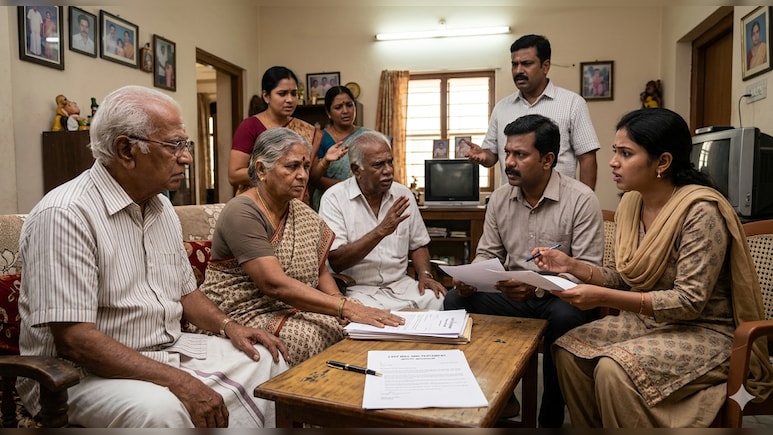
Indian families plan weddings in detail. They plan children's education. They plan retirement.
But they do not plan what happens after they are gone.
And that silence is costing families years of court battles, frozen bank accounts, and broken relationships.
"Most Indian families don't have a will. And the reason isn't that they don't care about their family - it's the opposite," says Shashank Udupa, SEBI-registered RA and fund manager at Smallcase.
"Talking about death in an Indian household feels like inviting it. Writing a will feels like you're planning to die. So people avoid it. They assume the family will figure it out. And that is where things honestly go wrong. Only problem is, love doesn't hold up in a property dispute."
The myth: "Our family is close, we don't need a will". This is the most common assumption. Families believe harmony today guarantees harmony tomorrow.
But when someone passes away without a will, reality looks very different:
- Bank accounts get frozen
- Property ownership gets contested
- Siblings turn into legal opponents
- Cases drag on for a decade
- Legal costs exceed the value of the estate
Udupa says he has seen this happen in "educated, well-off families who just never got around to it."
What Exactly Is A Will?
"A Will is a basic but very pertinent document in one's estate plan," explains Sneha Makhija, Head of Wealth Planning at Sanctum Wealth. It simply states:
- Who gets what
- How assets should be distributed
- Who will execute your wishes (executor)
- Without it, intestate succession laws decide for you.
For example, in the case of a Hindu male, assets are divided equally among mother, spouse, and children first -- whether or not that was the person's intent. This often leads to multiple co-owners of the same asset. And friction begins there.
The biggest misconception: "A will is complicated". Many people assume:
- It needs lawyers
- It needs court procedures
- It needs expensive paperwork
- It doesn't.
"A will can be written on a plain piece of paper," says Makhija. All it needs:
- Signature of the person writing it
- Two witnesses (not beneficiaries)
- A clear list of assets and beneficiaries
- Registration is not mandatory, but recommended.
"WILL registration in India takes less than a few hours. The conversation that leads to it might take ten minutes," says Udupa.
"Both are worth having now, not later."
However, the cultural hesitation is deeper than legal complexity. "For Indian families, reluctance to write wills stems not from lack of assets, but from a deeper cultural hesitation," says Kumar Binit, CEO of Airpay Money.
"Writing a will is still seen as inviting the subject of death rather than managing it responsibly." People also wrongly believe:
- Wills are only for the wealthy
- Nominations are enough
- They are too young to think about it
- It may create conflict in the family
In reality, a nominee is often just a custodian. The will overrides nominations.
In fact, the cost of not having a will shows up later. Binit points to what happens after death without a will:
- Succession certificates take 45-90 days even in simple cases
- Half of inheritance disputes involve gender-based claims (as per judicial data)
India's Elderly Population Rising Sharply
An estimated Rs 40-60 lakh crore will transfer between generations in the next decade. "A large share of that will move through legal proceedings because the person who built it never wrote down what they wanted," he says. "That's a planning failure with a straightforward fix."
Why families keep postponing it:-
Makhija lists the real reasons families avoid starting:
- It feels inauspicious
- People don't like acknowledging mortality
- Procrastination - wealth creation takes priority over succession
- Fear that it signals division
- Overthinking how to divide assets perfectly before even starting
- Blind faith that earlier generations managed without it
However, today's assets are very different from the past: Demat accounts, mutual funds, multiple bank accounts, digital assets, and properties across cities. Hence, clarity on division of assets is no longer optional.
Who Should Have A Will?
There is no wealth threshold. "If one has an asset, irrespective of its value, and an intended beneficiary, one should have a will," says Makhija.
This includes:
- A single bank account
- One property
- Dependent parents
- Minor children
- A non-working spouse
- The uncomfortable truth
According to Udupa: "Not writing a will is one of the most expensive financial decisions a family can make. They just don't find out until it's too late."
The discomfort of writing it lasts a few minutes. The discomfort of not writing it can last generations.
And that is why, despite rising wealth, Indian families are still hesitant to write wills -- not because they don't care, but because they care too emotionally to discuss the one thing that protects everyone after they are gone.
Track Latest News Live on NDTV.com and get news updates from India and around the world

