





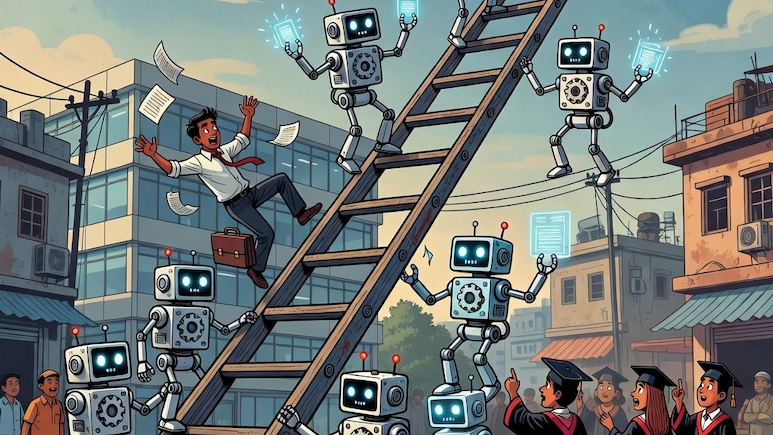
For millions of middle-class Indians, the first job has always meant more than a salary. It is the first taste of financial independence.
The first chance to learn how an office works. The first step towards a better designation, a bigger pay cheque and, eventually, a better life.
But what if that first step starts disappearing?
Artificial intelligence is rapidly taking over repetitive tasks that were once handed to fresh graduates and junior employees. And that is raising a bigger question than whether AI will kill jobs. If young workers no longer get entry-level work, where will they learn?
AI Could Remove The First Rung
The traditional career ladder was simple. A fresher joined a company, handled routine work, learnt from seniors and slowly took on bigger responsibilities.
AI is disrupting that model. "AI is removing the first rung of the middle class career ladder," said Chetan Mangalwedhe, Founder & CEO, TalentiFi-X.
The skills expected from a fresher are also changing. "The new entry-level worker must know how to supervise AI, catch errors, apply judgment and understand the customer," Mangalwedhe said.
If businesses stop hiring juniors for routine tasks, they may save costs today. But they could also end up with a smaller pool of experienced talent tomorrow.
Vimal Dangri, CHRO & General Counsel, Mastek, believes the answer is not simply to protect old jobs. Companies may have to redesign them.
"AI is not simply replacing entry-level jobs; it is changing the very foundation of the career ladder," he told NDTV. Future entry-level roles could focus less on repetitive execution and more on problem-solving, judgement, collaboration and continuous learning.
Jaspreet Bindra, Co-founder & CEO, AI & Beyond, said the people who succeed will be those who can use technology without blindly depending on it. "The real challenge is not AI replacing people, but people being left behind because they didn't adapt," he said.
There's Another Side To The Story
Trupti Raikar, Enterprise Architecture, AI and Digital Transformation Expert, Infosys Limited, said AI could eventually make junior roles more meaningful. "As machines take over repetitive work, young employees could move faster into innovation, design and decision-making," Trupti told NDTV.
But there is a catch. You cannot become good at decision-making without first making decisions. You cannot understand customers without interacting with them. And you cannot build professional judgement without experience.
That is why the biggest disruption from AI may not be the disappearance of jobs. It could be the disappearance of the traditional way of getting your first break.
Track Latest News Live on NDTV.com and get news updates from India and around the world

