





The conflict in the Middle East may be rattling global supply chains, but India's electronics industry has shown remarkable resilience.
Even as freight costs rise and global supply chains face fresh uncertainty because of the US-Iran-Israel conflict, industry executives say strong domestic demand and growing manufacturing capabilities are helping India stay on course. Interestingly, the momentum is increasingly being driven by consumers beyond the metros.
"The biggest transformation is happening on the demand side. Consumers in tier-2 and tier-3 markets increasingly expect premium features at accessible price points. India's consumer electronics market is expected to grow from over $70 billion today to more than $120 billion by 2030. The challenge for brands is delivering better technology while navigating global sourcing dependencies and evolving supply-chain dynamics. The winners will be those who can combine innovation, affordability, and resilience," said Varin Agarwal, Chief Snapper, SnapUp.
Also Read | Layoffs Are Rising In Tech, But These Skills Are Helping People Unlock Better Pay
India's Electronics Sector In Numbers
The country's electronics production has climbed from Rs 1.9 lakh crore in FY15 to more than Rs 11.3 lakh crore in FY25. Exports have crossed Rs 3.27 lakh crore. Mobile phone production has surged to Rs 5.45 lakh crore, while smartphone exports have jumped from just Rs 1,500 crore a decade ago to more than Rs 2 lakh crore.
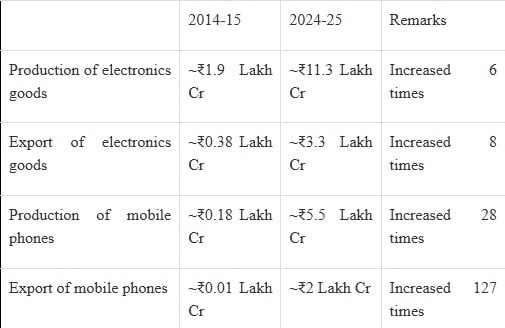
Photo Credit: Ministry of Electronics & IT
Today, more than 99 per cent of smartphones sold in India are made locally, helping the country emerge as the world's second-largest mobile phone manufacturer.
Impact Of Iran War On India's Electronics
Industry experts say the current disruptions are exposing areas where India can become stronger rather than slowing its growth story.
While electronics manufacturing has scaled rapidly, domestic value addition is estimated at around 18-20 per cent, reflecting continued dependence on imported semiconductors, display panels, memory chips, battery cells and specialised materials.
Recent disruptions have affected supplies of certain critical inputs, including high-purity polyphenylene ether (PPE) resin used in printed circuit boards (PCBs). At the same time, prices of several PCB raw materials have risen sharply, adding pressure on manufacturers.
However, companies say years of supply-chain diversification are helping cushion the impact.
"The recent supply-chain disruptions have highlighted the complexity of modern electronics manufacturing. While localisation efforts are accelerating across the industry, many critical materials and specialised chemicals continue to be part of highly interconnected global supply chains, making resilience and supply continuity increasingly important considerations for manufacturers," said Anurag Roy, Managing Director, ELANTAS Beck India Limited.
"Resilience has never been built around a single sourcing strategy. Over the years, we have built a model that combines local supplier ecosystems, regional manufacturing capabilities and access to global procurement networks. This approach has enabled us to remain responsive to evolving customer requirements while ensuring continuity of supply amid changing market conditions," Roy added.
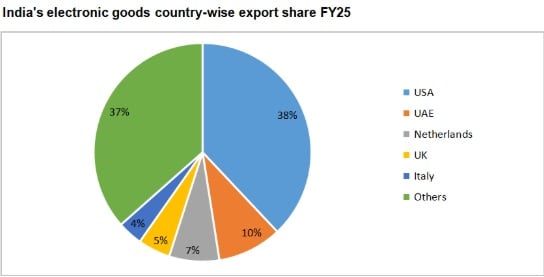
Photo Credit: NIRYAT Portal
The broader industry sees the current situation as a catalyst for the next phase of India's electronics journey.
"India has already proven that it can scale electronics manufacturing. The next challenge is creating deeper value within the country. Semiconductors remain one of the largest component import categories. Recent supply-chain disruptions have reinforced why component localisation, automation, and semiconductor capability will be critical for India's next phase of growth," said Tushar Tekriwal, Director, Startron Lifestyles.
Shift Already Underway
India has approved semiconductor projects worth around Rs 1.6 lakh crore, including Tata Electronics' fabrication facility and Micron's assembly and testing plant. Policymakers and industry executives believe these investments will help reduce import dependence over time and strengthen domestic supply chains.
Tekriwal said the country's progress over the past decade has already transformed its position in the global electronics landscape.
"Over the last decade, we have seen India's electronics manufacturing ecosystem evolve at a pace few would have imagined. Electronics production has grown, while exports have increased from roughly Rs 38,000 crore to more than Rs 3 lakh crore. The numbers clearly show how India is moving from being primarily a consumption market to becoming a serious manufacturing destination," he said.
The demand story remains equally compelling.
A recent assessment by Nuvama Institutional Equities found that premium products continue to outperform mass-market segments despite higher input costs. Industry executives say consumers are increasingly prioritising quality, features and performance.
"One of the biggest shifts in India's consumer electronics market is that consumer expectations are rising much faster than product prices. A few years ago, products in the Rs 1,000-1,500 category were largely purchased on price. Today, consumers expect better audio quality, Type-C charging, longer battery life, premium design, warranty support, and dependable after-sales service within the same budget range," said Sahil Aggarwal, Co-founder, Robotek India.
Roy believes the next stage of growth will depend on building stronger domestic ecosystems around manufacturing.
"India has made significant progress in strengthening its electronics manufacturing capabilities. The next phase of growth, however, will depend not only on expanding manufacturing capacity but also on strengthening the broader ecosystem that supports it. Building reliable value chains across materials, components and technologies will be critical to sustaining long-term growth and competitiveness," he said.
For now, strong export growth, rising demand from smaller cities and ongoing investments in semiconductors and component manufacturing are helping the sector stay on track even as geopolitical tensions reshape global trade routes.
Track Latest News Live on NDTV.com and get news updates from India and around the world

