




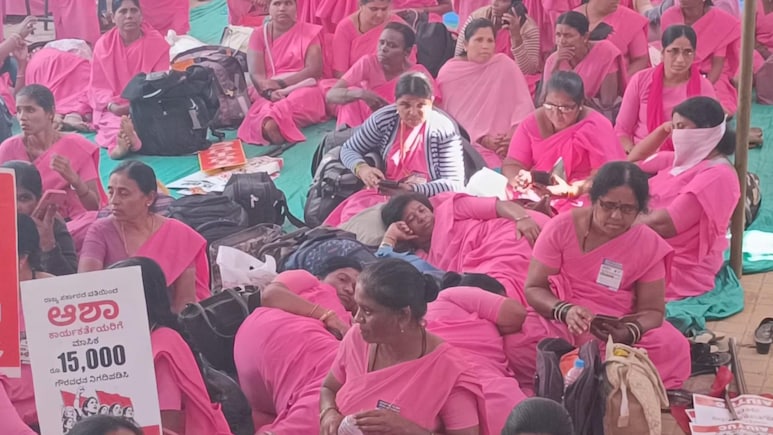
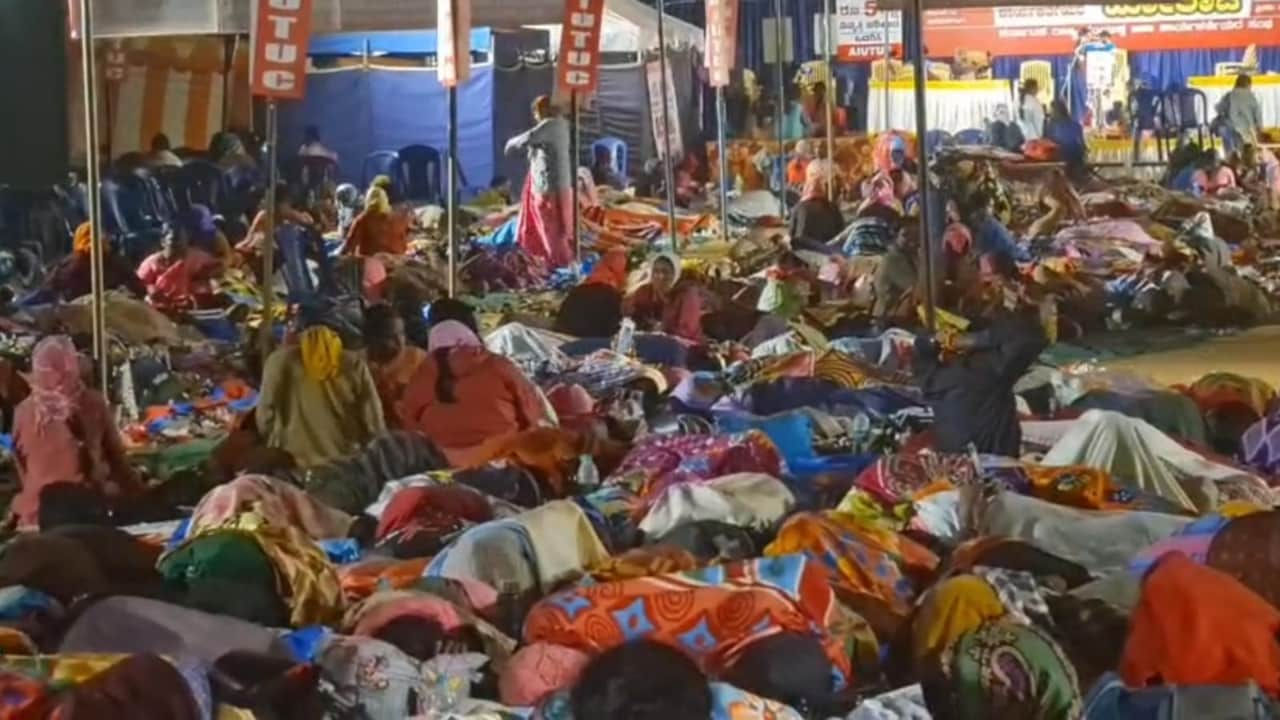
As night falls over Bengaluru and the November chill settles into Freedom Park, thousands of women huddle together under open skies, wrapped in thin shawls without blankets, fighting for a wage that lets them survive.
For six days, roughly 20,000 Accredited Social Health Activists (ASHA) from across Karnataka have turned the protest ground into a makeshift home. They are the backbone of India's public healthcare system, the first responders who knocked on doors during the peak of the COVID-19 pandemic and the tireless foot soldiers behind pulse polio drives. Yet today, the women who spent years safeguarding the state's health are braving freezing nights, inadequate sanitation, and exhaustion because government assurances have repeatedly failed to translate into written orders.
At the heart of their indefinite agitation, which began on November 17, is a straightforward plea: a fixed monthly honorarium of Rs 15,000, alongside basic welfare protections.
In one corner of the sprawling protest site sits 48-year-old Kaveri Amma from Belagavi district. Having served as an ASHA worker for over a decade, she left her 10-year-old and 7-year-old children back home with relatives to join the demonstration. For Kaveri, returning empty-handed is no longer an option.
"I have been an ASHA worker for more than a decade, working day and night and helping everyone," she says, her voice steady despite six days on the pavement. "What am I getting from the state government? Just Rs 5,000, plus a central incentive that doesn't even come every month. I have kept my children away from me for the last six days so that their future becomes bright. If I go back now without an order, what will happen to them?"
Nearby, Nagalakshmi from Vijayapura cradles her young child against the cold. An ASHA worker for seven years, she points to the harsh conditions at the venue, sleeping on hard ground without blankets and struggling with a lack of proper washrooms.
"Who wants to live like this?" Nagalakshmi asks. "But we don't have any option. Last year, we sat on protest, and the government promised Rs 10,000. We trusted them and withdrew, but they never gave it. This time, I will not leave until the government issues an official order, even if it means I die here."
For many of the women gathered in Bengaluru, the administration's reluctance feels like a deep betrayal, especially given the risks they took during public health emergencies.
Nazia Begum, an ASHA worker from Bengaluru, recalls the height of the COVID-19 lockdowns when fear kept most people indoors. "When COVID was here, nobody came out except us. We went everywhere," she says. "I was even beaten once when I went to tell people to come for vaccination. We risked our lives for the public, and today the government isn't even bothered about us."
While the Central Government launched the ASHA scheme in 2005, Karnataka began recruiting workers in 2009 and was notably the first state in the country to introduce a fixed monthly honorarium. Today, roughly 41,000 ASHA workers operate across the state. However, workers say that the Rs 5,000 state payout, which vanishes within two weeks against the rising costs of dal, sugar, cooking gas, and bus fares, forces them to borrow money just to feed their families for the rest of the month.
Rama TC, State Vice-President of the Karnataka Rajya Samyuktha ASHA Karyakarteyara Sangha, argues that a state that once led the nation in supporting health workers has now fallen severely behind. Pointing out that neighboring Kerala provides Rs 12,000 to its ASHA workers, Rama notes that Rs 15,000 is the bare minimum required to survive Karnataka's high cost of living.
Beyond the honorarium, the union is pushing back against systemic policies they say are penalizing workers. They are strongly opposing the mandatory use of the Samastha App for uploading daily work records, noting that technical glitches in the existing RCH portal already cost workers their case-based incentives and adding another platform will only deprive them further. At the same time, the union has condemned the lack of paid sick leave as inhuman, pointing out that workers diagnosed with cancer and other critical illnesses currently face wage cuts while undergoing treatment. To ensure long-term security, protestors are also demanding a one-time retirement benefit of Rs 5 lakh, modeled on the welfare scheme currently provided to ASHA workers in West Bengal.
Efforts by the state leadership to diffuse the agitation have so far hit a wall. Health and Family Welfare Minister UT Khader visited Freedom Park to receive the workers' memorandum and assure them of support, and on Saturday evening, he held a round of talks with ASHA representatives. However, the meeting ended without a breakthrough. Even an emotional appeal from Chief Minister DK Shivakumar,who addressed the protesters as their "elder brother" and promised that their demands would be discussed and resolved in the upcoming assembly session, failed to sway the crowd. Having already called off a protest last year after then-Chief Minister Siddaramaiah promised a Rs 10,000 honorarium that never materialized, the workers refused to budge on verbal assurances alone.
Behind the government's hesitation lies a significant financial crunch. Policy experts point out that the state exchequer is already under severe strain due to its flagship guarantee schemes, and raising the honorarium by even Rs 5,000 for 41,000 workers would impose an additional annual burden of roughly Rs 246 crore.
The protestors, however, remain unconvinced by the fiscal argument. Union leaders and workers alike point out that the administration has found ways to allocate thousands of crores for road projects and Rs 500 crore for government advertisements, questioning why the coffers suddenly run dry only when it is time to pay the frontline women keeping Karnataka healthy.
As the protest stretches into its sixth day, Freedom Park remains a sea of resilience. For Kaveri, Nagalakshmi, Nazia, and 20,000 others, the biting Bengaluru cold is a small price to pay compared to a lifetime of financial insecurity and they are prepared to wait until ink finally meets paper.
Track Latest News Live on NDTV.com and get news updates from India and around the world

