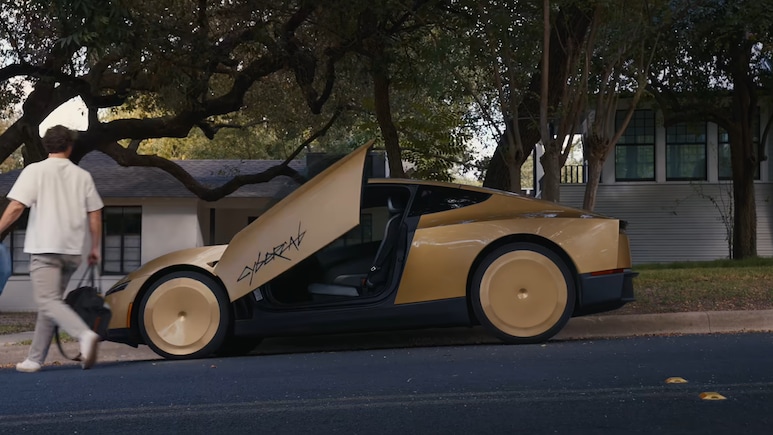
Tesla has begun operating its purpose-built Cybercab robotaxis in Austin, Texas, but the rollout has immediately drawn scrutiny from the US National Highway Traffic Safety Administration. The regulator has opened an audit into the process and technical data Tesla used to self-certify the driverless vehicles as compliant with federal motor-vehicle safety standards.
Cybercabs On Austin Streets
Tesla deployed the two-seat Cybercab in Austin this week as part of its robotaxi service. The launch was accompanied by an event for invited guests and forms part of Elon Musk's stated plan to expand an autonomous ride-hailing network across the United States.
Also Read: Skoda Octavia RS Gets Second Batch In India At Rs 56.69 Lakh
The Cybercab differs substantially from a conventional passenger car. It has no permanently attached steering wheel, accelerator pedal, brake pedal or exterior mirrors. Passengers therefore cannot assume control of the vehicle through traditional manual inputs if an unexpected situation develops during a journey.
Tesla told the NHTSA that it had self-certified the vehicle as meeting all applicable Federal Motor Vehicle Safety Standards, known as FMVSS. In the United States, automakers generally self-certify new vehicles before they are sold or placed on public roads, rather than obtaining model-by-model approval in advance.
Also Read: Kia Carens, Carens Clavis CNG Specifications Revealed Ahead Of Launch
NHTSA Examines Certification Process
The NHTSA has opened what it calls an Audit Query, or AQ, covering roughly 1,000 Cybercab vehicles. The review does not by itself mean the agency has concluded that Tesla violated a safety rule or that the Cybercab service must stop. Rather, it is intended to assess the basis for Tesla's certification and whether the company's compliance approach was appropriate.
In its notice, the agency said it would examine "the process and technical data" Tesla used to make its certification. It will also consider how the company determined whether some federal standards were inapplicable to a vehicle without conventional driver controls.
Also Read: Kia Sorento SUV Launched In India At 27.99 Lakh; Gets Diesel, Hybrid AWD
The Cybercab's design creates a different regulatory question from a vehicle that merely adds advanced driver-assistance functions. Requirements covering mirrors, braking controls and steering systems were written around vehicles with human drivers. A fully autonomous vehicle without a driving position must still demonstrate that it meets relevant safety requirements or explain why specific requirements do not apply.
Broader Robotaxi Ambitions
Tesla's existing robotaxi operations in Austin have operated for more than a year using conventional Tesla vehicles. The company has also begun offering rides in five additional cities across Texas and Florida, according to reports. The Cybercab is intended to become the dedicated vehicle for a larger, lower-cost driverless transport service.
Musk has said Tesla plans a wider national expansion, although the pace of that rollout will depend on operational readiness and regulatory requirements in each jurisdiction. The NHTSA's review could help clarify how federal safety standards apply to purpose-built autonomous vehicles, not only Tesla's model.
Similar Cases
Tesla is not the first autonomous-vehicle company to face questions about a vehicle without manual controls. Zoox, Amazon's robotaxi subsidiary, previously underwent a regulatory review after self-certifying its own steering-wheel-free vehicle. The company ultimately received approval after formal scrutiny.
Track Latest News Live on NDTV.com and get news updates from India and around the world
