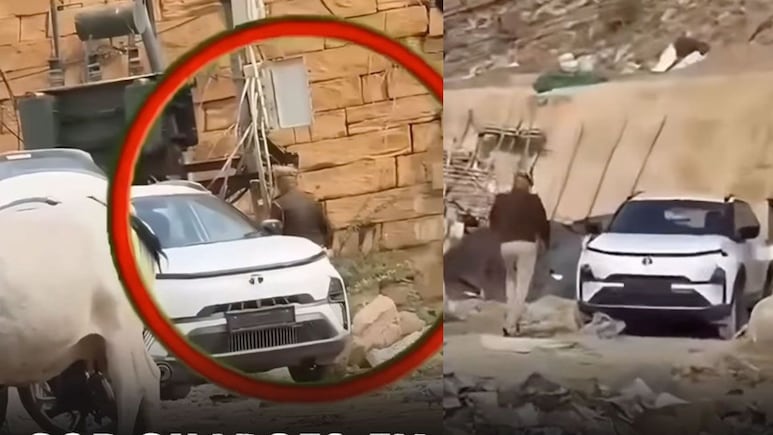
A video reportedly from Rajasthan's Jaisalmer showing a police constable allegedly charging a Tata Nexon EV directly from an electricity distribution point has sparked widespread criticism online. The act, captured in a short clip circulating on social media, raises serious safety and legal concerns related to the misuse of public electrical infrastructure.
In the video, the policeman, dressed in uniform, is seen plugging a white Nexon EV into a power pole near a transformer. The vehicle, which reportedly lacked a number plate, appeared to be connected through a makeshift wire at a local power distribution point. It remains unclear whether the electric SUV belonged to the constable or someone else.
Also Read: Tesla To Discontinue Model S And Model X: What It Means For The Brand
Local residents reportedly noticed the act and recorded the video, which was later posted online. The Instagram page that shared the footage stated that it had not been able to confirm all details of the incident, but the visuals have since gone viral.
Also Read: Hyundai Exter Facelift Spied On Test - Here's What Tata Punch Rival Gets
Experts point out that such charging practices are extremely risky. Distribution transformers carry high-voltage current unsuitable for direct charging of electric vehicles. Without a regulated EV charging unit that ensures controlled voltage and frequency, the vehicle's electrical systems, including its battery management system and on-board charger, can suffer severe damage. Power fluctuations could also trigger short circuits or fires.
There is also a significant risk of electric shock to anyone handling live connections near a transformer. Regulations mandate that EV charging should not occur within 15 metres of such units. Harmonics or interference caused by unsafe charging can also affect other electrical systems connected to the same network.
Overloading is another concern. Electric vehicles draw a large amount of continuous current, which can strain an already loaded transformer, potentially leading to overheating, fuse damage, or local power outages.
Legally, this act violates Section 135 of the Indian Electricity Act, 2003, which classifies unauthorized tapping of power lines or bypassing electric meters as theft. The offence can attract imprisonment of up to three years and a fine amounting to three times the financial gain.
Track Latest News Live on NDTV.com and get news updates from India and around the world
