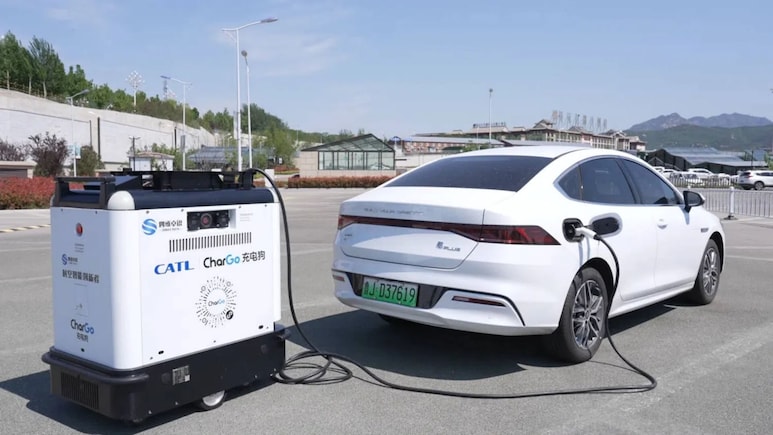
- Mobile-charging robot converts parking spaces into EV charging points in China
- Robot called Energy Tank navigates autonomously and starts fast charging via app
- 100-kWh battery powers EVs from 10% charge to usable level in 40 to 60 minutes
A mobile-charging robot developed in China is turning ordinary parking spaces into on-the-go electric-vehicle (EV) charging points, offering a practical solution for owners in areas with limited fixed infrastructure. The compact, self-guided unit, marketed as a "mobile power bank," has been deployed in older residential complexes, where more than 400 EVs compete for scarce parking and grid capacity.
Residents can summon the robot via a smartphone app, after which the device, about 1.5 meters tall and equipped with a 100-kWh battery pack, autonomously navigates to the parked car and begins fast charging within minutes. According to CarNewsChina's report, an EV at around 10 per cent state of charge can be replenished to a usable level in roughly 40 to 60 minutes, significantly easing range anxiety for urban dwellers.
Also Read: Woman Drags Tesla To Court After Cybertruck Almost Drives Her Off Bridge With Child Onboard
The robot, branded as the "Energy Tank" by Eraergy, is designed as a full-chain reconfigurable unit that integrates battery storage, a driveable chassis, and intelligent control software. It is available in three variants with 30, 100, and 200-kWh capacities and can deliver up to 120 kW of discharge power, enabling compatibility with a broad range of EV models.
Also Read: Booked 2026 Renault Duster? 7 Genuine Accessories Worth Buying From Day One
The company is expanding the model beyond residential areas into hotels, highway service zones, and logistics yards, where partners such as SF Express use the units to top-up delivery vehicles during loading or waiting periods.
Industry observers highlight that such mobile systems tackle the classic "car-finds-a-pile" problem by flipping the dynamic: instead of drivers hunting for chargers, the charger comes to the vehicle. Given the constraints of older housing compounds and limited grid headroom, the technology could prove particularly useful in dense urban environments across China and other markets grappling with uneven charging access, like India.
Track Latest News Live on NDTV.com and get news updates from India and around the world
