





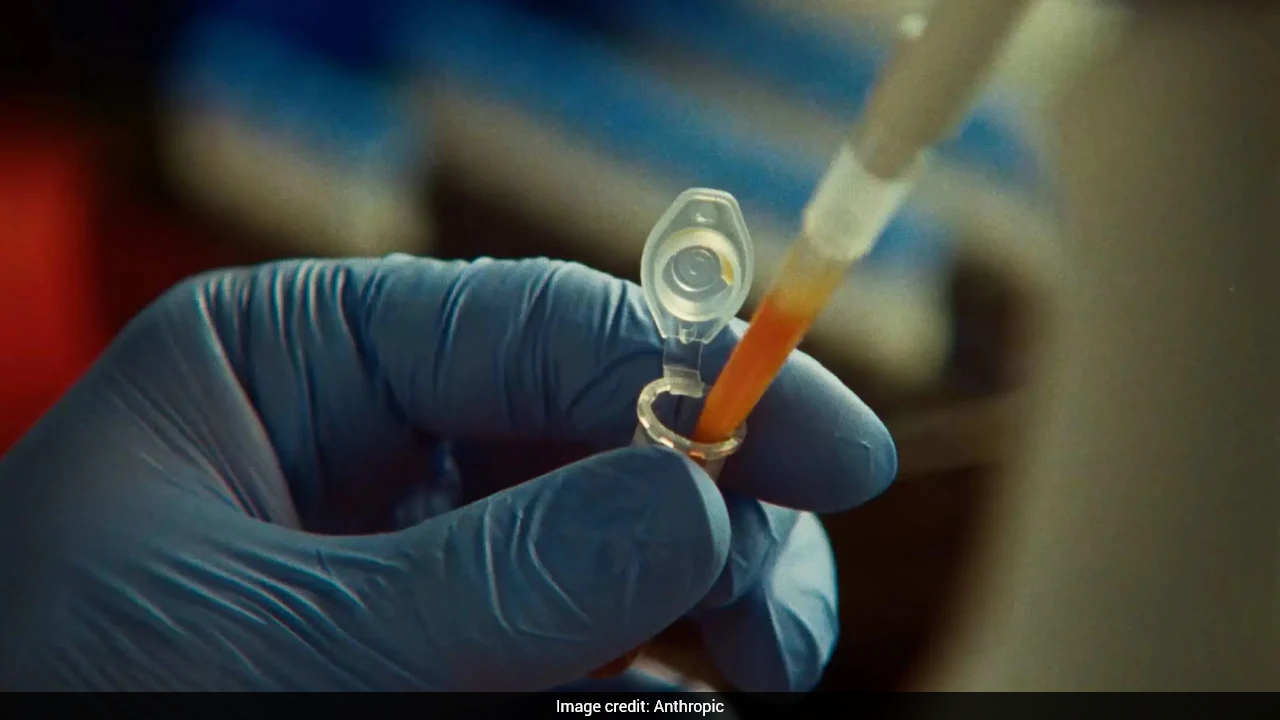
Biology appears to be the next frontier for artificial intelligence (AI) companies. After coding, software development and solving complex mathematical question, companies have set their eyes on editing the human genome. Anthropic made a bold claim last month: its artificial intelligence model, Claude, had independently identified a previously uncharacterised biological system that could offer clues for developing new gene-editing tools, much like CRISPR. But the announcement soon ran into controversy, with a scientist claiming he had already studied the same system.
What Did Anthropic's AI Discover?
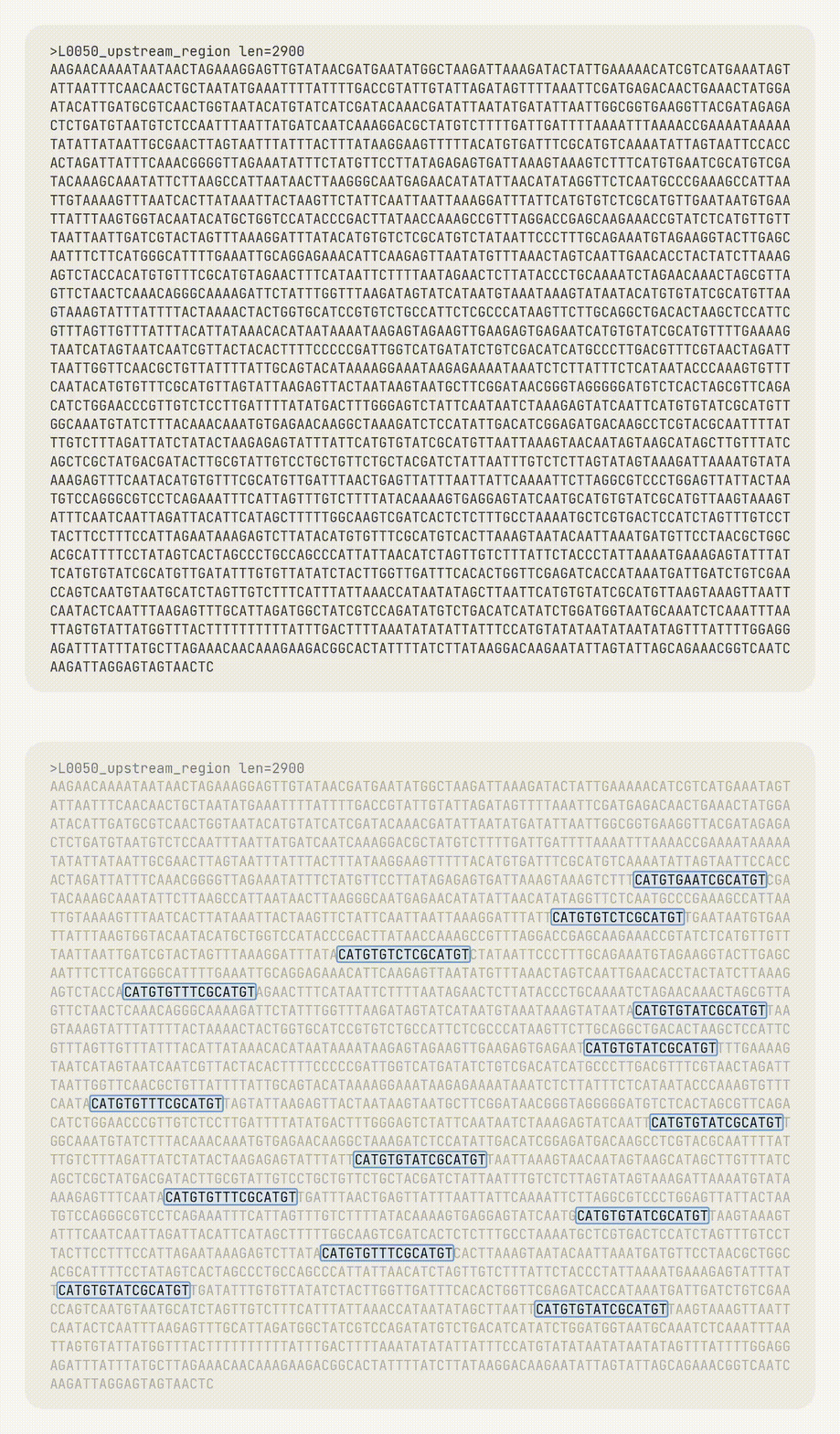
The raw DNA edited by Claude AI in which it found the pattern.
Photo Credit: Anthropic
On September 23, Anthropic said Claude had identified an unusual biological system in bacteriophages, viruses that infect bacteria. The company named it array-associated reverse transcriptases, or ART. The system has certain features that resemble CRISPR, the technology scientists use to modify DNA. CRISPR has transformed genetic research and is being used to develop treatments for some diseases.
Anthropic said around 950 AI agents searched more than 200,000 reverse transcriptases, eventually identifying a promising candidate after about 21 hours of analysis.
However, researchers have not yet established what ART does or shown that it can edit genes like CRISPR.
Naturally, The Discovery Is Facing Questions
Days after Anthropic's announcement, Mario Rodriguez Mestre, a researcher at the University of Copenhagen, told CNN that his team had been studying the same biological system for years.
Mestre said he had also used Claude extensively during his doctoral research, including sharing unpublished research material with the chatbot. He questioned whether the AI company's claimed discovery was genuinely independent of work he had already done.
The controversy centres on two questions: Whether Claude identified something genuinely new and whether information from the researcher's interactions with AI could have influenced the result.
What Anthropic Said About The Scientist's Claim
There is no established evidence that Anthropic used Mestre's unpublished work to make the discovery.
Anthropic has said its model was not trained on user transcripts. The company also described its research process as one in which Claude's agents searched genetic databases, examined unusual patterns and generated hypotheses, with scientists providing initial direction and conducting laboratory experiments.
Anthropic itself acknowledged that the underlying reverse transcriptase had been identified in earlier research. Its claimed contribution was recognising a pattern of repeating DNA sequences alongside the enzyme, suggesting it could be part of a previously uncharacterised biological system.
But identifying a pattern is only the beginning. Scientists still need to establish how the system works and whether it has any practical application.
The research has also not yet been published in a peer-reviewed scientific journal, according to CNN's report.
What Does This Mean For AI Research?
The episode highlights both the promise and the limitations of AI in science.
AI models can sift through enormous datasets and identify patterns that researchers might overlook. But a promising lead is not the same as a proven discovery, and questions about originality and scientific credit still need answers.
Track Latest News Live on NDTV.com and get news updates from India and around the world

