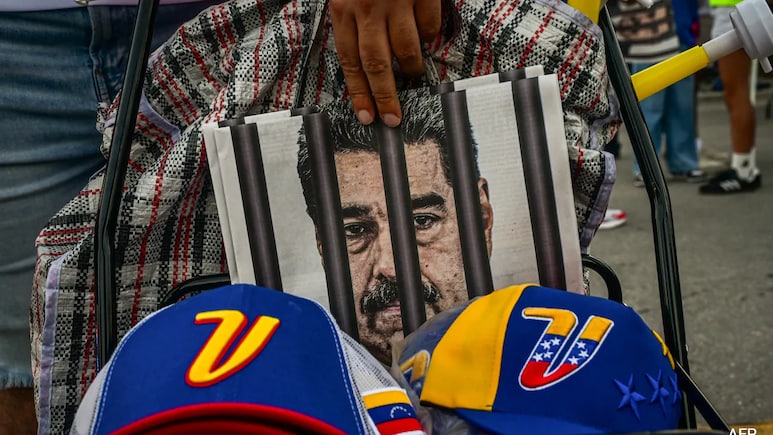
The United States' military strikes in Venezuela and the subsequent capture of President Nicolas Maduro and his wife have triggered a sharp diplomatic split globally.
Maduro and his wife, Cilia Flores, are now facing multiple federal charges, including their involvement in a narco-terrorism conspiracy and coordinating with drug trafficking and terrorist groups to distribute cocaine. They are also charged with conspiracy to import cocaine into the US, possession of machine guns and destructive devices, and conspiracy to possess weapons in connection with the broader scheme.
Countries Condemning The US Action
A large bloc of countries has rejected the US operation as a violation of international law and Venezuelan sovereignty.
Major powers Russia, China, Iran, and Belarus are on the list. Moscow called the strikes an “act of armed aggression,” arguing that the justifications offered by Washington were “unfounded” and urging an immediate focus on dialogue to prevent escalation.
Beijing said it was “deeply shocked” by the use of force against a sovereign country and its president, calling on the US to respect the UN Charter.
Iran called for the UN Security Council to act “immediately to halt the unlawful aggression.”
Across Latin America, several governments voiced strong opposition.
Brazil's President Luiz Inacio Lula da Silva said the bombings and capture of Maduro “cross an unacceptable line” and warned that such actions push the world toward “violence, chaos, and instability.”
Chile, Colombia, Uruguay, Mexico, Bolivia, Peru, and Nicaragua all said that Venezuela's crisis must be resolved through peaceful and democratic means, not external military intervention.
A joint statement by Brazil, Chile, Colombia, Mexico, Spain, and Uruguay said the strikes “contravene fundamental principles of international law” and endanger civilians while undermining regional peace.
Spain's Prime Minister Pedro Sanchez said that while Madrid does not recognise the Maduro regime, it also “will not recognise an intervention that violates international law.”
In Europe, several leaders raised concerns. Germany's Chancellor Friedrich Merz said the legal assessment of the US operation was “complex” and warned against political instability.
Norway called the intervention “not in accordance with international law,” while Slovakia said it reflected the breakdown of the post-World War II global order.
Denmark, the Czech Republic, Italy, and Malaysia requested de-escalation and diplomacy.
At the United Nations, Secretary-General Antonio Guterres' spokesperson warned that the developments constituted “a dangerous precedent”, adding that international law and the UN Charter must be respected by all parties.
Countries Supporting The US Action
Israel's Prime Minister Benjamin Netanyahu congratulated US President Donald Trump for what he called “bold and historic leadership,” praising the “decisive resolve” of American forces.
Somaliland, a self-proclaimed independent region recognised only by Israel, has backed the US action. Its Foreign Ministry said the territory “affirms its principled alignment with the United States in support of calibrated international action to uphold constitutional order and the rule of law in Venezuela, and to support a peaceful, Venezuelan-led transition.”
Argentina's President Javier Milei went further, calling the developments “excellent news for the free world” and describing the situation as the collapse of a dictatorship that had clung to power despite electoral defeat.
Ecuador's President Daniel Noboa framed the strikes as the beginning of the end for what he called “narco-Chavista criminals.”
Neutral Responses
India's Ministry of External Affairs (MEA) revealed “deep concern” over the attacks and the capture of Maduro. “India reaffirms its support to the well-being and safety of the people of Venezuela. We call upon all concerned to address issues peacefully through dialogue, ensuring peace and stability of the region,” the ministry said.
The United Kingdom, through Prime Minister Keir Starmer, said it was not involved in the operation and would first establish the facts, while saying that international law must be upheld.
Canada said it stood with the Venezuelans' desire for democracy but urged all parties to respect international law.
The European Union, through Commission President Ursula von der Leyen, said it supports a peaceful and democratic transition in Venezuela, saying that “any solution must respect international law and the UN Charter.”
Japan, Singapore, South Africa, Panama, Paraguay, Trinidad and Tobago, and Malaysia all adopted similar positions.
Track Latest News Live on NDTV.com and get news updates from India and around the world


