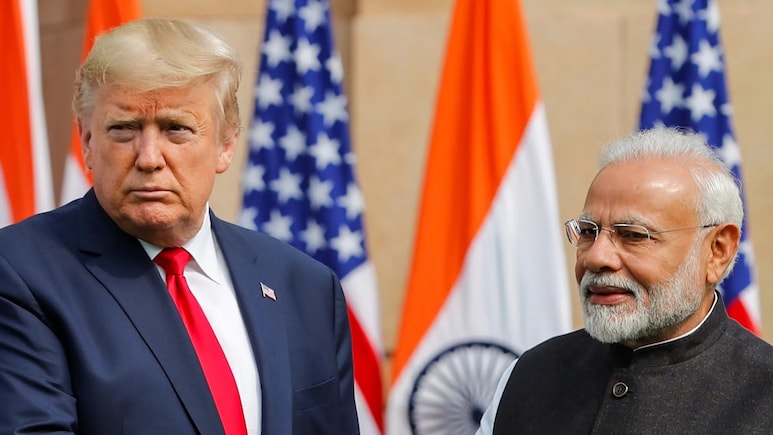
Senior officials in the Donald Trump administration have moved swiftly to define the public narrative around the newly announced US-India trade deal, presenting it as a decisive economic win for American exporters and a strategic breakthrough that reshapes India's energy and purchasing choices—despite the absence of detailed documentation from either side.
A day after President Donald Trump said US tariffs on Indian goods would be reduced from 50 per cent to 18 per cent, US Trade Representative Jamieson Greer told American media the agreement is essentially complete. "This is it. The time has come, and now we have the deal. We'll finish papering it. But we know the specifics. We know the details," he said, describing the pact as "a very exciting opportunity."
-

-
 "High Inflation Is Like Tax On Everyone": RBI Governor At NDTV World Summit
 -
 AI Agents To Outnumber Humans Soon? What Futurist Mike Walsh Told NDTV
 -
 This Delhi Boy Has 3 Michelin Stars. His Heart Still Goes To Rajindar Da Dhaba
 -
 Ashwini Vaishnaw Explains Semiconductor Complexity: 'Everything On This Tiny Nail'
 -
 Indian-Branded Mobile Phones By October 23, 2028, Says Ashwini Vaishnaw
 -
 AI Law In India Soon? What Ashwini Vaishnaw Said At NDTV World Summit
 -
 'Need To Look At Next 10 Years': Bondada Chairperson To NDTV On Solar Energy
 -
 World's 1st AI Actor Tilly Norwood Was Asked If She Knew Hindi. A Conversation Followed
 -
 AI Law In India Soon? What Ashwini Vaishnaw Said At NDTV World Summit
 -
 Iran's Supreme Leader's Representative Says India Can Play 'Big Role' In Middle East Peace
Greer indicated Washington would retain an 18 per cent tariff because of what he called a "giant trade deficit" with India, while asserting that India has agreed to lower its tariffs across a wide range of sectors, including agriculture, manufactured goods, chemicals, and medical devices.
At the White House, Press Secretary Karoline Levitt expanded the scope of the narrative well beyond tariffs. She said Trump's phone call with Prime Minister Narendra Modi had resulted in India agreeing to stop purchasing Russian oil, increase purchases of American oil, and potentially source oil from Venezuela as well. She added that PM Modi had committed to $500 billion in purchases of US energy, transportation, and agricultural products, and that American exports to India would face "a tariff of zero per cent."
"Well, I have the great honour and pleasure of seeing President Trump interact with leaders all around the world. When it comes to Prime Minister Modi, I know he particularly enjoys their relationship and has a deep respect for the prime minister and for his country of India," Leavitt said. "They had a great call. It was very productive yesterday, and they struck a deal..."
Inside White House's Framing Of India Trade Pact
The coordinated messaging suggests the administration is seeking to lock in a perception of a sweeping breakthrough before the technical architecture of the agreement is made public. The emphasis is threefold—that the US has extracted meaningful market access from India, that it has used trade leverage to influence India's energy sourcing away from Russia, and that it has secured large-scale purchase commitments that benefit American industry and workers.
Yet, crucial elements remain unclear. Greer's remark that officials will "finish papering" the deal indicates that formal texts, annexes, schedules, and implementation timelines may still be under negotiation. Leavitt's assertion of zero tariffs on US exports raises questions about how sensitive sectors—particularly agriculture—will be handled in practice and whether phase-ins, quotas, or safeguards are embedded in the fine print.
On the Indian side, there has been no release of tariff-line details, legal text, or sector-specific commitments so far. New Delhi has not publicly confirmed the scale of energy purchase pledges, the status of Russian oil imports, or the claim of zero tariffs for US exports.
For now, the Trump administration's narrative is clear and assertive: the deal is done, it is historic, and it delivers both economic and geopolitical gains. Whether the eventual text matches the scale of these claims will become evident only when the paperwork Greer referred to is finally put on the table.
Track Latest News Live on NDTV.com and get news updates from India and around the world


