Despite protests in small towns and cities across the US, the Trump administration is pushing ahead with the purchase of warehouses it plans to convert into immigration jails in what could be the largest expansion of such detention capacity in US history.
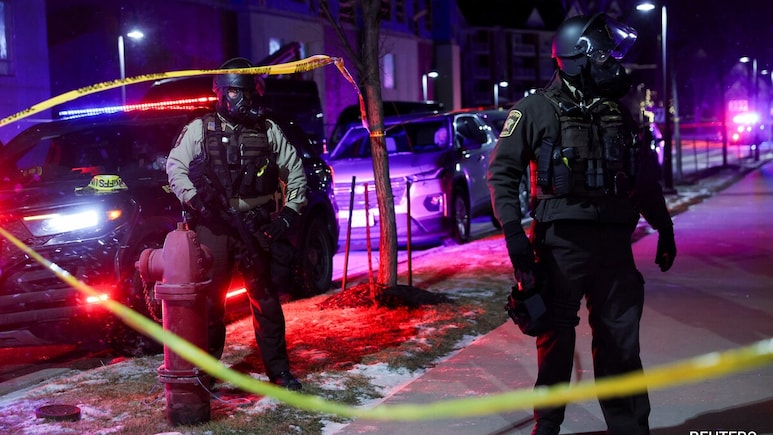
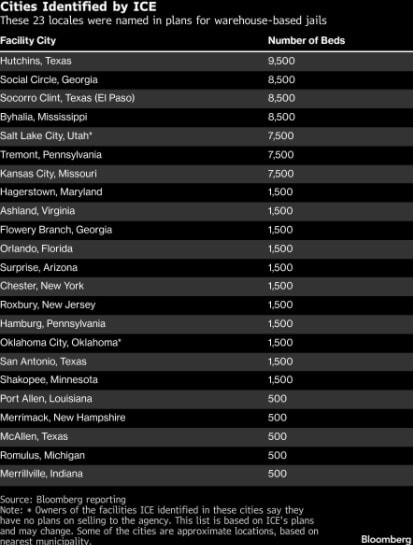
The cost for acquiring two warehouses alone was $172 million. A third in El Paso, Texas, could be among the largest jails of any kind in the country if completed as envisioned, with 8,500 beds. The deals mark the latest turn in US Immigration and Customs Enforcement's plan to use as many as 23 warehouses for detaining thousands of immigrants arrested by federal agents in Minneapolis and other cities. Those aggressive enforcement actions have ignited clashes with protesters and led to agents killing two US citizens.
On Jan. 16, the administration paid $102 million for a site near Hagerstown, Maryland, according to a local court filing. A week later, the government paid $70 million in cash for a warehouse in Surprise, Arizona. The price tags - roughly in line with the industry average for the warehouse market - cover just the acquisition of the sites, which are currently empty shells. ICE still has to pay companies to outfit the buildings with toilets, showers, beds, dining and recreation areas and then run them as detention centers.
The El Paso site was purchased by the Department of Homeland Security recently, according to people familiar with the transaction who asked not to be named discussing a confidential process. But the sale price hasn't yet been made public. Other transactions appear to be near completion. Canadian billionaire Jim Pattison's company said in a statement that it had accepted an offer to sell its 550,000-square-foot warehouse in Ashland, Virginia, to a US government contractor. "Some time later, we became aware of the ultimate owner and intended use of the building," it said. "This transaction is still subject to certain approvals and closing conditions."
In an indication of just how sensitive the warehouse conversions have become, the company added: "We understand that the conversation around immigration policy and enforcement is particularly heated, and has become much more so over the past few weeks. We respect that this issue is deeply important to many people."
On Thursday, Oklahoma City Mayor David Holt said he'd met with the owners of a warehouse identified by ICE who told him they were no longer going to sell or lease the facility to the agency. "I commend the owners for their decision and thank them on behalf of the people of Oklahoma City," Holt said. "I ask that every single property owner in Oklahoma City exhibit the same concern for our community in the days ahead."
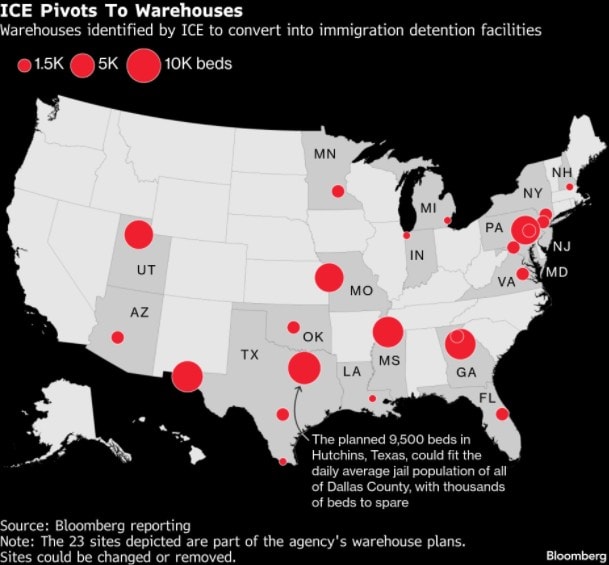
The warehouses, many of which originally were designed and marketed as e-commerce distribution facilities, represent a significant pivot for the administration's $45 billion immigration detention buildout. Last year, it relied on tent camps constructed in remote places like the Florida Everglades and an Army base in Texas.
Add image caption here
Little has been publicly shared about ICE's plans for the new detention centers in small towns and cities across the country. Already, many residents have voiced opposition and local leaders are considering options to prevent the agency from using them. The concerns include both immigration politics as well as land-use issues - proximity to homes and schools, and questions of sewer capacity and water demand. Given such pushback and the logistical challenges, there's no guarantee each of the 23 sites will be converted.
More than 200 people showed up to protest the warehouse plans in Hagerstown on Jan. 20 in below-freezing temperatures. "One of the most obscene, one of the most inhumane, one of the most illegal operations being carried out by this Trump Administration is what they're doing at the Department of Homeland Security and ICE," US Senator Chris Van Hollen, a Maryland Democrat, told the protesters. "We do not want an ICE facility here in the state of Maryland."
DHS and ICE didn't respond to a detailed request for comment. Neither did the companies that sold the properties in Maryland, Arizona and Texas - Fundrise, Rockefeller Group and Flint Development, respectively.
The 23 proposed sites would range in size from 500 to 9,500 beds. If completed as planned, the larger facilities would be some of the biggest detention centers of any kind in the country. For example, the 9,500-bed facility ICE is planning for Hutchins, Texas, could fit the entire average daily jail population of Dallas County with thousands of beds to spare.
In recent weeks the federal government has given tours of potential sites in more than 20 cities to contractors and shared with them the designs, including preferred layouts, for at least 15 of the sites, according to people familiar with the confidential process. Contractors - the ones who will turn these warehouses into jails - were required to send in their proposals for the first sites this week, starting with Hagerstown, according to those sources.
To reach its goal of deporting 1 million people a year, the Trump administration has said it needs more than 100,000 detention beds. Currently, there are more than 73,000 people in ICE custody, a record. The new sites could give the agency an additional 76,500 beds, according to documents shared with Bloomberg News. To fill all of them, the administration would have to expand immigration arrests beyond what it is already doing, said Emma Winger, deputy legal director at the American Immigration Council.
"To reach these kinds of numbers, they'd need to go out into the communities and find people who've been living their lives and been here a long time," Winger said. "They'd have to dramatically increase their presence in communities across the country."
ICE and Customs and Border Protection have already ramped up their presence and arrests on American streets. The estimated 3,000 immigration agents deployed in Minneapolis-St. Paul is roughly 10 times the number sent last September to Chicago, a significantly larger city. In January alone, federal immigration agents in the Twin Cities fatally shot two people, Renee Good and Alex Pretti. At least six people have died nationwide since Trump's crackdown began.
As the administration increases its law enforcement efforts on the ground, it's also casting a wider net for the types of people who could end up in detention. More than 1 million people have had their temporary immigration statuses canceled since Trump returned to office, putting them at risk of deportation. Immigration officers have also arrested immigrants at routine court appearances and check-ins. More recently, in Minnesota, DHS said it's targeting 5,600 immigrants to reverify their status claims. That has resulted in some people with legal status getting arrested, jailed and flown to Texas for interviews before being released and forced to pay their own way home, according to lawyers and advocates.
Unlike the cities where ICE and CBP agents have fanned out for arrest operations in recent months, many of the locations ICE has identified for its warehouse jails are in Republican-leaning areas. Still, residents in many of the chosen municipalities have been trying to block ICE's arrival.
This month, demonstrators protested warehouse conversions in New Hampshire, Utah, Texas and Georgia after the Washington Post published an earlier version of the conversion plan. In mid-January, a planned tour for contractors of a potential warehouse site in San Antonio was canceled after protesters showed up the same day, according to a person familiar with the scheduled visit. In Salt Lake City, the Ritchie Group, a local family business that owns the warehouse ICE identified as a future "mega center" jail, said it had "no plans to sell or lease the property in question to the federal government" after protesters showed up at their offices to pressure them.
Earlier in January, in Merrimack, New Hampshire, around 1,200 people protested the conversion of a warehouse owned by real estate giant CBRE. In the Village of Chester, New York, residents attended a community meeting to call on their leaders to stop ICE's plans in any way they could. The more than 400,000-square-foot warehouse that ICE has its eyes on there is owned by the holding company of billionaire and former Trump adviser Carl Icahn.
Social Circle, Georgia, is one of the 15 locations where ICE has shared design details with contractors. Marketing materials for the warehouse there - as well as brochures for sites in Mississippi, New Hampshire, New Jersey, Texas and Pennsylvania - highlight the suitability for commerce, distribution and logistics. Some of them cite their proximity to large stores such as Walmart.
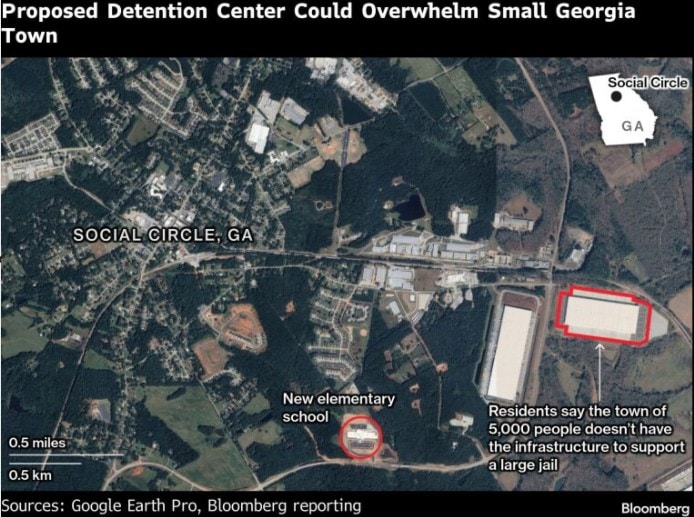
Eric Taylor, Social Circle's city manager, said this week that he still hadn't received any communication from federal officials about plans there for an 8,500-bed detention center. Taylor said the town of roughly 5,000 people doesn't have the infrastructure to host the planned facility. The city has 17 sworn police officers and 14 firefighters, and its water and sewage capacity is already maxed out, Taylor said, adding that property taxes on the warehouse would drop to zero if acquired by the federal government. The building is also close to the town's new elementary school.
Local governments are limited in what they can do to prevent ICE from opening and operating a detention facility, even if it doesn't meet local zoning requirements. That's because federal actions typically supersede local rules, though it can become more complicated when private companies are doing things on behalf of the federal government.
Municipalities will have other tools to stall or inhibit ICE's work: The federal government can't force a municipality to build a new public road or other utilities because a facility needs it. And many of the warehouses have their sewage and water systems serviced by municipalities, which means they could have a say over whether it has the capacity to meet a large jail's demands.
The Trump administration's push to make 3,000 immigration arrests per day - and its insistence that those adjudicating their cases do so from detention - has created an intense demand for jail space. It has gone through multiple iterations of plans to massively expand its detention capacity.
In the early days of Trump's second term, ICE leveraged longstanding relationships with private prison companies such as CoreCivic and Geo Group to boost detention space. Those companies gave ICE access to additional beds in their existing jails, purchased and leased new facilities and reopened shuttered ones. Those companies said in November earnings calls that they still have a total of more than 30,000 beds that they could bring online, if asked by the federal government.
"We continue to believe that detention beds like these represent the best value and are the most humane, most efficient logistically, have the highest audit compliance scores in their system, are more secure, weatherproof and are readily available," then-CoreCivic Chief Executive Officer Damon Hininger said on his company's earnings call.
Yet, by the middle of last year, the Trump administration had pivoted to a plan that was outlined in Project 2025: using soft-sided facilities, or tents, to quickly erect new detention camps. ICE created a shortlist of potential partners, which included a number of companies that typically build emergency tent camps in the wake of natural disasters.
Two large tent camps grew out of that strategy shift: a state-run facility in the Florida Everglades nicknamed "Alligator Alcatraz" by Republicans and a federally run camp on a military base in El Paso, Texas. Both have been plagued by allegations of inhumane conditions and mismanagement.
At El Paso's Camp East Montana, now the largest US immigration detention facility with about 3,000 people detained daily, the American Civil Liberties Union and other advocates allege a pattern of excessive force, sexual abuse and threats to coerce non-Mexican nationals to cross into the Mexican desert. ICE has denied allegations of abuse and said all people being deported are given due-process protections.
At least three people have died at the camp over the past two months. On Jan. 3, Geraldo Lunas Campos, a 55-year-old Cuban immigrant, died at the facility following a struggle with detention staff. Federal officials told the Washington Post that officers were attempting to restrain Campos during a suicide attempt. An autopsy report later released by the El Paso County medical examiner's office stated his death was a homicide and that he was asphyxiated after being restrained by law enforcement. On Jan. 14, Victor Manuel Diaz, 36, died in what ICE also said was a presumed suicide.
These incidents come amid a rising number of deaths in ICE detention since Trump returned to the White House. More than 30 people died in detention last year, the highest figure in two decades, and Campos and Diaz are two of the six people who have died in the agency's custody since the beginning of the year. A report from the American Immigration Council attributes the cause of many of last year's deaths to ICE's failure to provide adequate medical care.
Winger, the council's deputy legal director, said she expects dangers will persist, especially considering the capacity that ICE is planning for the new warehouse detention facilities.
"I suppose there's ways to build enough toilets and private places," she said. "But the various health needs of people in these facilities and ensuring that you even know who you're holding and who has vulnerabilities and who needs medication - it just seems impossible."
Track Latest News Live on NDTV.com and get news updates from India and around the world


