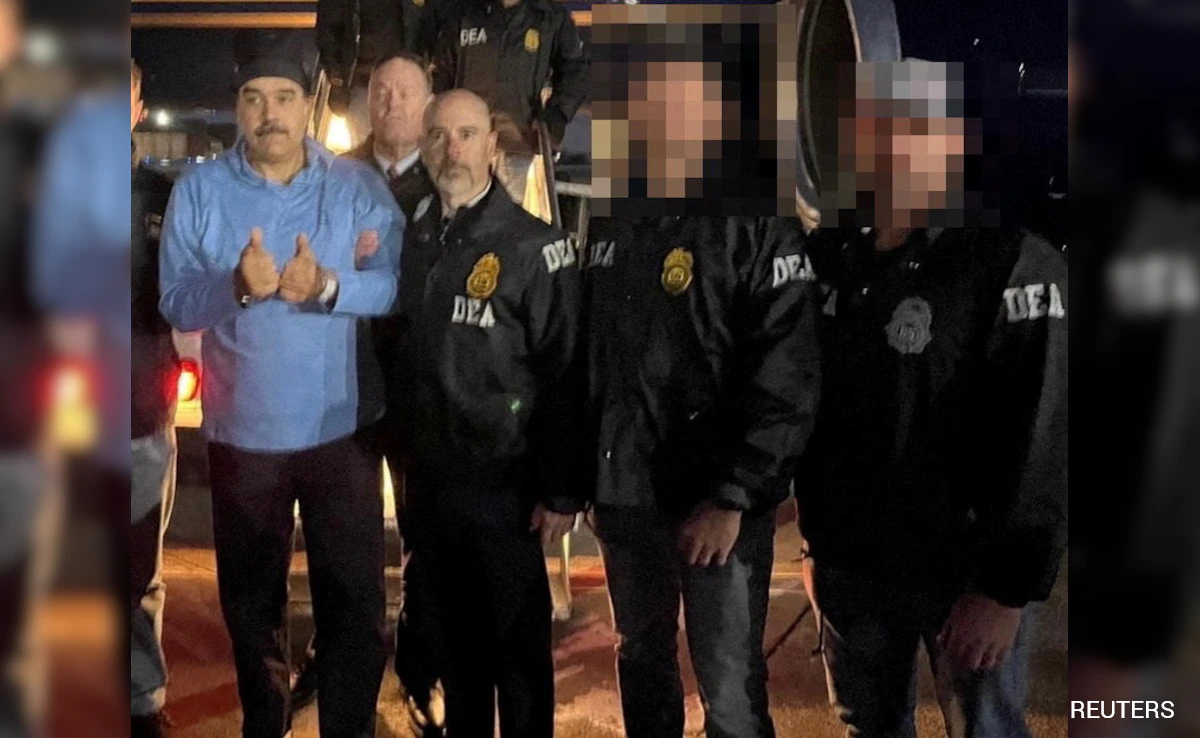
India's former Ambassador to Venezuela, YK Sinha, has likened the reported US assault on Caracas and the capture of President Nicolas Maduro to "a bygone era of gunboat diplomacy", warning that the episode could "open a Pandora's box" for the international system and embolden other powers to act similarly. Speaking to NDTV's Aditya Raj Kaul in an exclusive interview, Sinha said the images of Maduro being taken into custody, handcuffed and initially blindfolded, were designed to send "a very powerful signal" not only within Latin America but to governments across the world.
Sinha, who served as India's envoy in Caracas from 2007 to 2010, compared the latest developments to the US operation in Panama that led to the arrest of former Panamanian leader Manuel Noriega.
A Panama Reminder
"It reminds me of a bygone era of gunboat diplomacy... Noriega of Panama was also captured and then brought to the US for justice," he said, underscoring what he saw as a familiar pattern: a superpower using military force to seize a foreign leader and prosecute him under its own legal system.
In this case, Sinha noted, the scale of US military mobilisation had already suggested that an operation was imminent. "After such a large armada on the Caribbean Sea just outside Venezuela... some action is imminent," he said.
Yet the diplomat admitted he did not anticipate the timing or the speed with which the reported action unfolded. "I didn't expect that in the first few days of the new year, an assault would be launched... and in this manner," he said, describing the outcome as the rapid neutralisation of Venezuelan defences and the capture of Maduro and his wife.
Sinha said the visuals and messaging were intended to reshape regional perceptions of American power. In his view, the spectacle of a sitting president being transferred from Venezuelan territory to a US-controlled setting, the interview referenced a ship, Guantanamo Bay in Cuba, and ultimately a trial in New York, was aimed at demonstrating that Washington could still impose outcomes militarily in its perceived sphere of influence.
Trump's Return To Old Model
Sinha, who has also served as India's High Commissioner to the UK and Sri Lanka, also dwelt on US President Donald Trump's public remarks after Maduro's capture, particularly references to Venezuela's oil sector and the prospect of US companies expanding their presence.
Sinha argued that what Trump described was not new but a return to an older model of US dominance in the hemisphere. "The power grab or the land grab or resources grab... is nothing new," he said, adding that Venezuela's oil industry had historically been shaped by foreign firms until political shifts in Caracas began to curb outside control.
Tracing the roots of the current crisis, Sinha recalled Venezuela's long-running struggle over who benefits from its vast petroleum reserves. He noted that before Hugo Chavez came to power in 1999, "oil production was pretty much in the hands of American and European countries, mainly American."
Venezuelan Oil
He referred to the nationalisation of the Venezuelan oil industry and the role of state-owned company Petroleos de Venezuela (PDVSA), saying that Chavez later tightened control over the sector and that many international companies left, "except Chevron", as he put it.
Sinha argued that the departure of firms and the erosion of investment over time, compounded by sanctions, damaged Venezuela's production capacity. In his account, technology and machinery "got degraded", while the sanctions "impacted oil production and the oil export".
The result, he said, was that a country with "the largest reserves of oil" ended up exporting "a minuscule amount" relative to its potential. Against this background, he suggested, Trump's comments about "our oil" and plans for US firms to create "inroads" sounded like an attempt to reverse the Chavez-era trajectory and restore American primacy over Venezuelan resources.
Why Maduro Is No Chavez
At the same time, Sinha drew a distinction between Chavez and Maduro, suggesting that the late leader's charisma and political capital were not replicated by his successor. Maduro, he said, "is not...in the same class or [does not] have the same charisma that Chavez" did. That difference, in Sinha's view, complicated the internal political picture, particularly as competing claims to authority began to surface.
According to Sinha, the constitutional line of succession and the competing narratives about the legitimacy of elections were at the heart of the uncertainty. He referenced an interim arrangement involving Vice President Delcy Rodriguez, with the Supreme Court directing her to act as interim leader and elections expected within 30 days.
On Credibility of Venezuelan Polls
But Sinha noted that Western governments, especially the US, have questioned the credibility of Venezuela's last election, which they have described as flawed. In that scenario, he said, the opposition's claimed winner, Edmundo Gonzalez, could become a central figure, although he mentioned hearing that Gonzalez was in exile in Spain.
"This is a very murky situation. I don't know what's going to happen," Sinha said, emphasising that the decisive factor would likely be whether Venezuela's military and ruling party leadership remained unified.
Future Of Venezuela
He singled out senior figures he believed would shape the outcome, including Defence Minister Vladimir Padrino and Interior Minister Diosdado Cabello, describing Cabello as a heavyweight within the ruling party. Sinha pointed out that Cabello, like members of the Maduro family, had been indicted in the US case referenced in the interview, making the internal stakes even higher for the regime's key loyalists.
On the military balance, Sinha was blunt: "Militarily, Venezuela cannot stand up to the US."
However, he cautioned that winning a raid or an initial assault is not the same as controlling a country. "Putting troops on the ground is a completely different thing," he said, arguing that Washington would need reliable local partners willing and able to govern in alignment with US objectives. Without such a structure, he warned, a prolonged and destabilising standoff could follow.
Geopolitical Consequences Of US Power Grab
Asked about the broader geopolitical consequences, including what the episode might signal to Russia and China amid the ongoing Russia-Ukraine war, Sinha framed the message as a stark demonstration of raw power. "The simple message here is might is right," he said. In his view, such actions undermine the credibility of multilateral institutions and norms. "The old multilateral order has been turned on its head," he said, predicting that "2026 promises to be a very interesting year," noting that the developments unfolded within the first five days of the year.
US Hypocrisy
Sinha also questioned the stated US justification for counter-narcotics action. He argued that Venezuela is "hardly a conduit" for fentanyl or cocaine into the US, in contrast to routes typically associated with Mexico, Colombia and other countries. While he said evidence would have to be tested in court, he suggested that the public narrative did not align with what he described as existing US reports indicating Venezuela is not a primary channel for narcotics trafficking.
He warned that regional states could feel threatened by the precedent, noting Trump's additional rhetoric about Cuba and Colombia. Cuba, he said, would be especially vulnerable if Venezuelan oil supplies were choked off, because such a move would "have a grave impact on Cuba" and its economy. More broadly, Sinha argued, the world should be alarmed because, in his view, the operation constituted "a violation of international law".
On Washington's broader posture, Sinha accused the US of practising double standards on democracy and human rights, calling American advocacy of a "rules-based order" a "charade". Citing a catalogue of past US interventions, he argued that Washington's rhetoric often diverges from its actions. "The double standards and the hypocrisy are for everyone to see," he said.
Lesson For India
Turning to India, Sinha said New Delhi should not draw simplistic parallels between itself and countries targeted for regime-change operations. "India is not Venezuela, and India is not Syria," he said. Yet he urged strategic vigilance, saying India must be "very careful" and "mindful", particularly when confronted with what he called politically motivated external assessments such as "sham reports" and "indexes" on rights and democracy. He linked this to the government's emphasis on self-reliance, arguing that "Atmanirbhar Bharat" is not merely a slogan but a strategic necessity, especially in critical sectors like defence and minerals.
As the interview concluded, Sinha also spoke about India's difficult neighbourhood, from political churn in Bangladesh and Nepal to shifting alignments in Sri Lanka and security concerns involving extremist groups. While describing the situation as evolving, he stressed the need for careful calibration and sustained engagement, noting India's role as a "first responder" and key economic partner in the region.
For Sinha, however, the events in Venezuela carried a lesson far beyond Latin America: in a world already destabilised by major wars and intensifying great-power rivalry, the capture of a head of state through force risked normalising unilateral action. "This opens a Pandora's box," he said, a warning, he implied, that what unfolds in Caracas may reverberate across capitals worldwide.
Track Latest News Live on NDTV.com and get news updates from India and around the world


