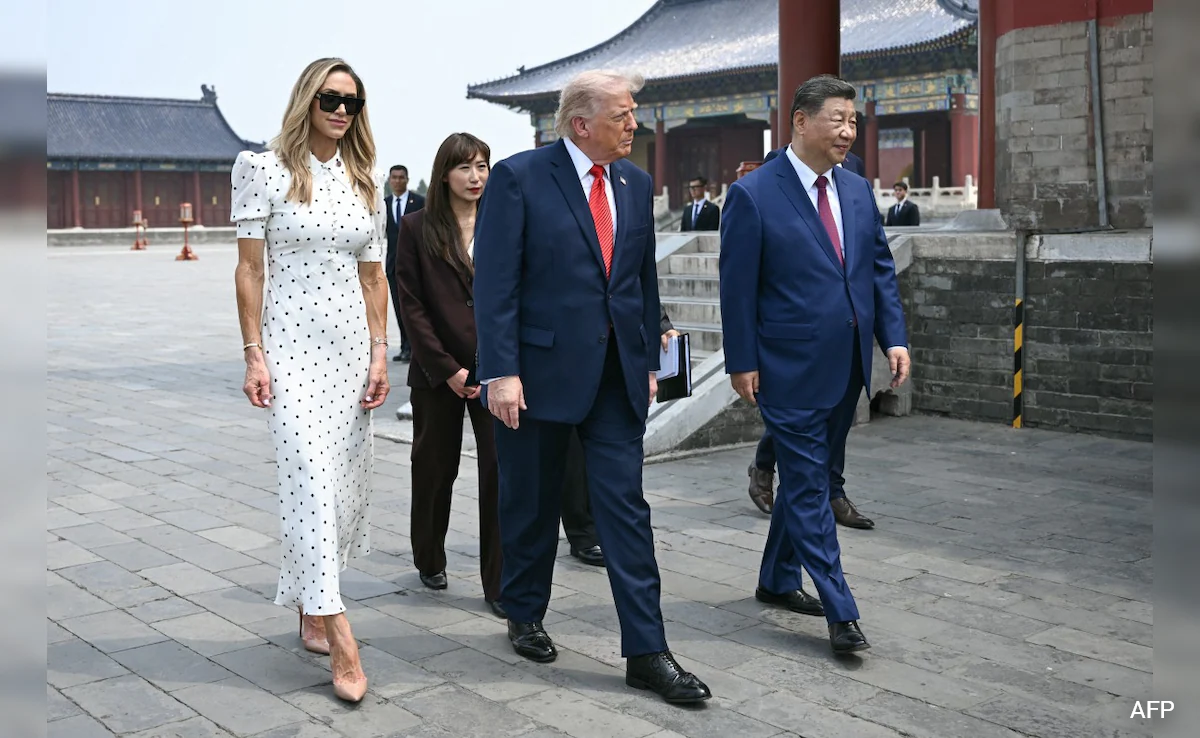
President Donald Trump is in Beijing for a two-day summit which marks his first visit to China since 2017 during his first term in office. The visit is taking place under heightened cybersecurity precautions for the US delegation as Trump and accompanying officials have left behind personal cellphones, according to a news report.
They have instead chosen to take restricted “clean” devices, temporary laptops and controlled communication systems designed to reduce risks of surveillance and hacking in China, Fox News reported.
Officials told the outlet that the measures are taken keeping in mind the long-standing concerns within the US government who considers China as “one of the world's most aggressive cyber environments.”
Follow LIVE Updates Of Trump-Xi Summit
Instead of standard encrypted messaging apps or synced devices, communication is routed through monitored systems, temporary accounts or in-person relays.
But these restrictions can significantly affect daily work as messages are delayed or rerouted, cloud access is limited and officials may spend days without their usual digital contacts or online footprint.
Current and former officials say the assumption is that any device taken into China should be treated as potentially compromised.
“China is a mass surveillance state. Briefings for US officials begin well before the president arrives, and they make clear that everything is monitored,” Bill Gage, a former Secret Service special agent and now director of executive protection for Safehaven Security Group, told Fox News.
“We always tell people to assume everything you say and do — both in person and digitally — could be monitored,” said Theresa Payton, former White House chief information officer and CEO of Fortalice Solutions.
Concerns around device security have long shaped how US officials operate during sensitive diplomatic travel. In China, those concerns are heightened, with officials assuming surveillance risks may extend beyond personal devices to hotels, networks and broader infrastructure.
Security risks also extend to everyday use of technology. Officials are cautioned about using unfamiliar charging ports due to concerns over “juice jacking.” Travellers typically rely on approved chargers and external battery packs carried from US rather than using local charging systems.
“There are no safe electronic communications in China,” Gage said and added that officials are instructed to limit digital activity to essential tasks only.
Temporary devices loaded with “golden images” are used so security teams can check if anything has been tampered with during the trip, Payton said.
But Chinese authorities have denied allegations. Chinese Embassy spokesperson Liu Pengyu told Fox News, “The Chinese government places a high priority on protecting data privacy and security in accordance with the law. It has never required—and will never require—enterprises or individuals to collect or store data in violation of the law.”
Track Latest News Live on NDTV.com and get news updates from India and around the world


