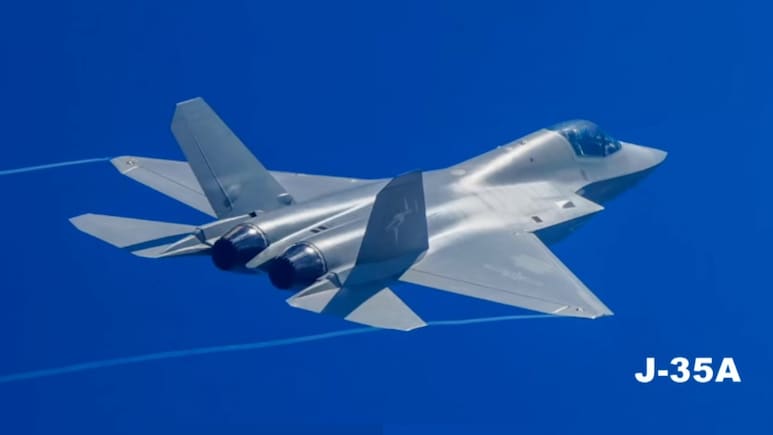
China has built a stealth fighter not just for its own forces but for foreign buyers eyeing a cheaper alternative to Western jets. The aircraft, an export-specific offshoot of the fifth-generation J-35 multi-role stealth fighter jet, is now being positioned as a direct challenger to the US-made F-35 Lightning II. Pakistan is likely to be the first in line to be a customer.
The timing is notable, landing almost exactly a year after Operation Sindoor triggered high-stakes aerial clashes between India and Pakistan.
While earlier glimpses of the J-35A were limited to a scale display at the Paris Air Show, fresh visuals suggest China has moved beyond prototypes. State broadcaster China Central Television recently aired footage of a fully assembled jet, serial number 001, emerging from a hangar during the "2026 May 1st International Labour Day 'Heart to Heart' Special Programme".
The aircraft carried the branding of the Aviation Industry Corporation of China instead of air force markings, signalling its export role. According to the South China Morning Post, this is the first time a combat-ready export variant, labelled J-35AE, has been publicly shown in full form.
The J-35 programme marks China's second attempt at fielding a fifth-generation stealth fighter after the J-20. Developed by the Shenyang Aircraft Corporation, the platform combines twin engines with internal weapons storage and advanced radar and infrared systems.
Built by Shenyang Aircraft Corporation, the land-based J-35A made its first public appearance at the Zhuhai Air Show in November 2024. This version is designed for the PLA Air Force, whereas the baseline J-35 is configured for carrier-based operations with the navy. Chinese state media claims the military already operates 57 models across the J-35 family.
The export-focused J-35AE is expected to mirror the domestic version in performance, even though Beijing has not released a full technical breakdown. Available reports suggest a top speed of around Mach 1.8 and the use of AESA radar capable of locking onto multiple targets at once.
In terms of firepower, the jet is designed to carry air-to-air missiles like the PL-15 within internal bays to maintain stealth. It can also mount additional weapons externally when required. The aircraft is further equipped with modern targeting technology, including an electro-optical system aimed at improving combat precision and survivability.
Will Pakistan be the first buyer?
For years, China has marketed the J-35 as a budget-friendly counterpart to the F-35, with estimates placing its cost between $35 million and $80 million per unit. Production claims have also been aggressive, with state media suggesting a new aircraft can roll off the line every 72 hours.
Yet, despite Chinese claims of multiple countries being interested in acquiring the jet, no country has formally signed on. That could shift with the J-35AE's rollout. The South China Morning Post reports that the aircraft is ready for operational use, and Pakistan remains the most likely launch customer.
Signals from Islamabad have been mixed but persistent. In early 2024, Pakistan Air Force chief Zaheer Sidhu openly expressed interest in acquiring the jet. By the end of the year, reports indicated approval for a 40-aircraft deal. In 2025, Pakistani pilots were said to be undergoing training in China, followed by an official announcement outlining plans to induct the J-35A within two years.
Even so, Pakistan's Defence Minister Khawaja Asif, has publicly downplayed the reports, saying, "it's only in the media, and beneficial mainly for Chinese defence sales."
Despite that denial, momentum appears to be building. With China now showcasing a finished export model and training already underway, Pakistan remains the frontrunner. If the deal materialises, it could involve up to 40 jets along with additional assets like KJ-500 airborne early warning and control aircraft, with deliveries potentially beginning by late 2026 or 2027.
Track Latest News Live on NDTV.com and get news updates from India and around the world


