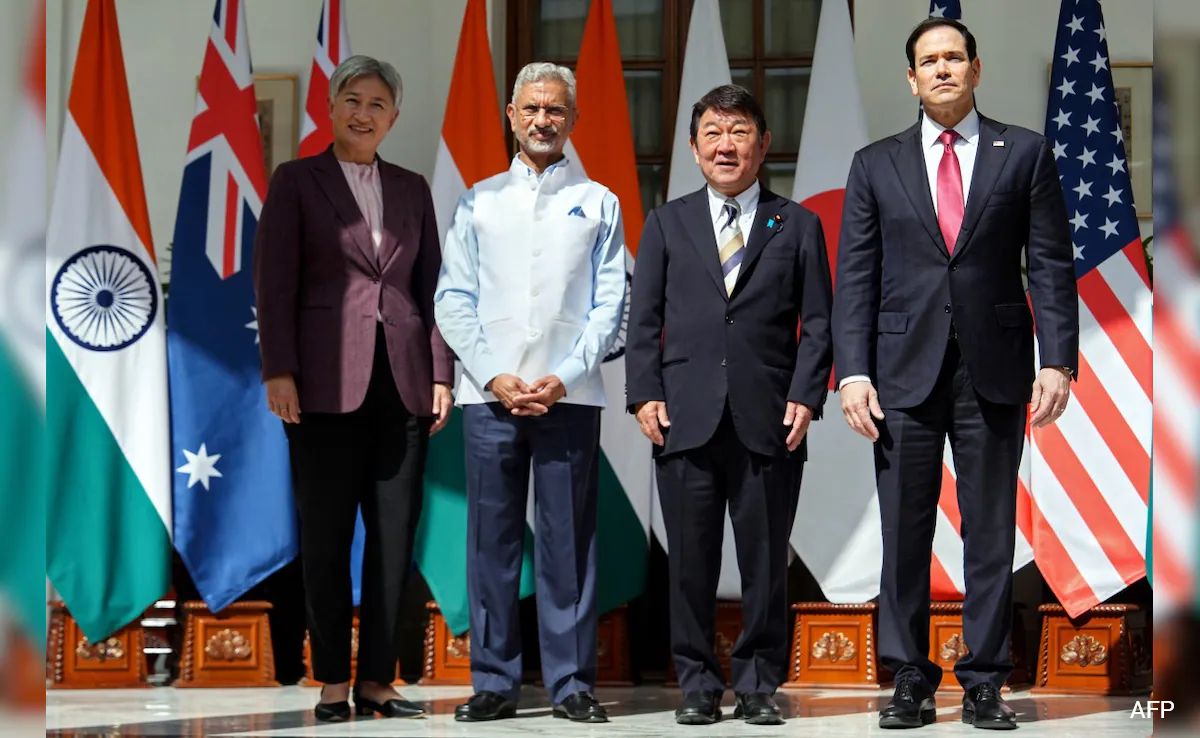
The four nations of the Quad - India, Australia, Japan, and the United States - unveiled an ambitious critical minerals framework Tuesday, pledging to mobilize up to $20 billion in government and private sector financing to build supply chains that bypass China's commanding position in one of the world's most strategically sensitive resource markets.
The Quad Critical Minerals Initiative, announced at the conclusion of a Foreign Ministers' meeting in New Delhi, establishes a structured cooperation framework covering mining, processing, recycling, and regulatory alignment across the four partner nations. It represents the most concrete economic deliverable the grouping has produced since reviving its ministerial-level engagement, and signals a determined push to convert the Quad's security-oriented reputation into tangible industrial policy.
-

-
 Andrew Ng On AI At Scale: Building The Intelligence Economy | NDTV World Summit 2026
 -
 NDTV World Summit 2026: Behind The Scenes As Ayush And Vedika Preview Two-Day Mega Event
 -
 Who Is Rajiv Mehta? Lilavati Hospital Trustee To Speak At NDTV World Summit 2026
 -
 Ex-CIA Director To Decode 'War In Times Of AI' At NDTV World Summit
 -
 From Call Centre To Billion-Dollar Disruptor: Nikhil Kamath At NDTV World Summit
 -
 'Every 5 Years, You'll See A New India': Swami Sarvapriyananda Ahead Of NDTV World Summit
 -
 Alain Ebobisse, Africa50 CEO, To Attend NDTV World Summit 2026. All About Him
 -
 Kriti Sanon At NDTV World Summit: A Look At Her Career And Business Ventures
 -
 Ex-CIA Director To Decode 'War In Times Of AI' At NDTV World Summit
 -
 Who Is Vikram Rai, CEO, South Asia GE Aerospace, Set To Attend The NDTV World Summit 2026
The timing is pointed. China currently dominates the processing of rare earth elements and a range of critical minerals - lithium, cobalt, nickel, graphite - that underpin everything from electric vehicle batteries and semiconductors to missile guidance systems and fighter jet components. Western governments and their allies have grown increasingly alarmed at their exposure to potential supply disruptions, particularly as geopolitical tensions over Taiwan and trade policy have sharpened.
The $20 billion mobilisation target - drawn from export credit agencies, development finance institutions, private capital, and instruments including loans, equity stakes, guarantees, and offtake agreements - is designed to move identified projects from aspiration to construction.
The framework specifically targets initiatives with a "Quad nexus": Projects located in partner countries, operated by companies headquartered within the group, or supplying Quad markets.
Beyond raw investment, the framework takes aim at a less visible but equally important bottleneck: regulatory fragmentation. Slow and inconsistent permitting processes have long stalled critical mineral projects across democratic nations, handing faster-moving state-backed Chinese enterprises a structural advantage. The four governments have committed to sharing best practices on licensing and permitting, exploring streamlined timelines, and cooperating on geological mapping and resource assessment - effectively trying to build a common operating environment for mineral development.
Perhaps the most forward-looking element of the framework concerns recycling and recovery. Rather than relying solely on new extraction, the Quad partners intend to collaborate on recovering critical minerals from electronic waste and industrial scrap, investing in collection networks and recycling technologies, and exploring streamlined cross-border procedures for relevant materials. As existing stocks of consumer electronics and industrial equipment age out, the recoverable mineral content represents a significant secondary supply source - one that reduces dependence on primary mining and lowers environmental costs.
The framework also contemplates coordinated responses to what it terms "non-market policies and unfair trade practices" - diplomatic language that points squarely at Chinese state subsidies and below-cost pricing strategies that have historically undercut investment in rival processing capacity.
For India, the announcement carries particular strategic weight. New Delhi signed a bilateral critical minerals framework with Washington on the same day, and joined the U.S.-led Pax Silica initiative earlier this year. India holds substantial untapped mineral reserves and is actively seeking foreign partnerships to develop domestic processing capabilities - currently its most significant gap.
Australia brings proven mining expertise and enormous resource deposits. Japan contributes advanced processing technology and a powerful industrial demand base. The United States adds financing firepower and market scale.
The question now is execution. Previous multilateral resource initiatives have stalled at the announcement stage. Officials from all four governments acknowledged that turning framework commitments into operational mines and processing plants will require sustained political will - and the patience to navigate environmental reviews, community consultations, and market volatility.
But with China's mineral leverage growing more visible by the month, the pressure to deliver has rarely been sharper.
Track Latest News Live on NDTV.com and get news updates from India and around the world


